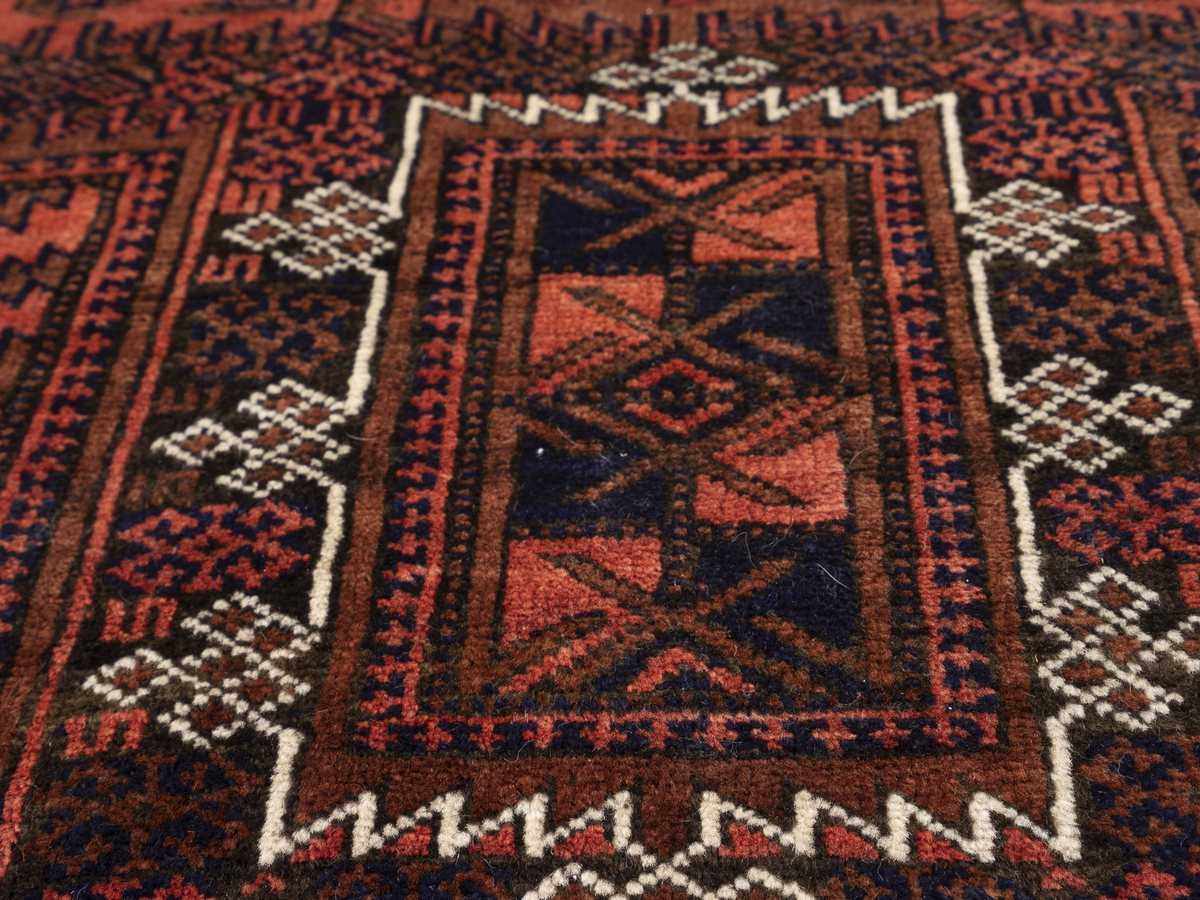
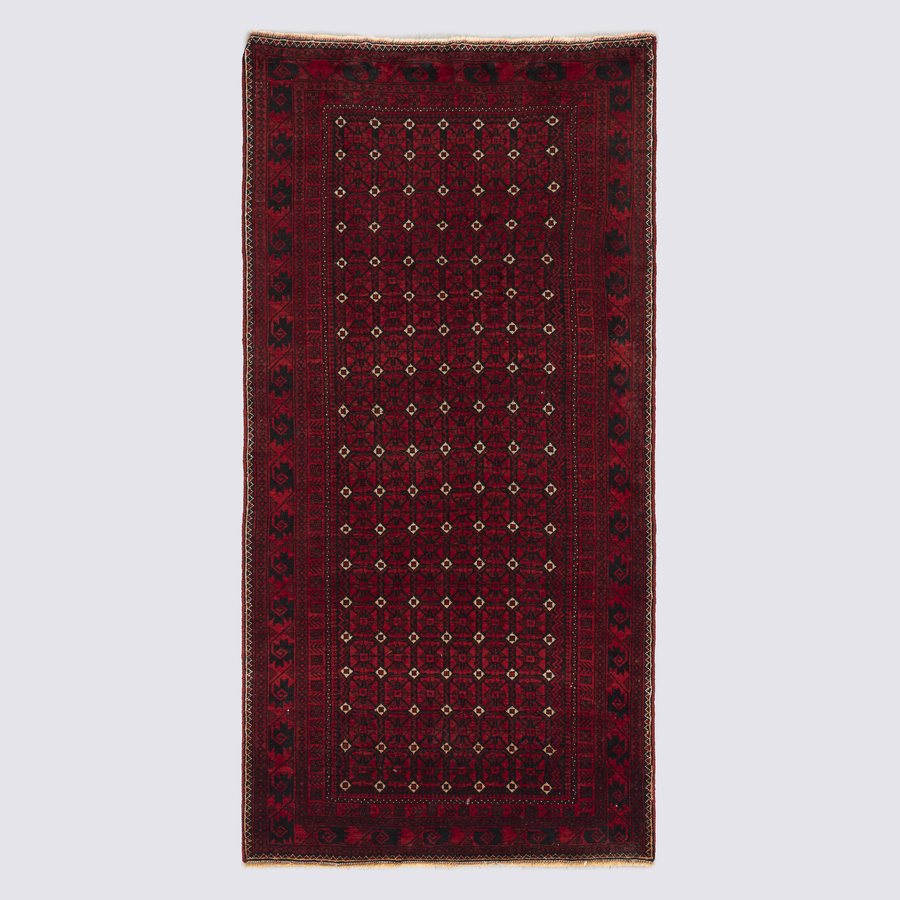
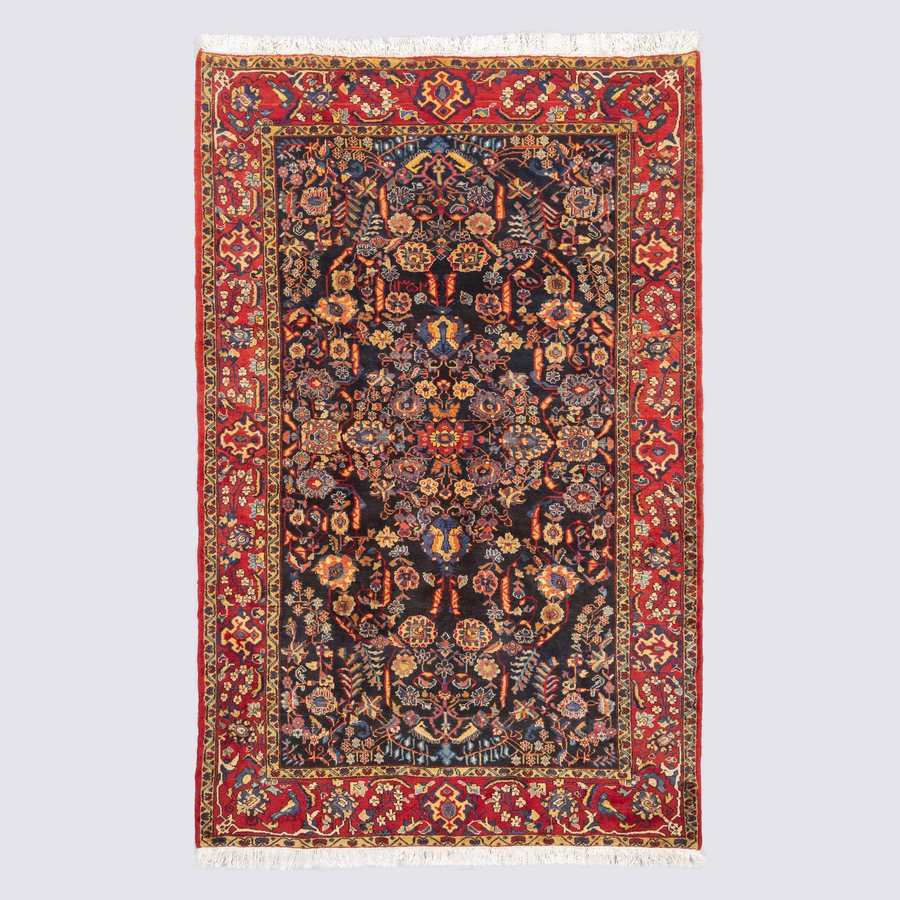
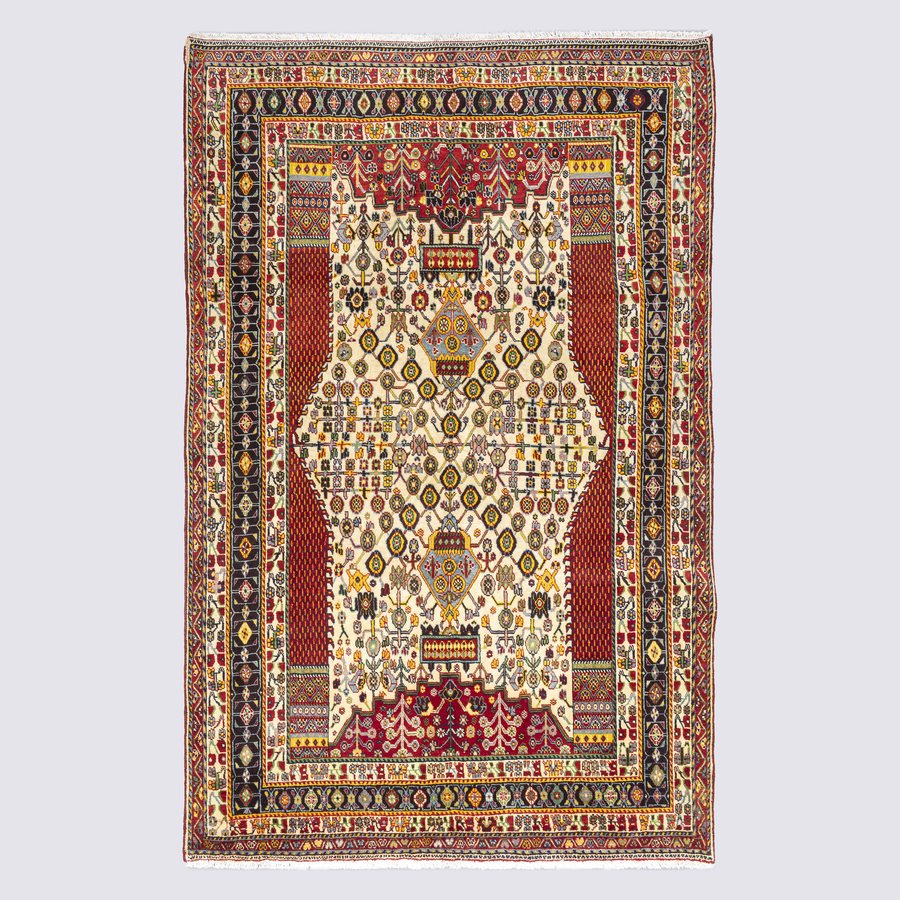
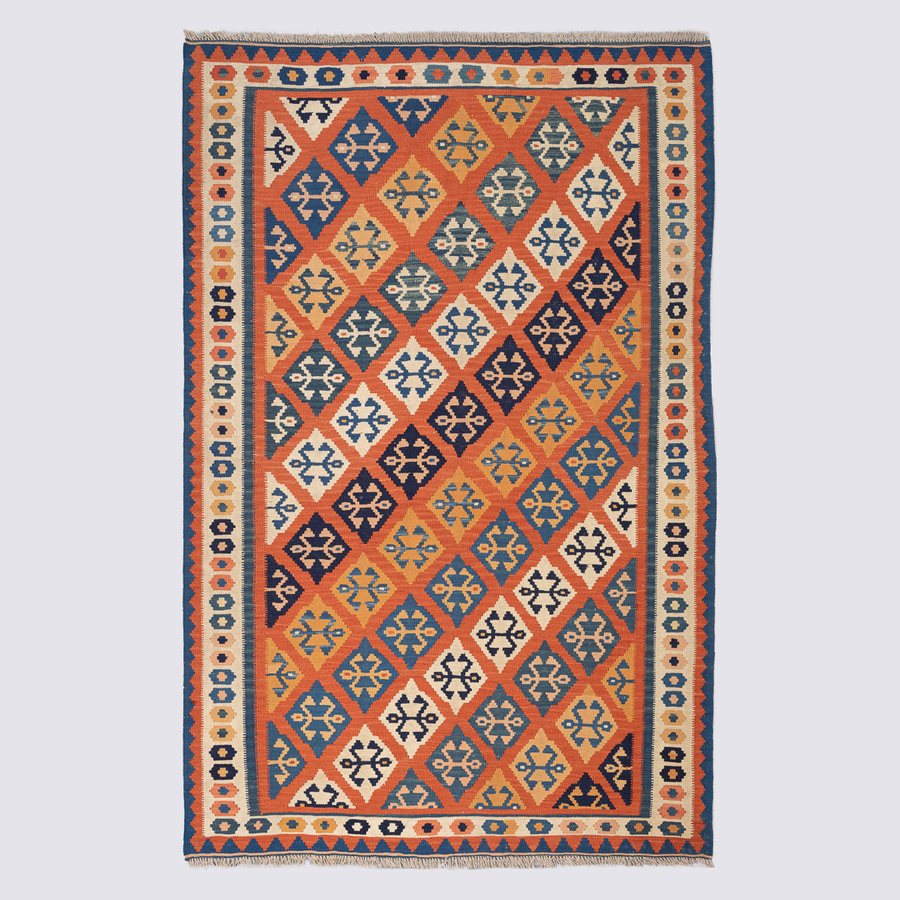
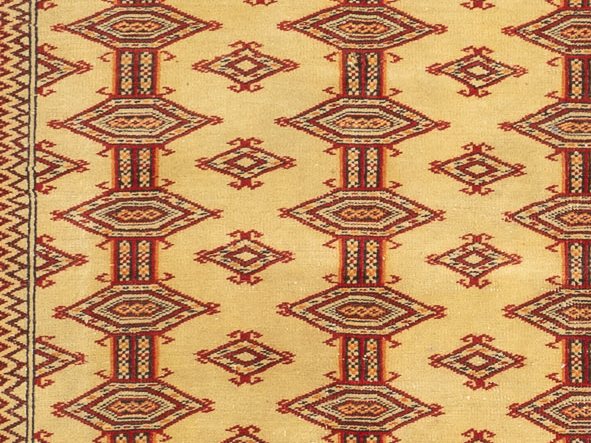
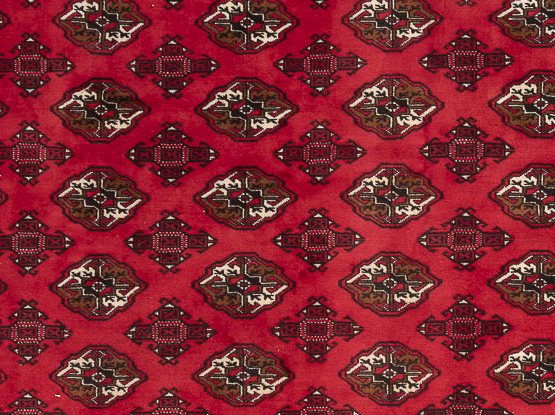
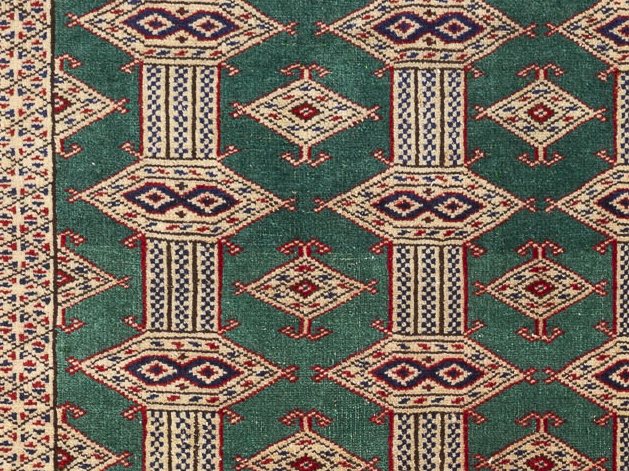
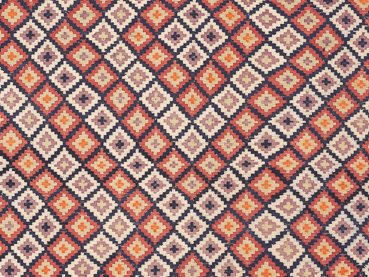
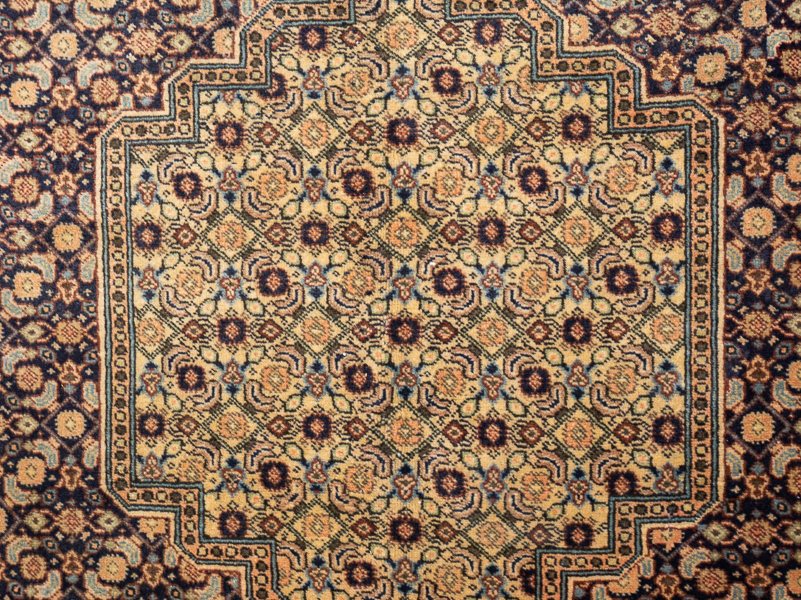
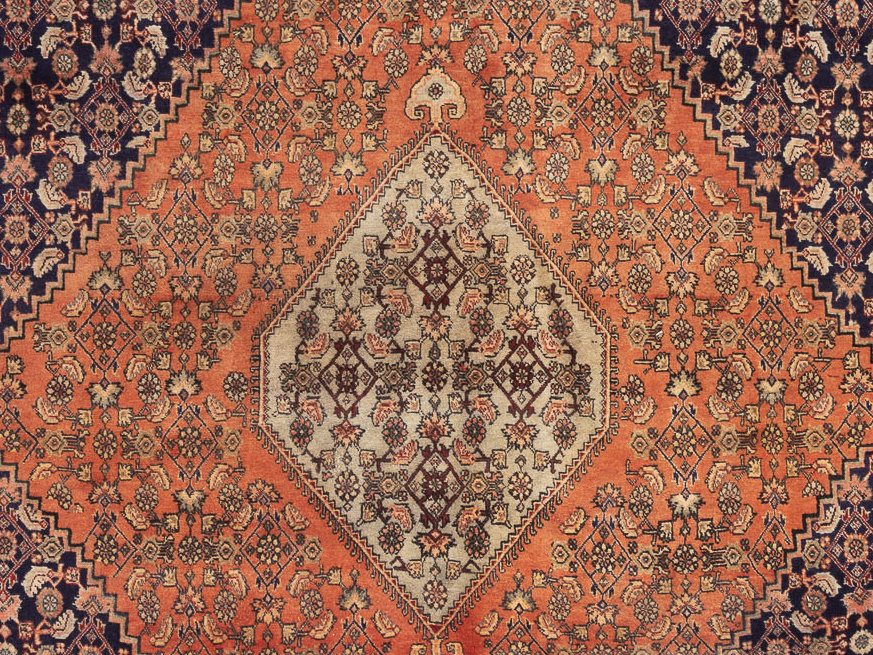
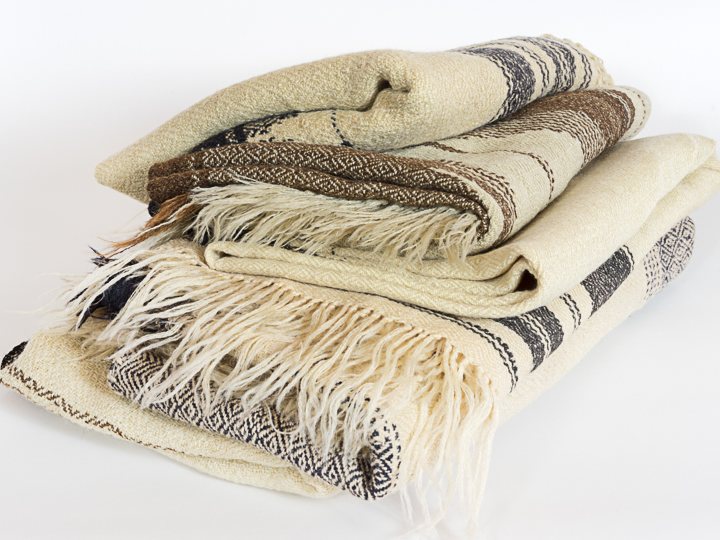
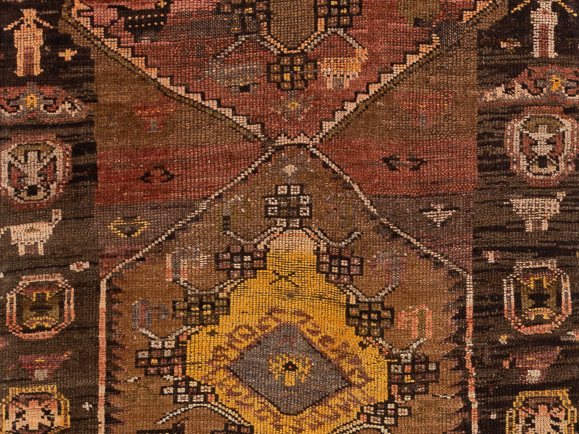
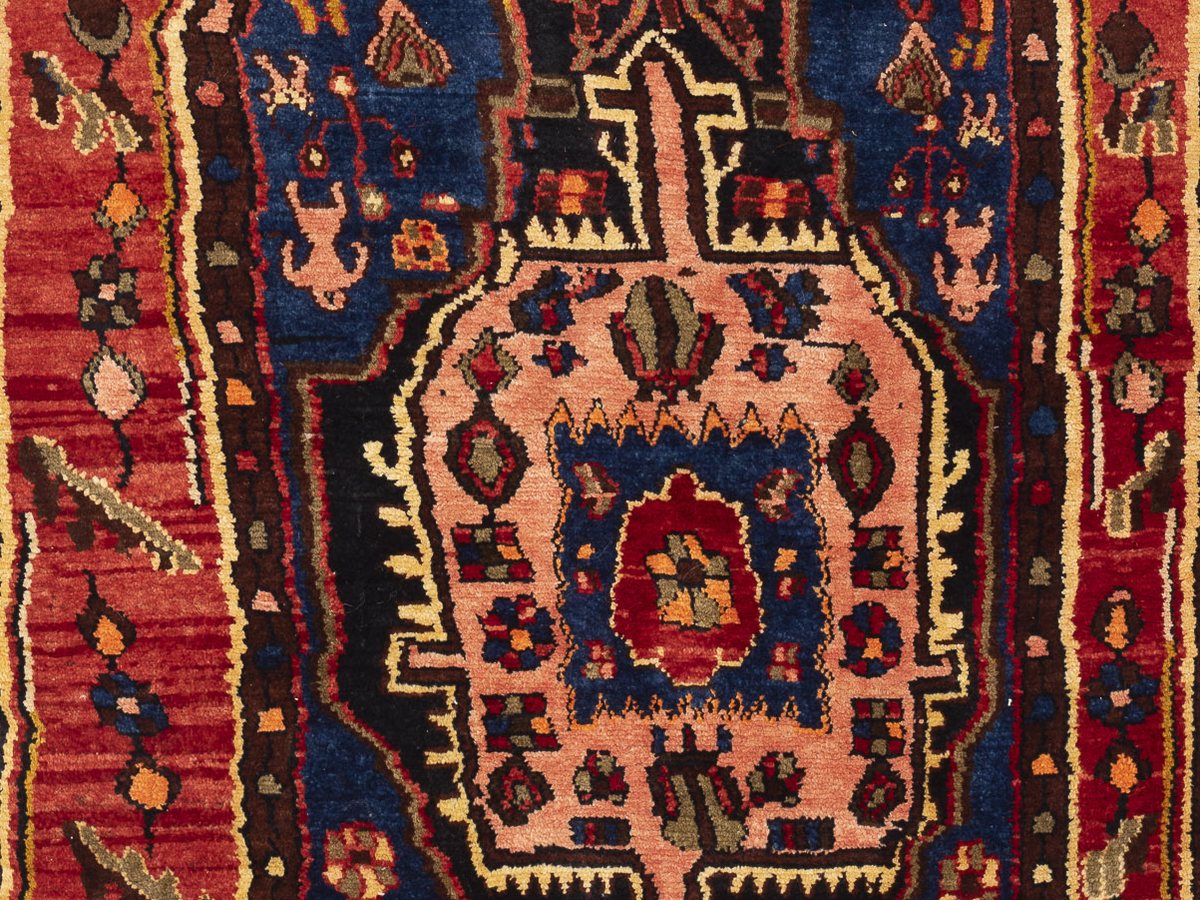
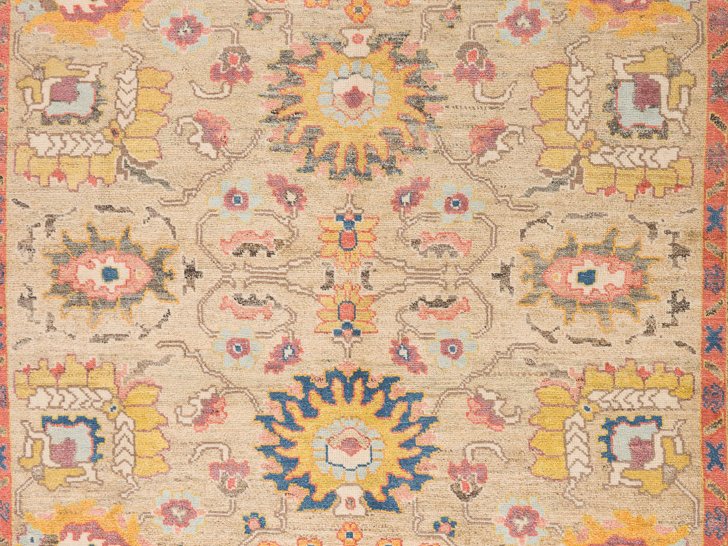
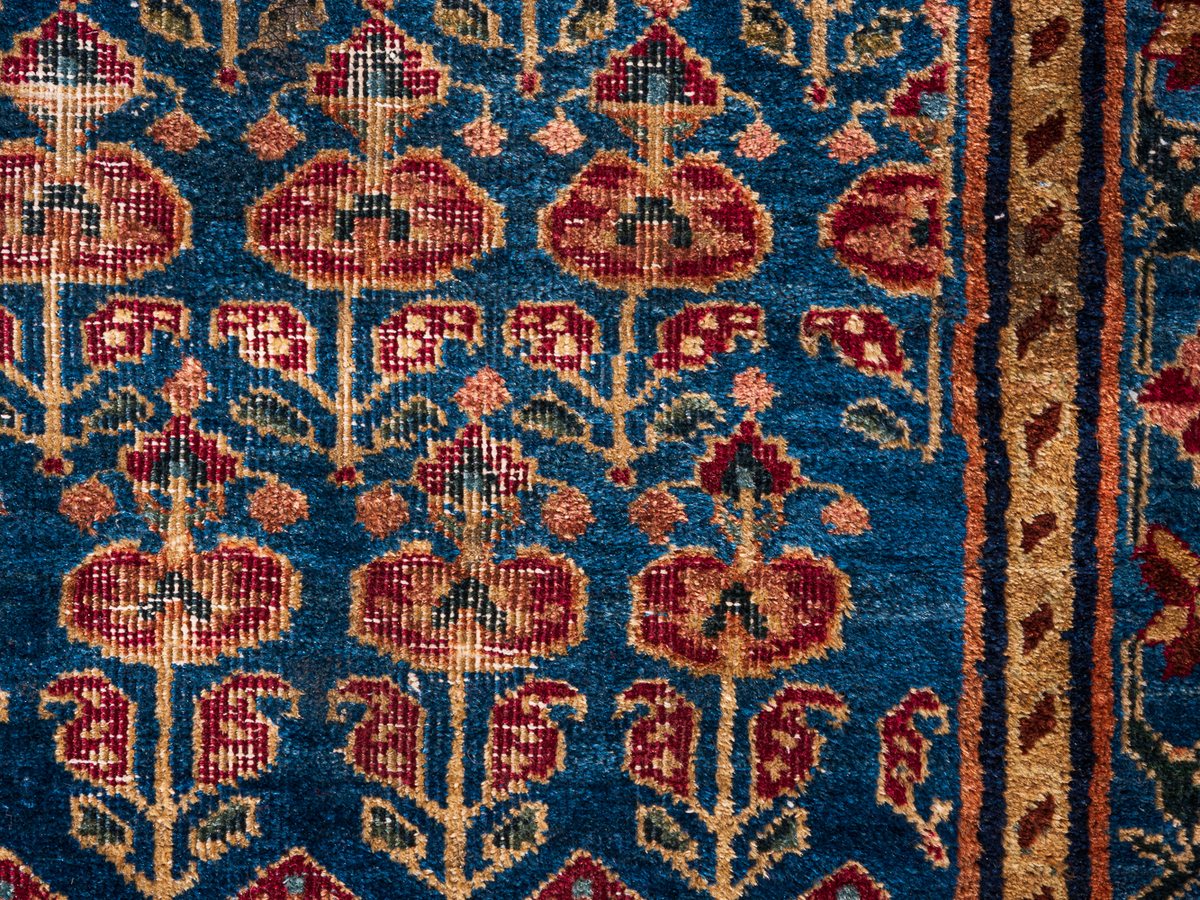
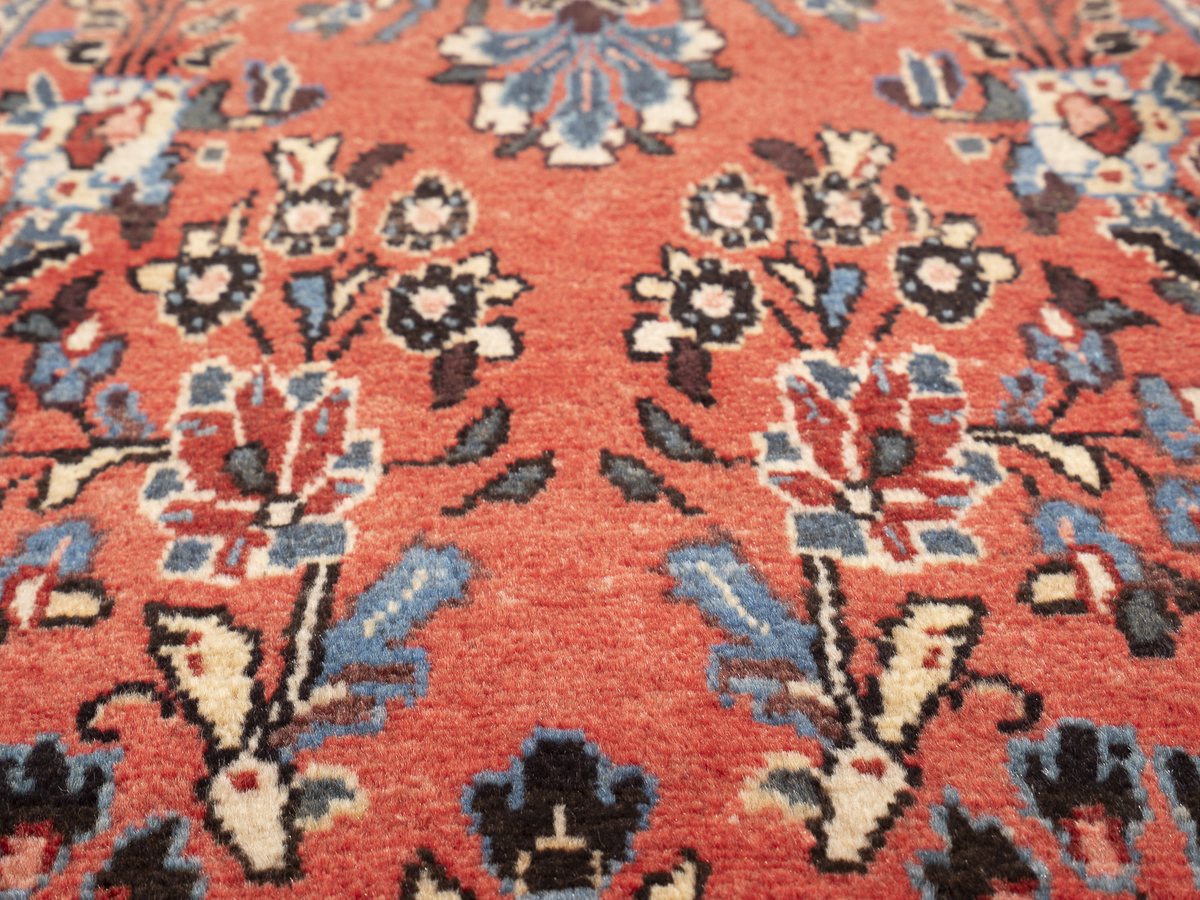
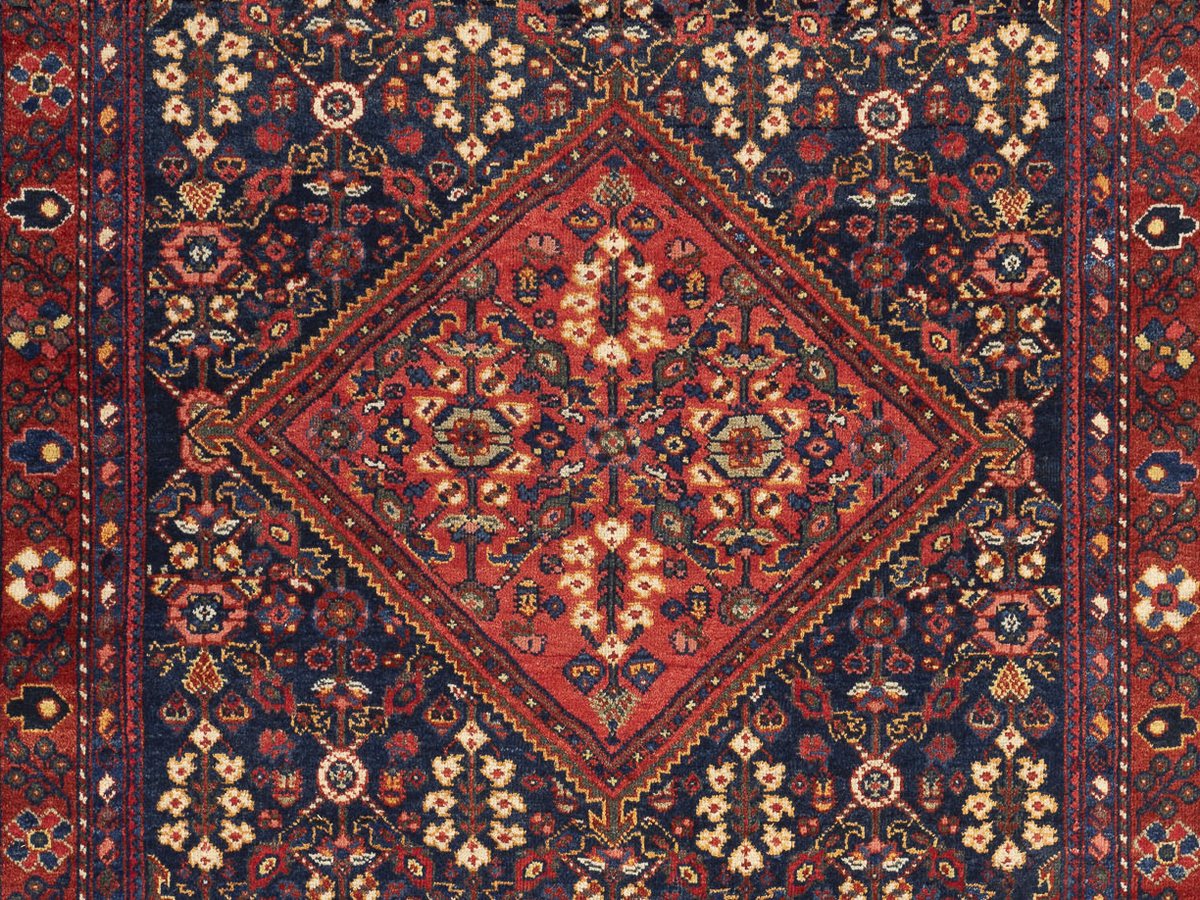
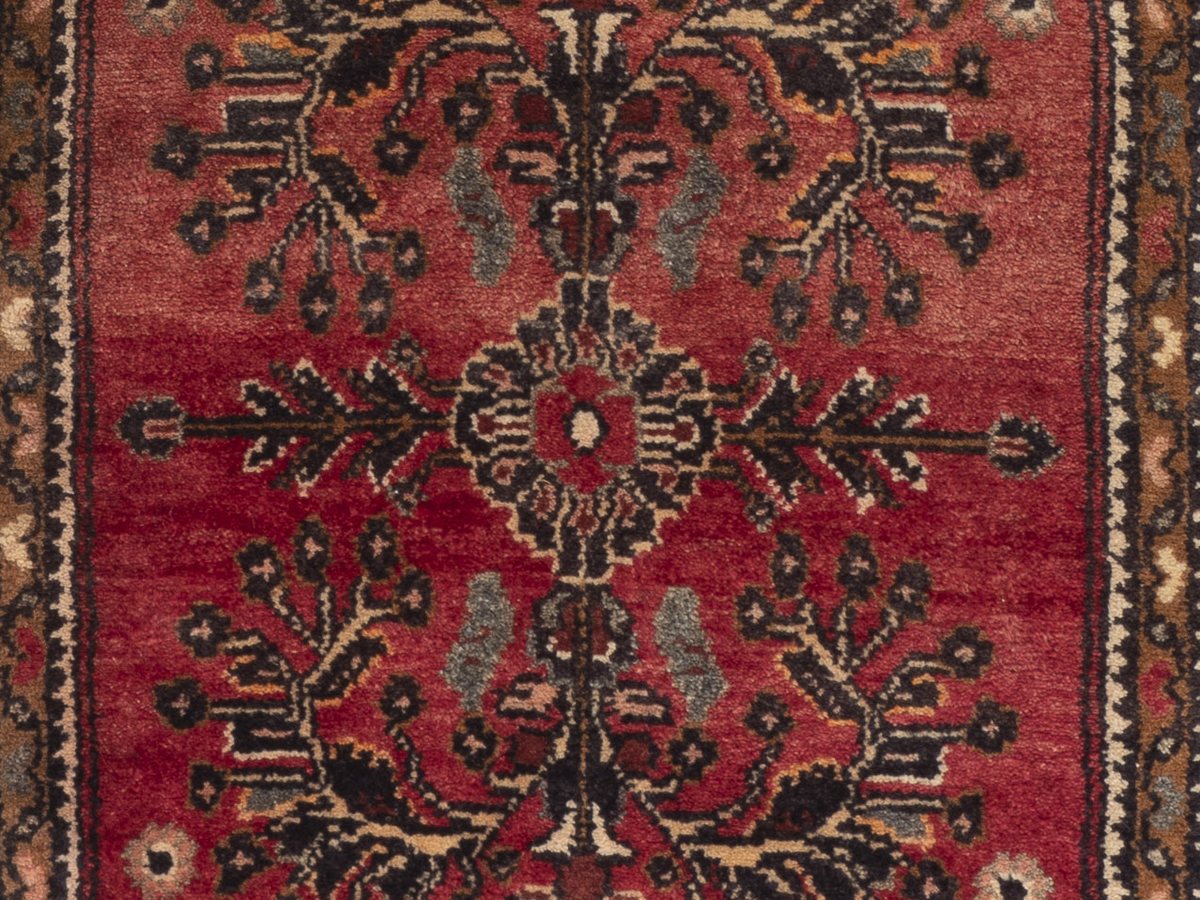
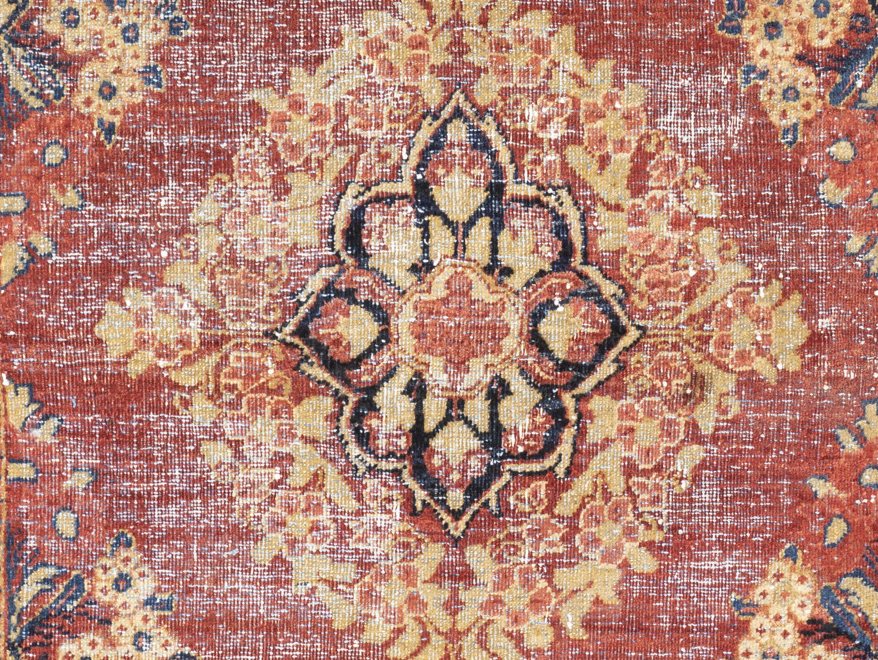
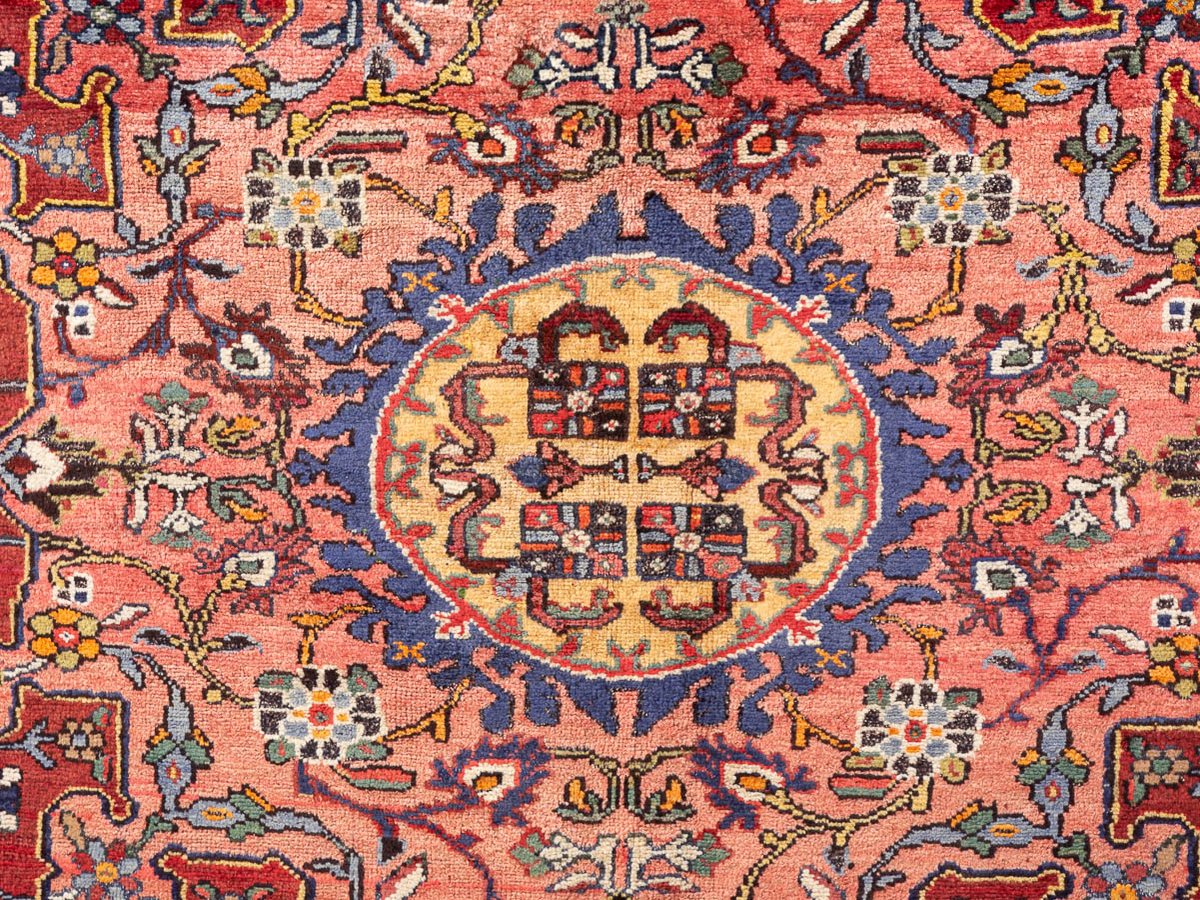
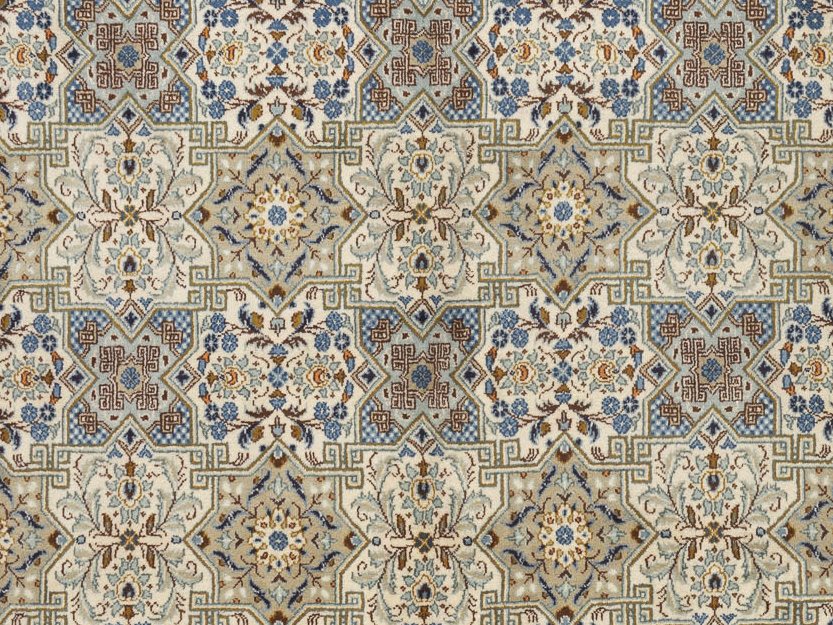
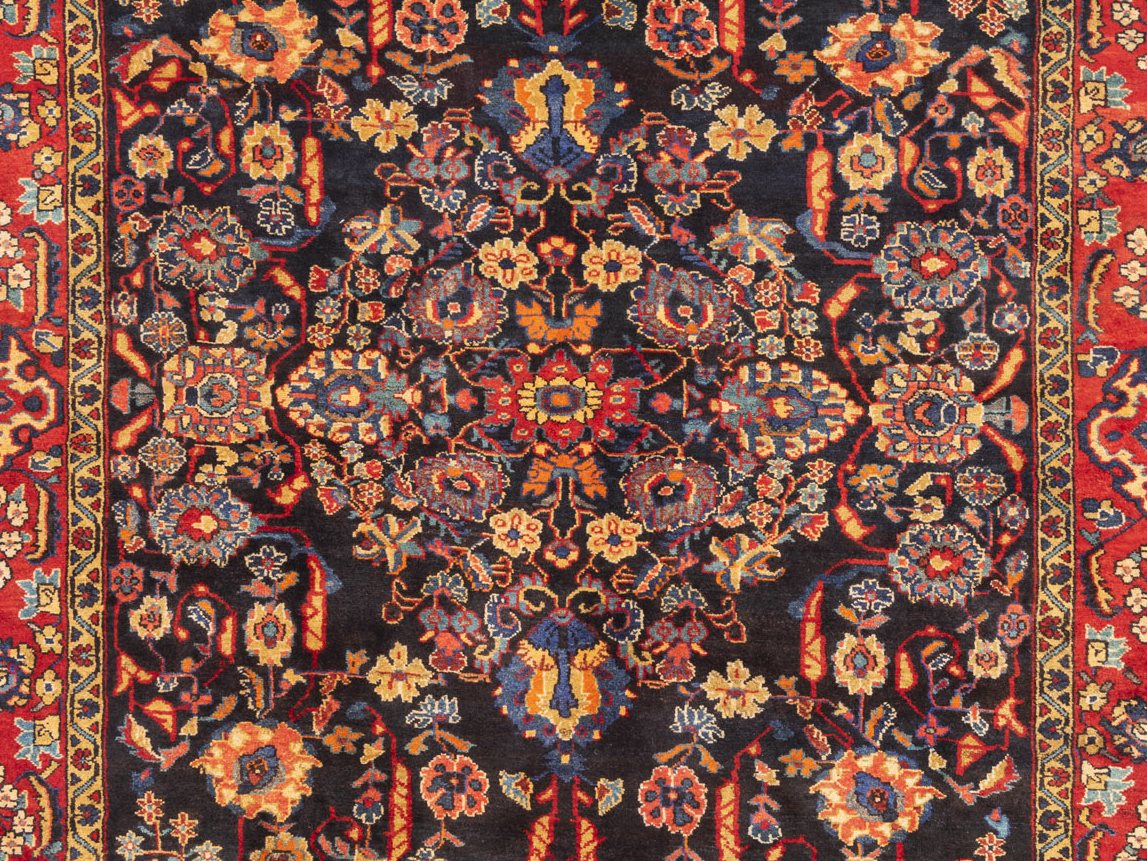
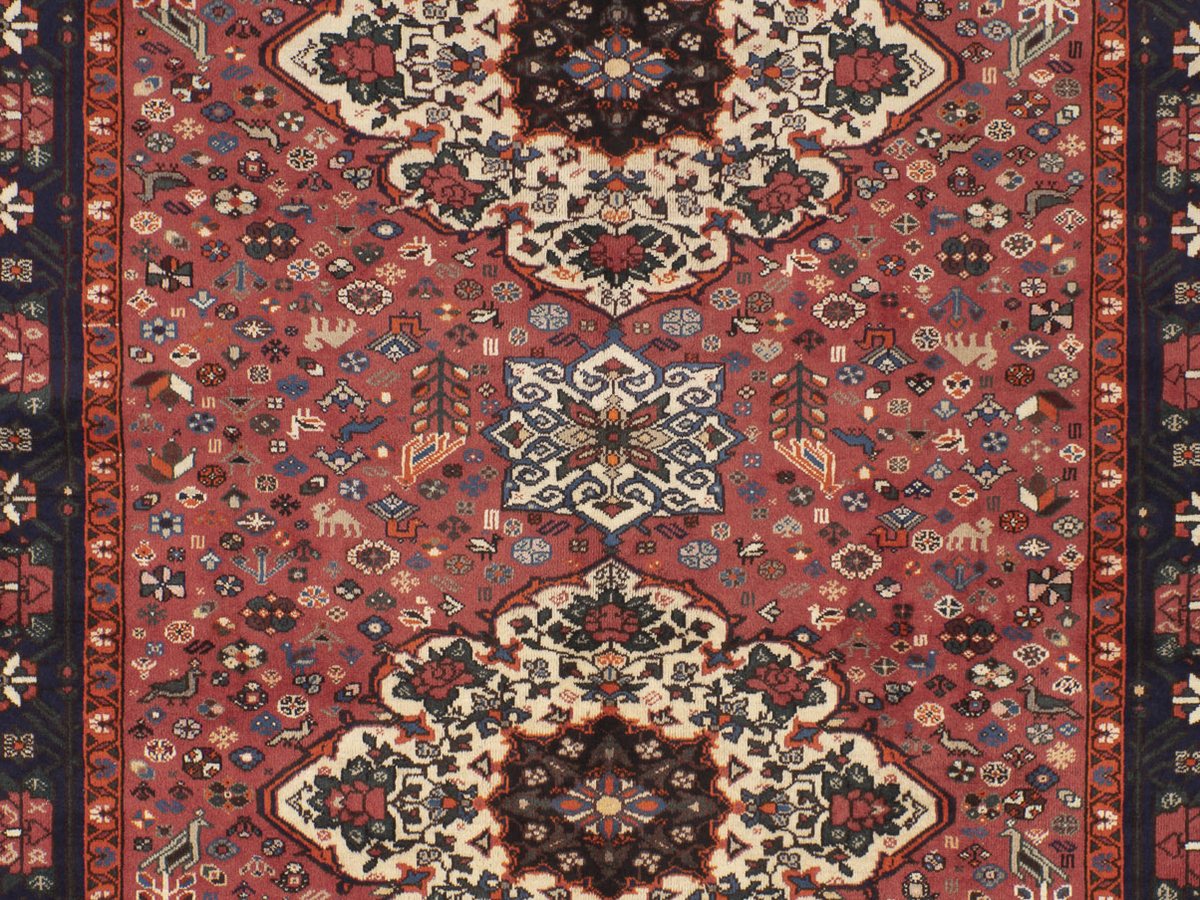
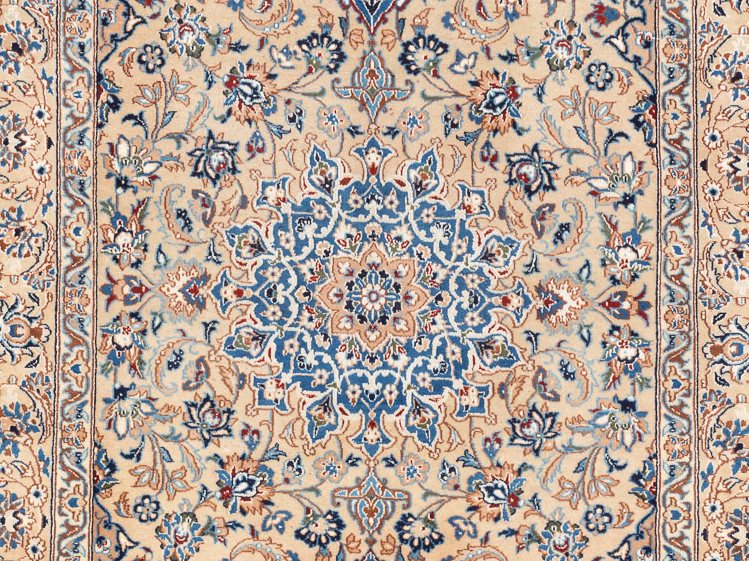
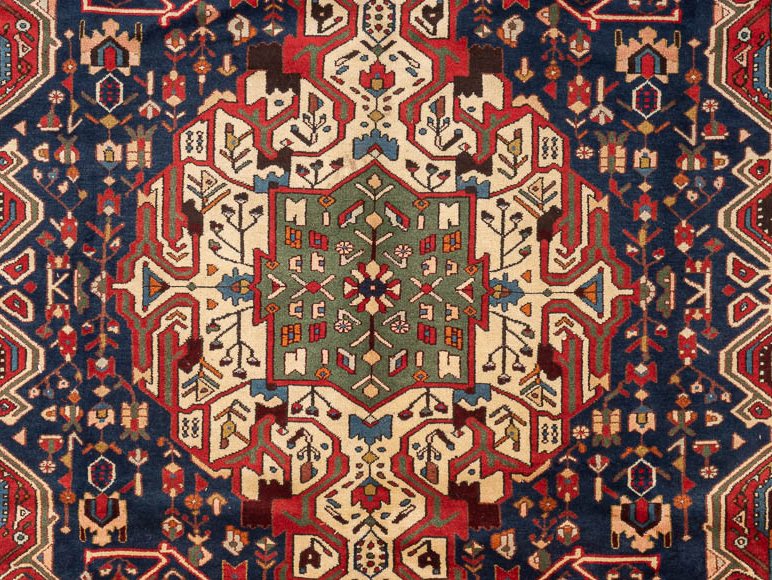
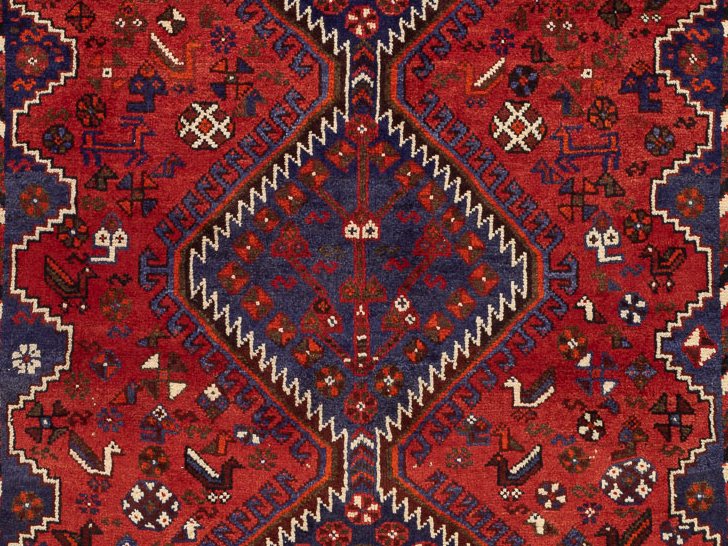
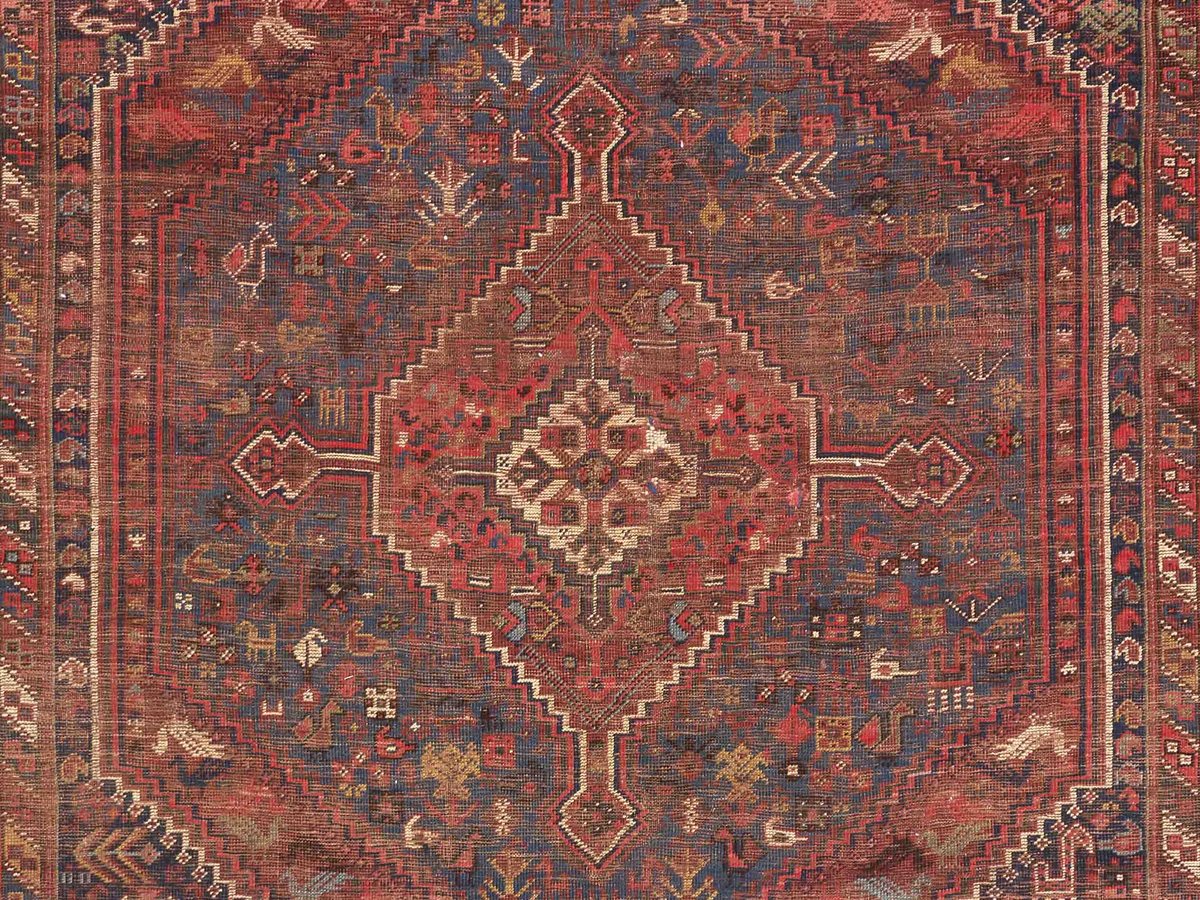
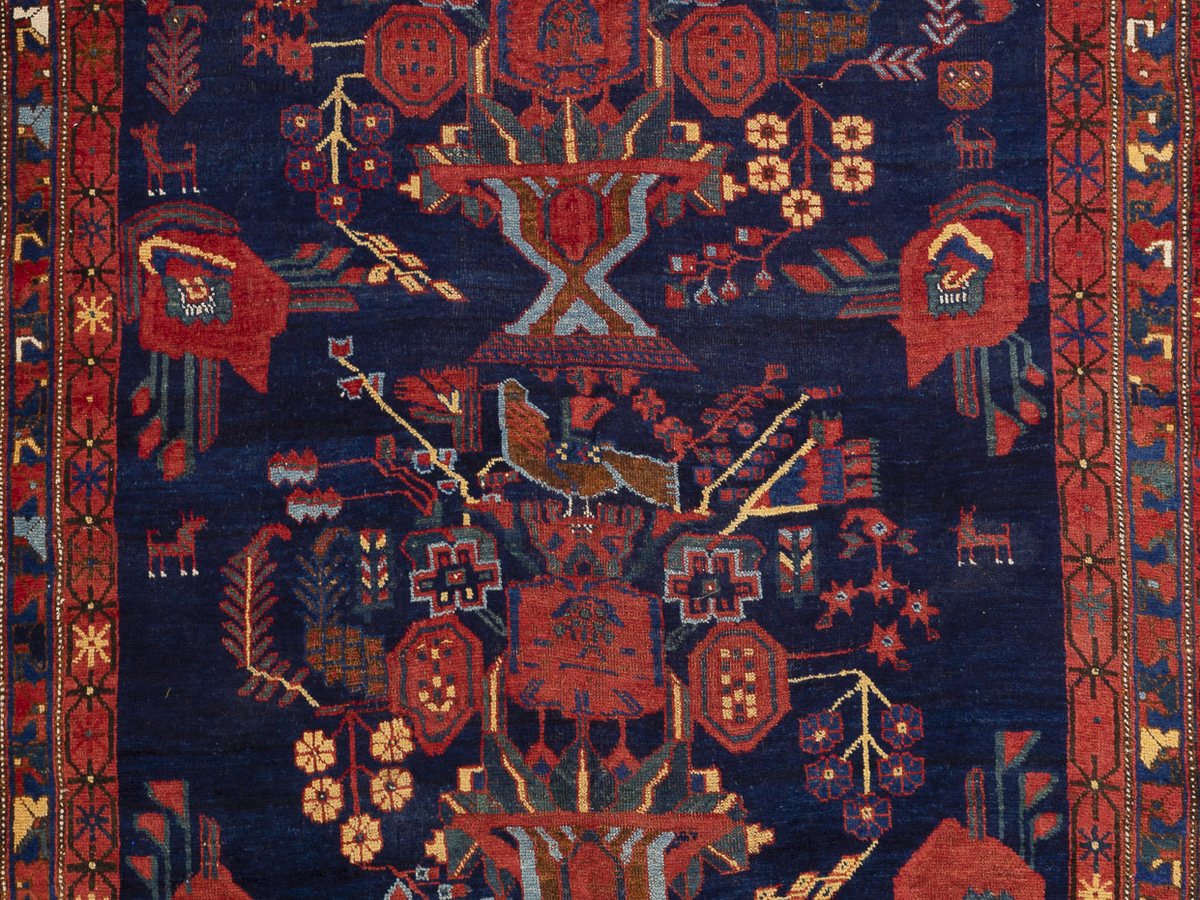
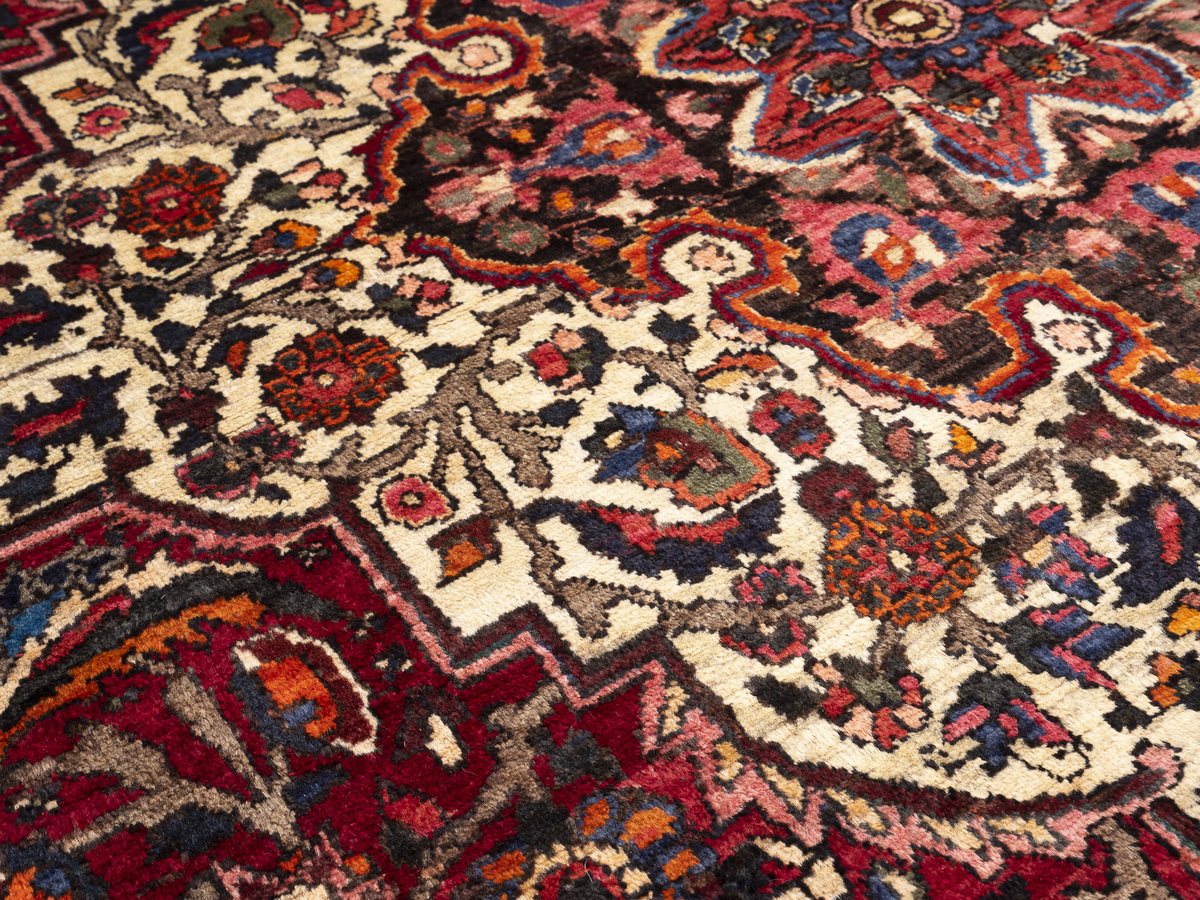
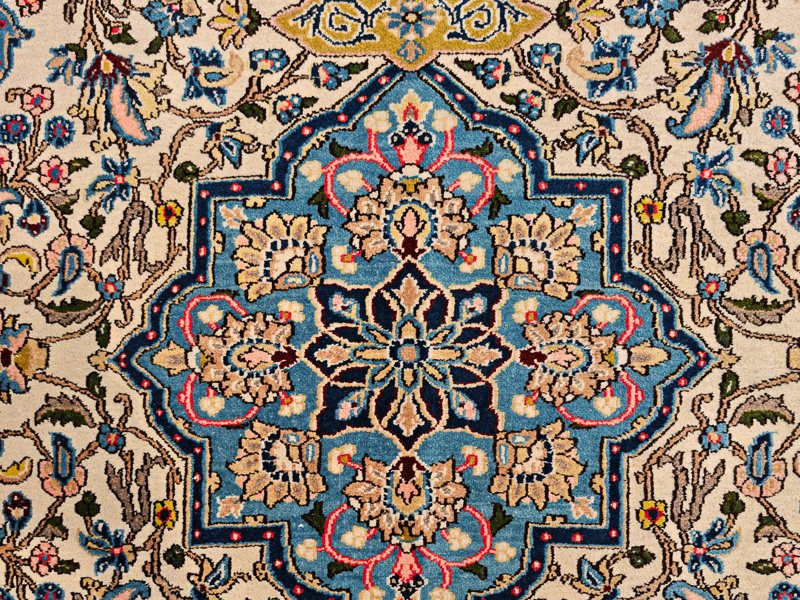
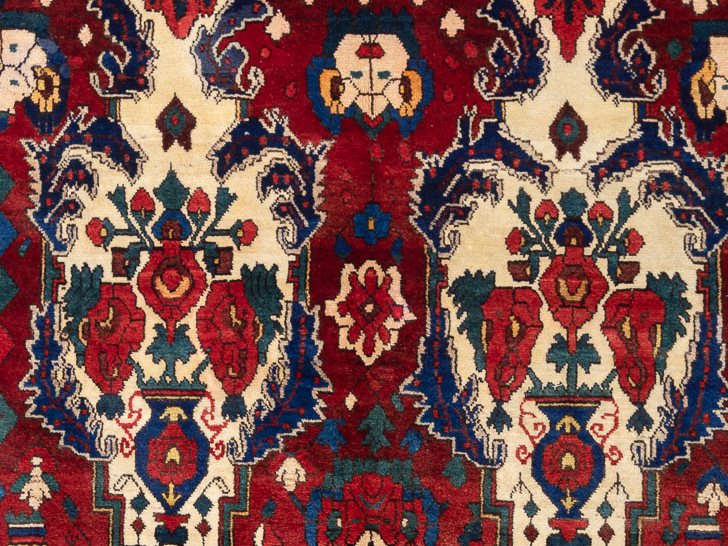
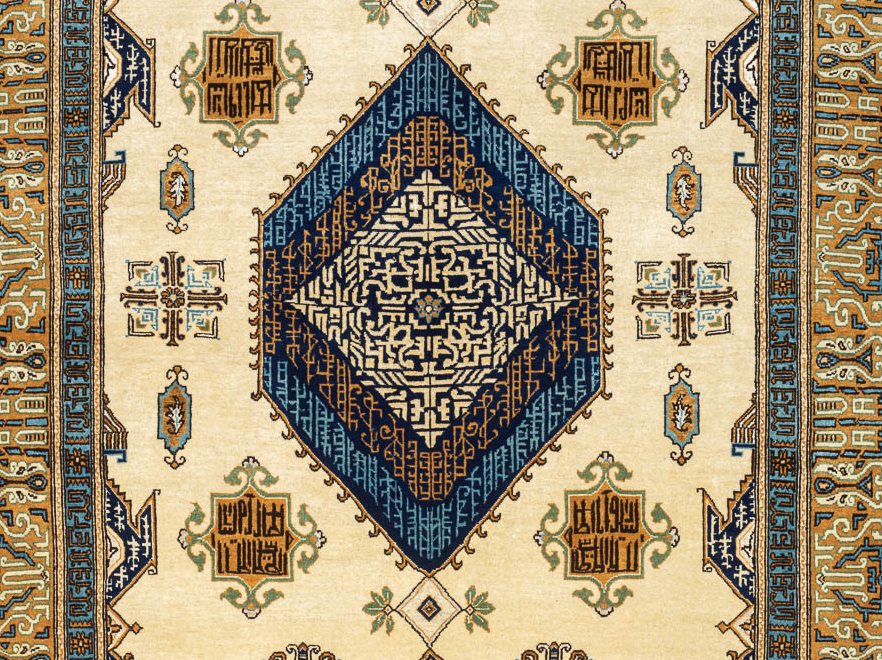
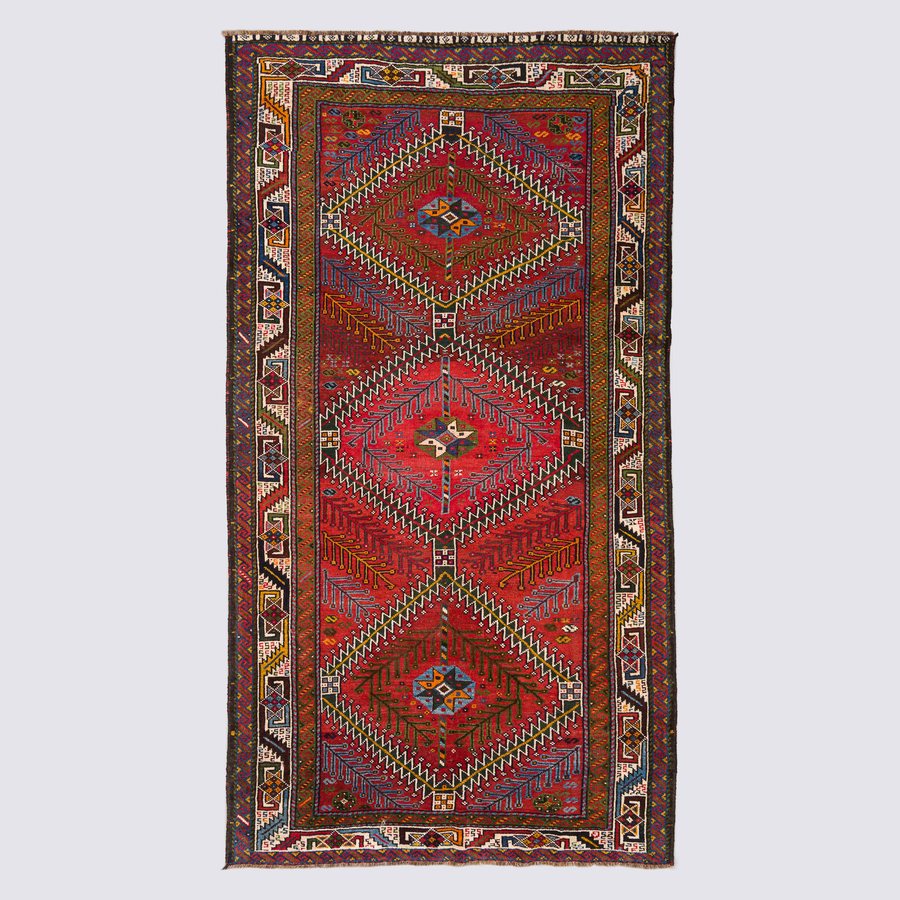
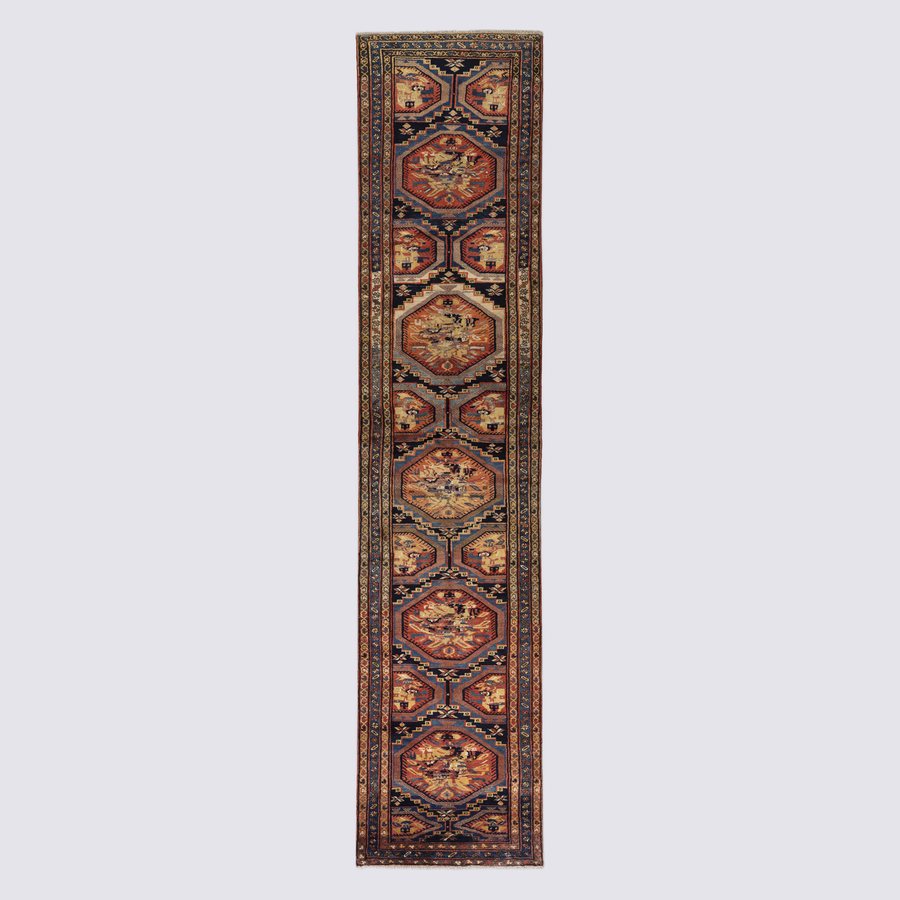
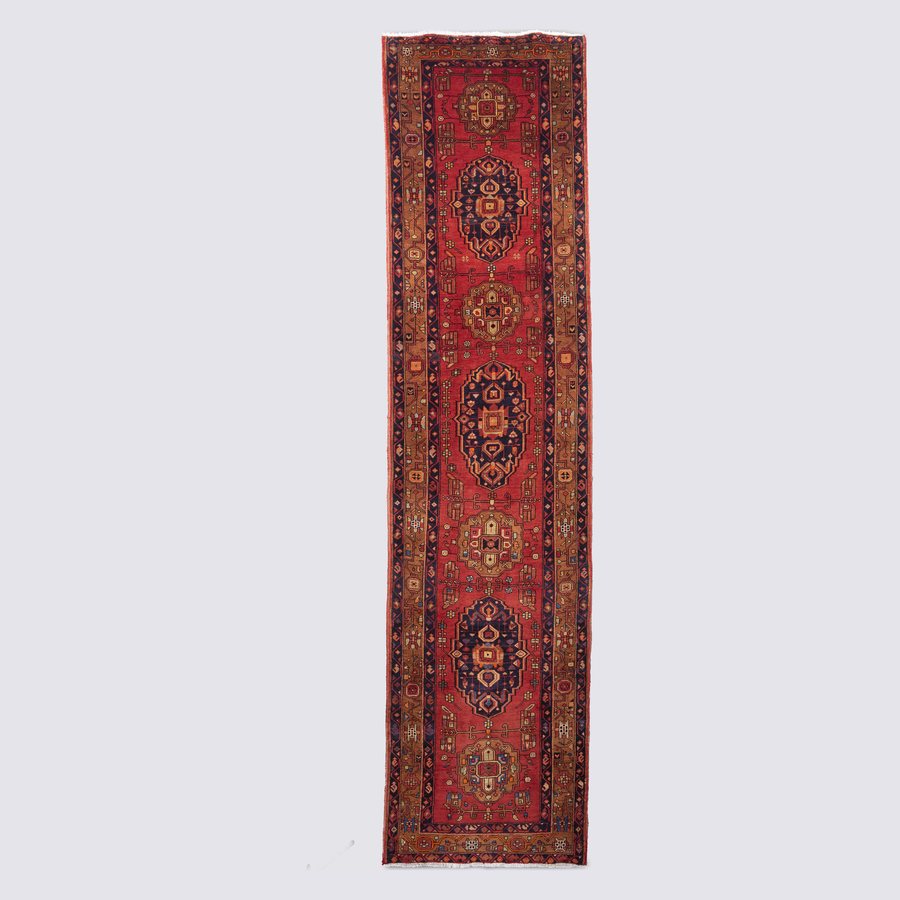
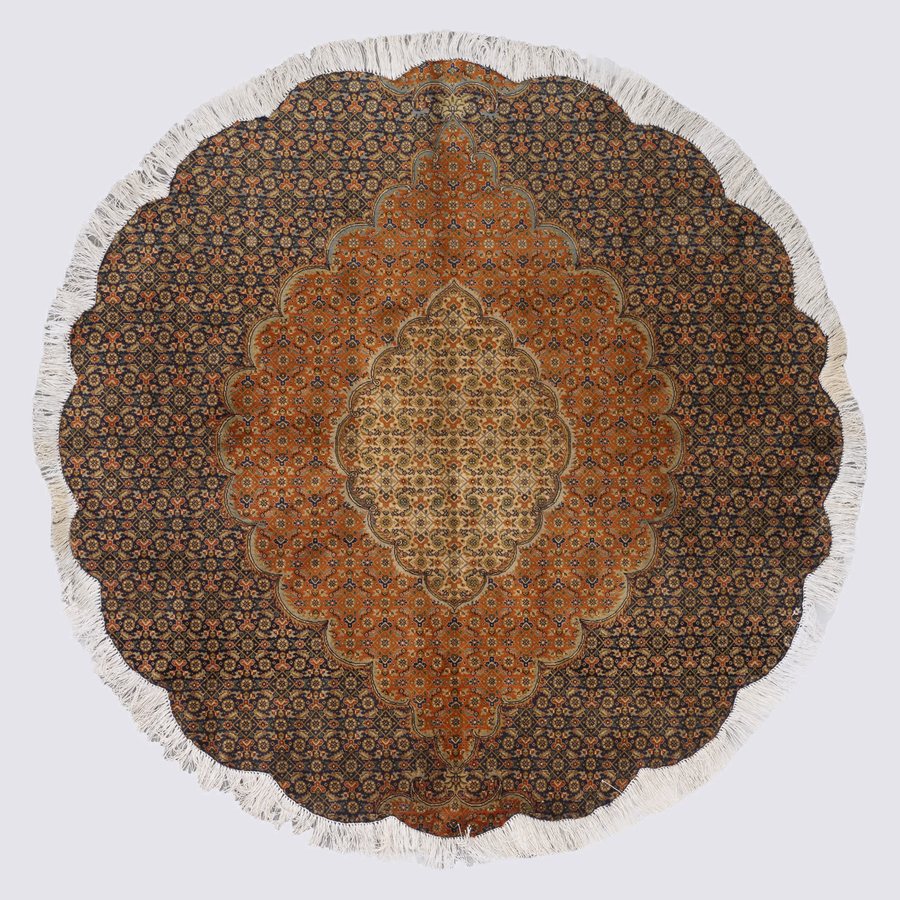
The words used in our listings, explained: how a piece was woven, what it is made of, its design and colours, where it comes from, and how we date it. Persian names are given where they are in common use.
Search terms, alternate spellings, Persian names and definitions. Select a result to read its entry in the full guide below.
I. KINDS OF RUG
How it was woven.
Handwoven rugs include knotted pile rugs and flatweaves. This section also explains how tufted and machine-made rugs differ, and how origin and design names are used.
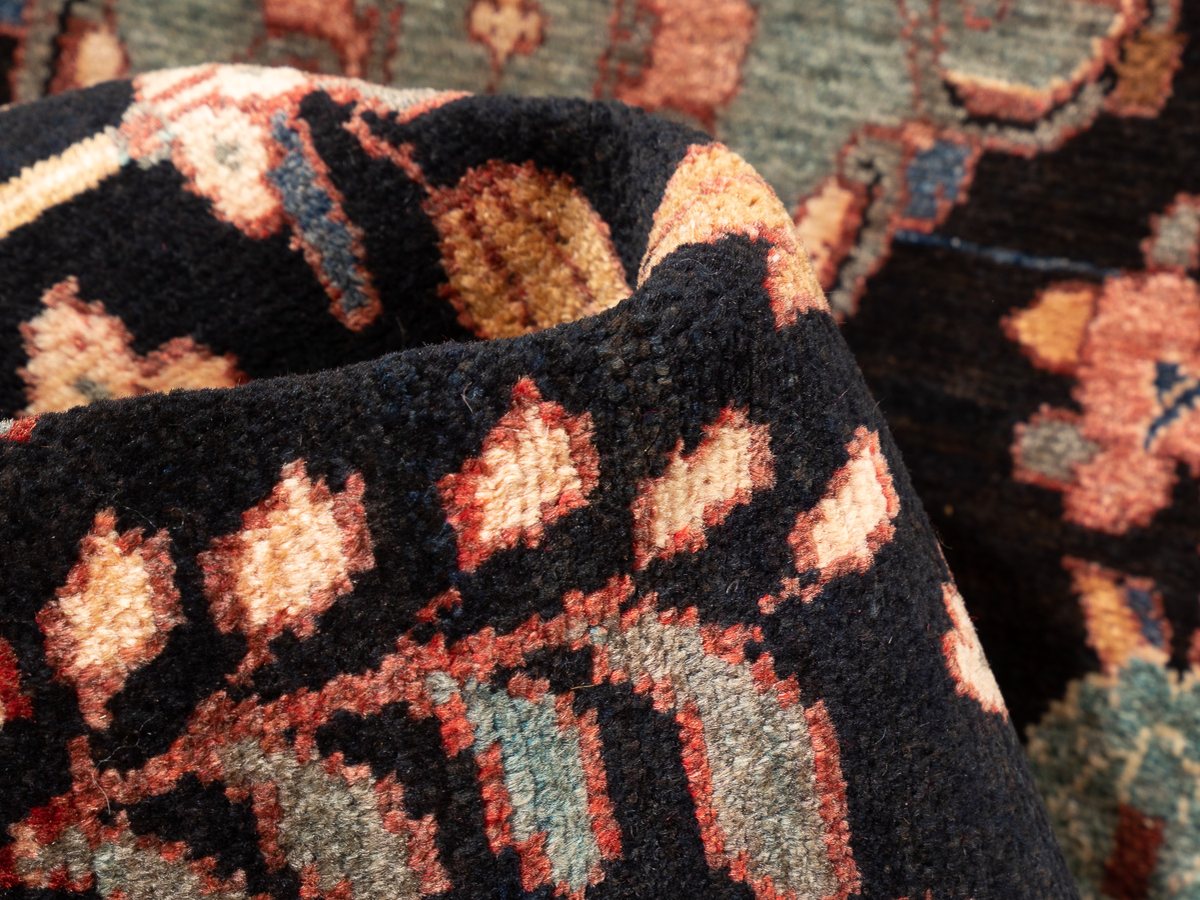
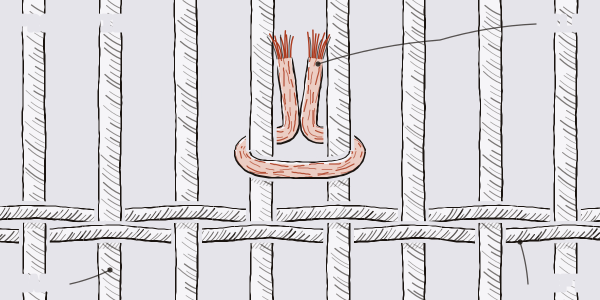
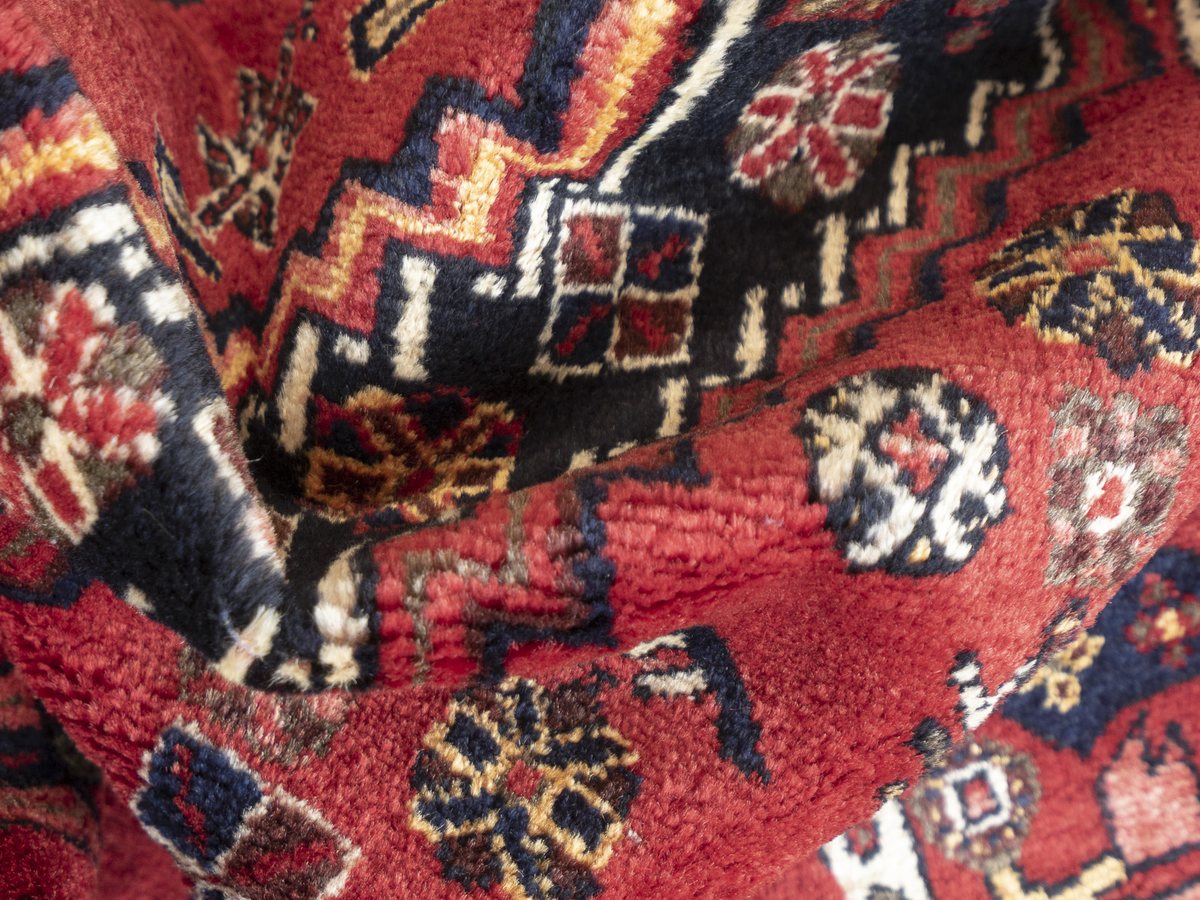
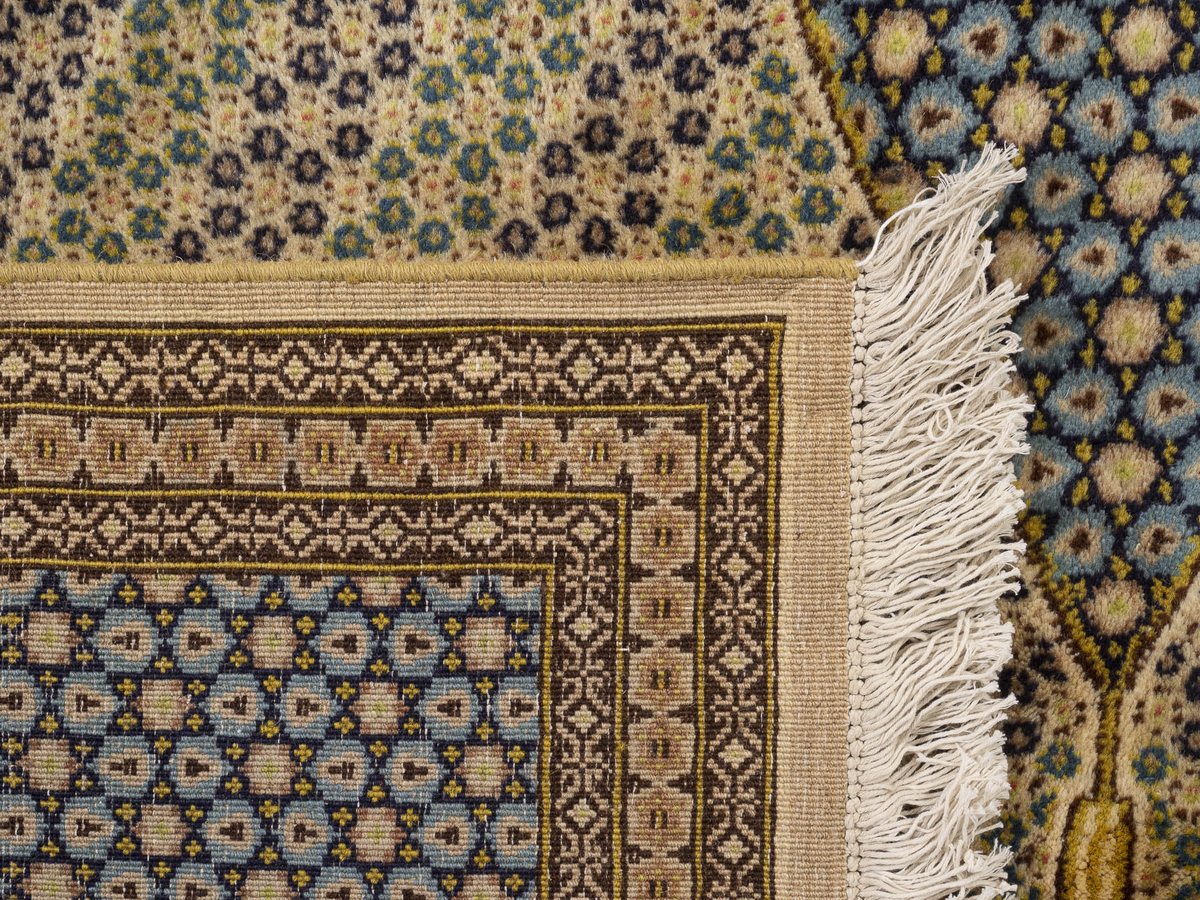
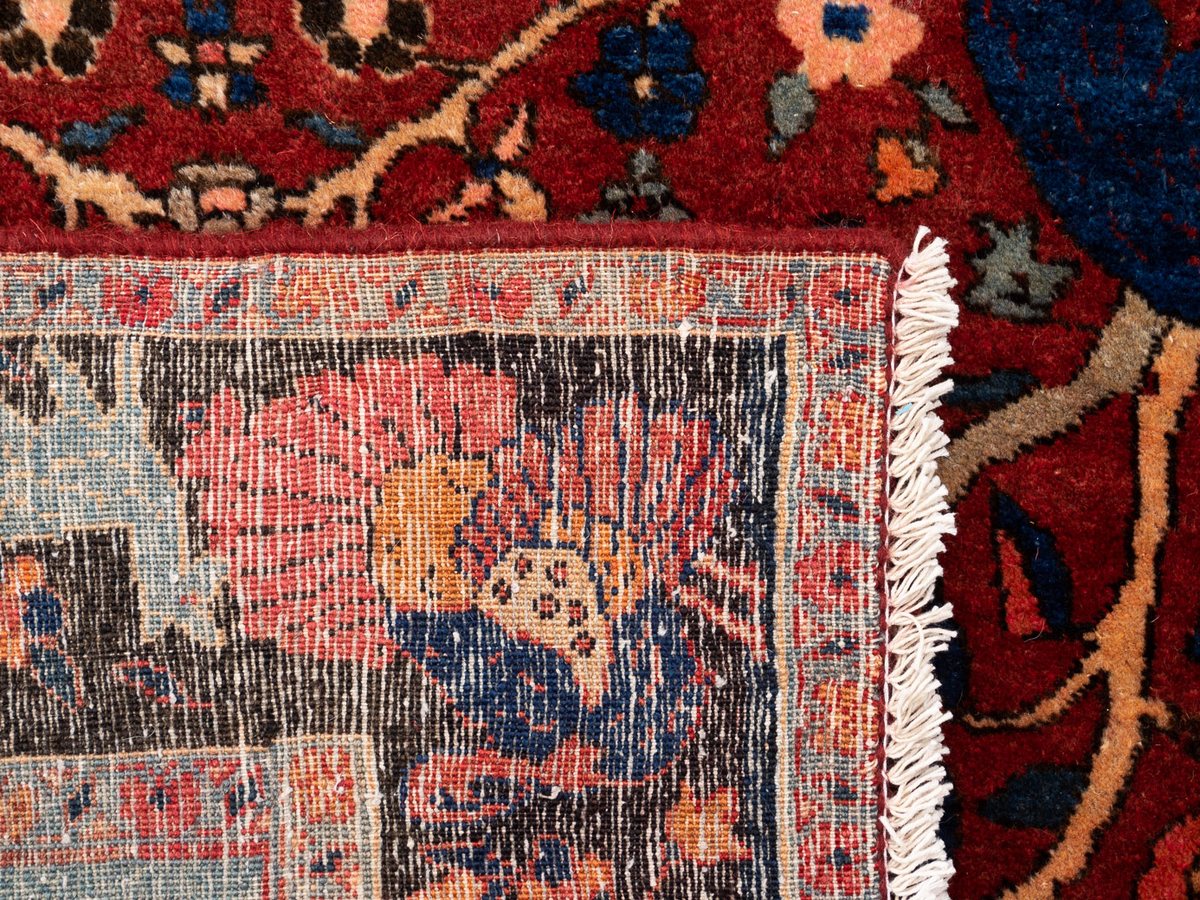
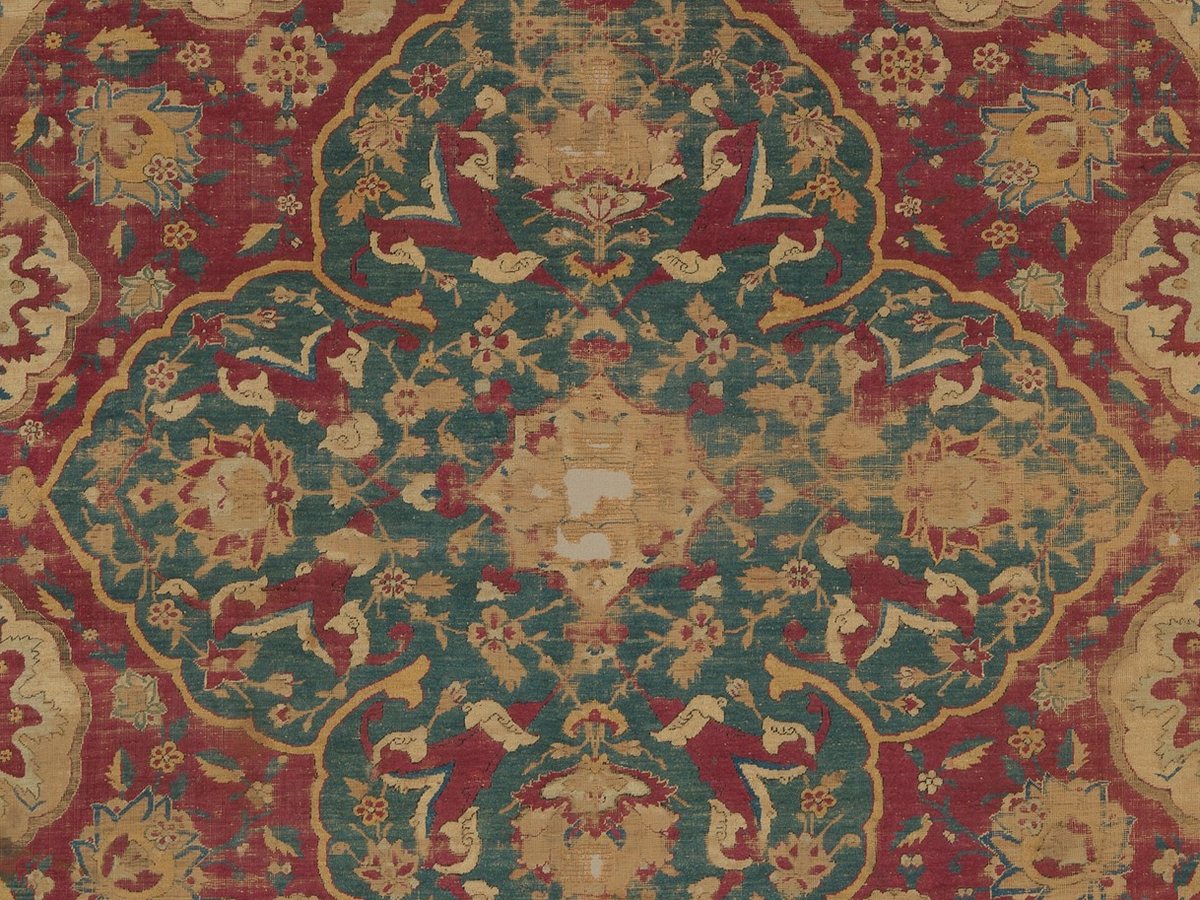
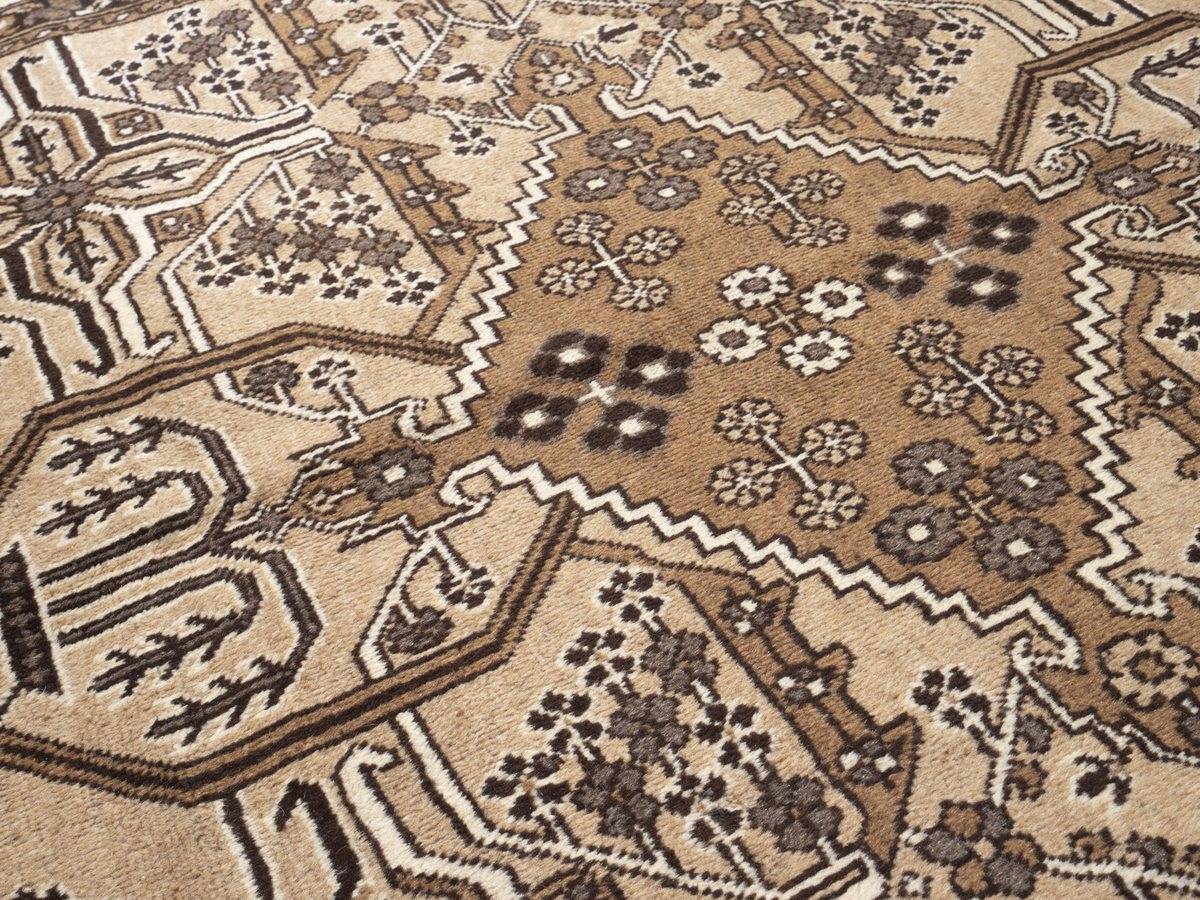
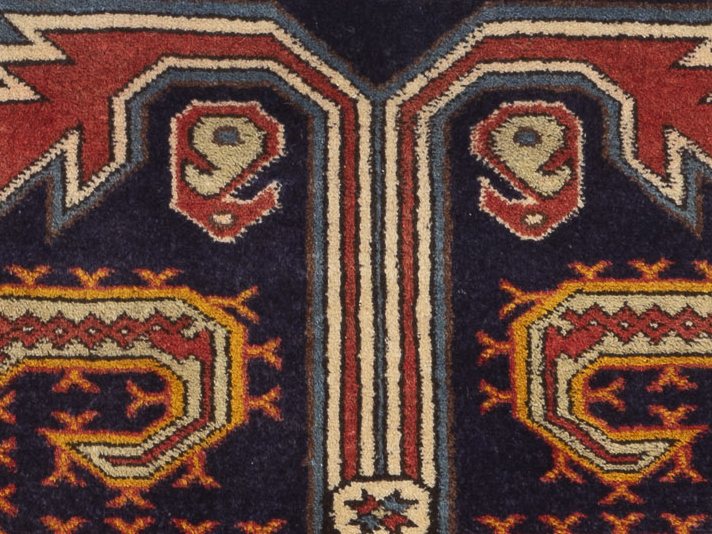
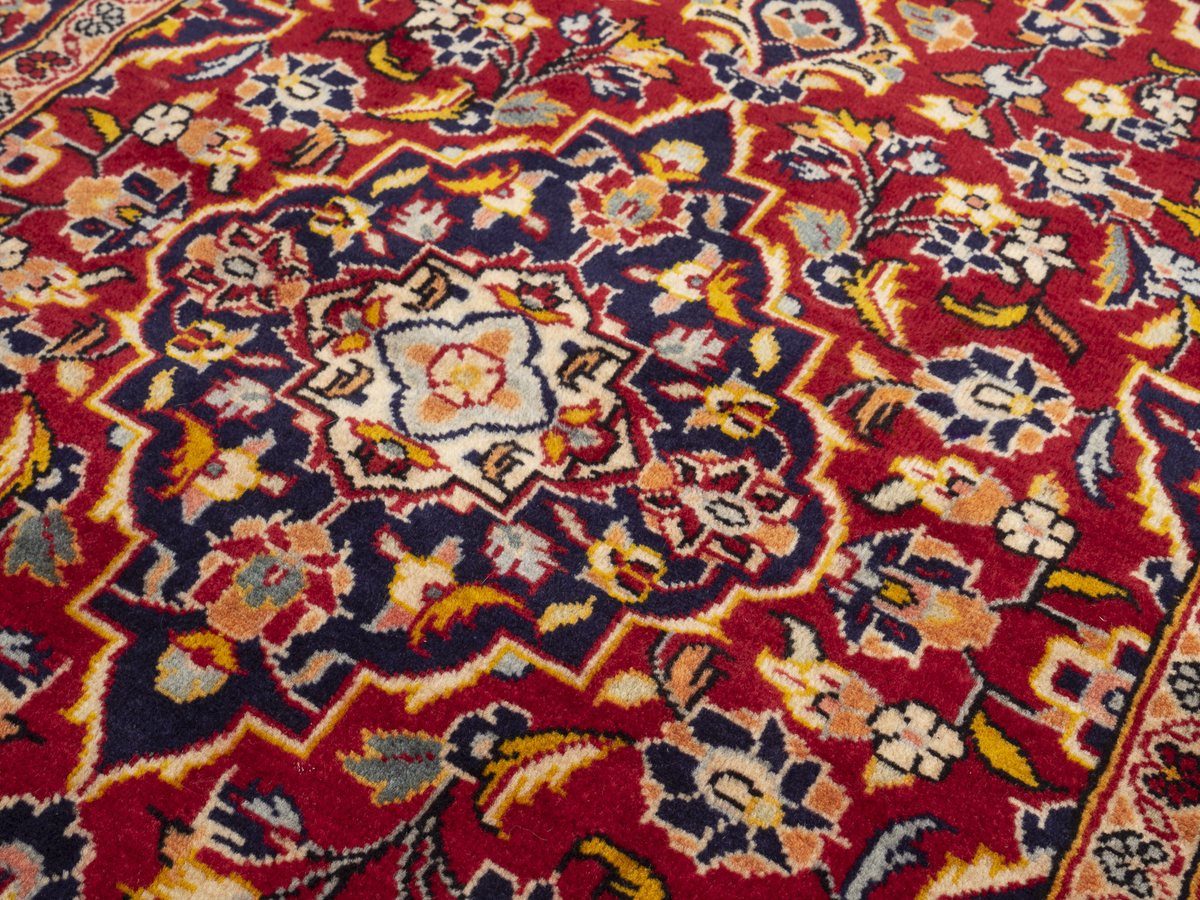
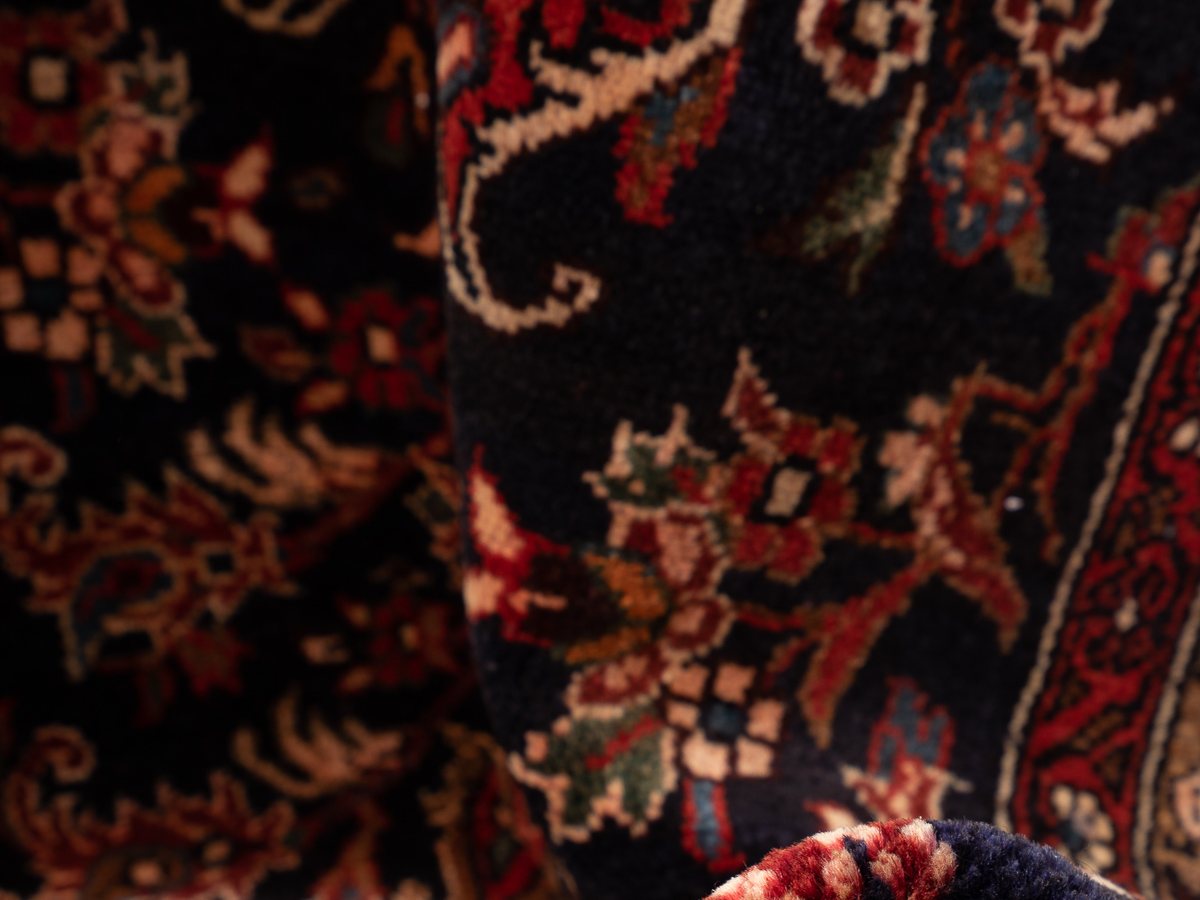
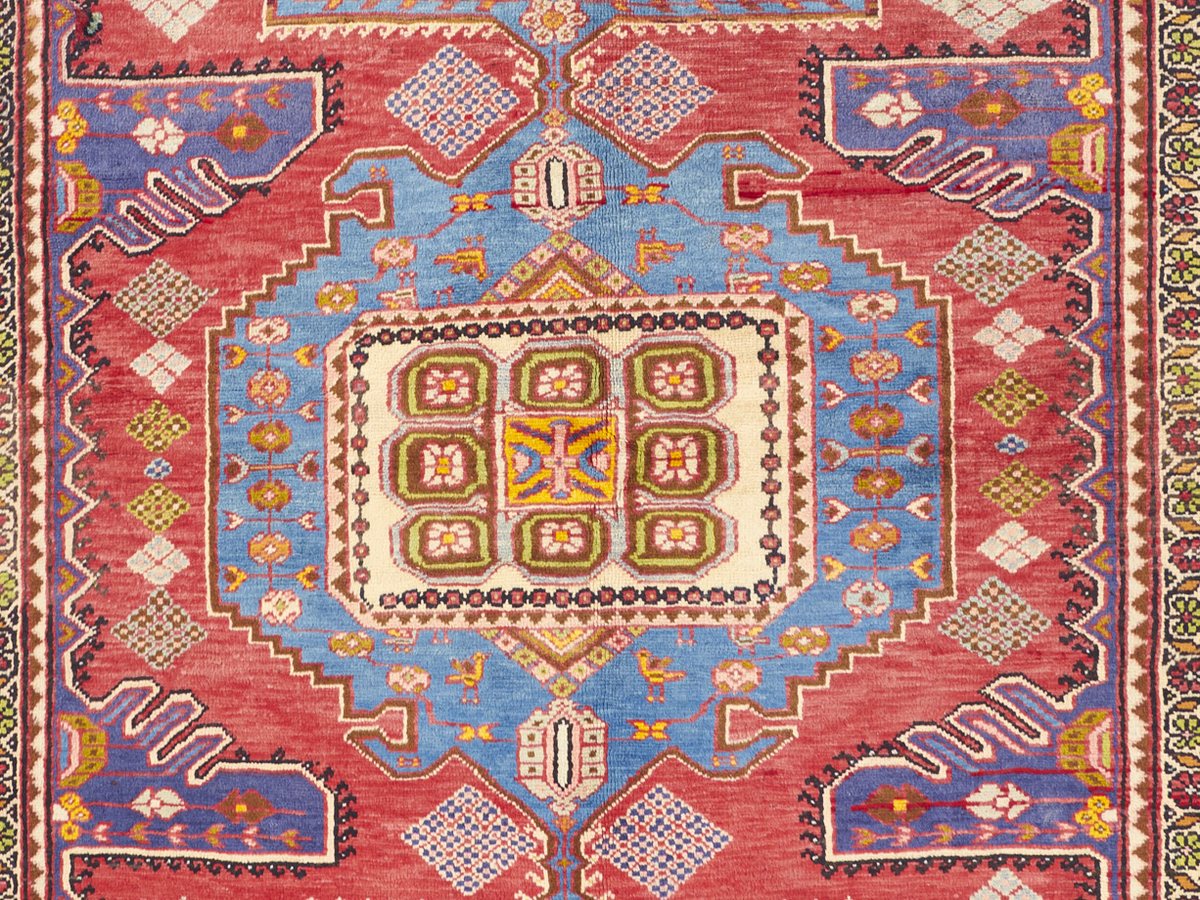
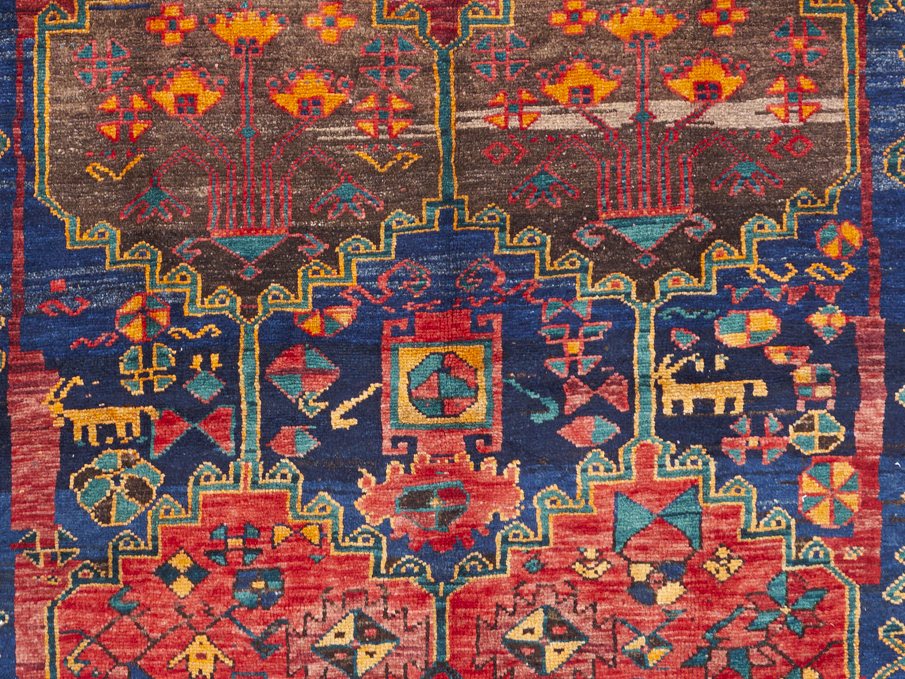
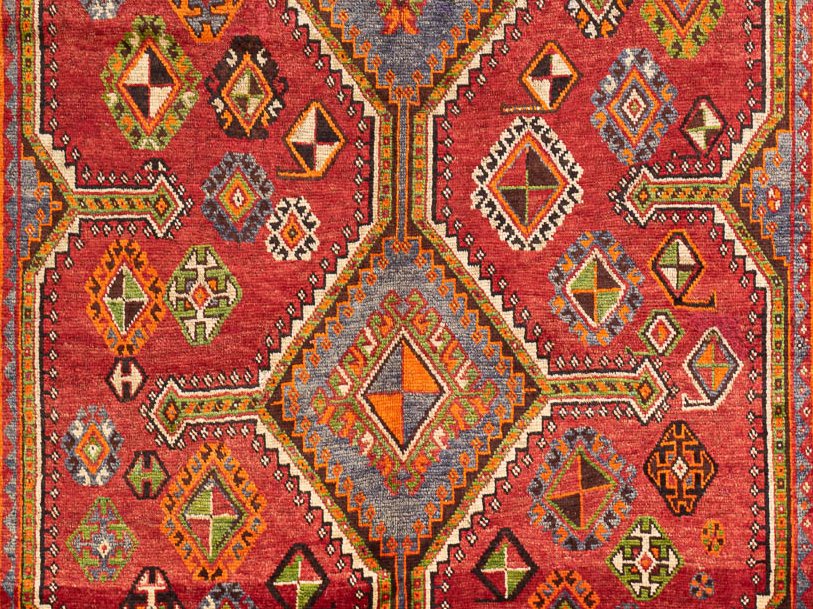
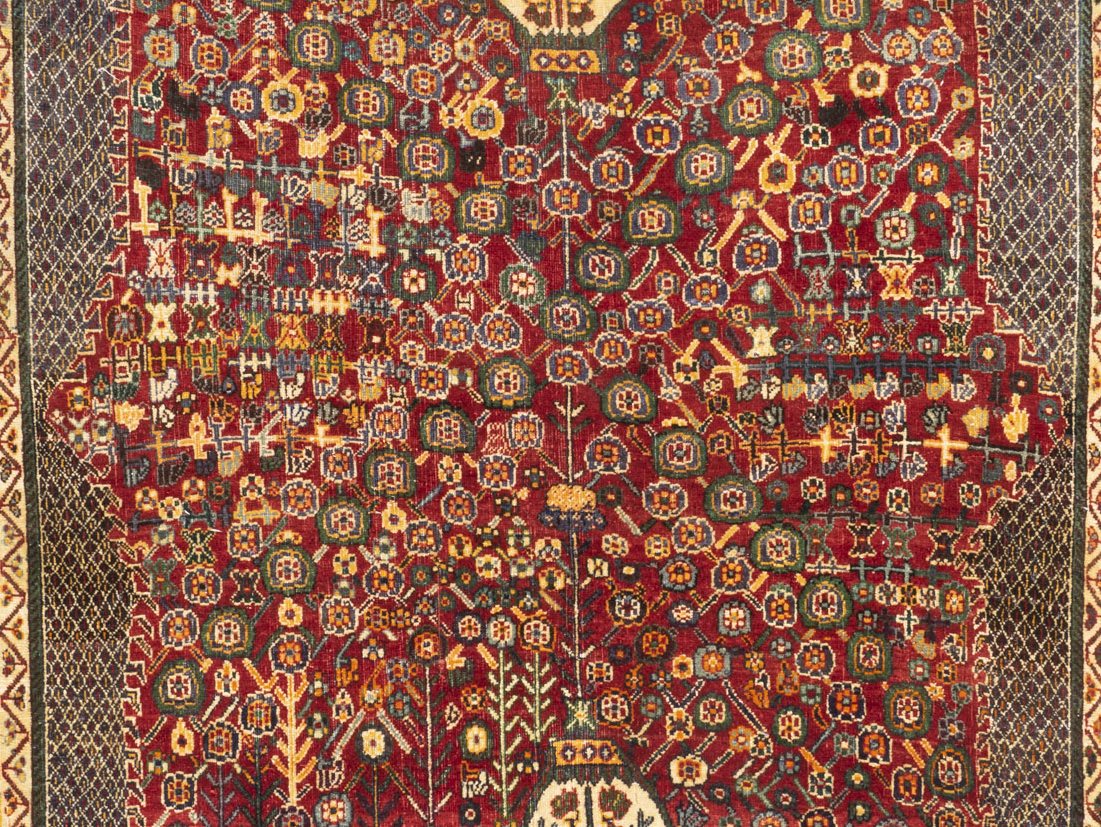
A rug whose surface is a pile of cut yarn. Short lengths of yarn are knotted around pairs of warps between rows of weft, then cut, and the cut ends stand up to form the design. In Persian such a carpet is a qali; a small one is a qalicheh.
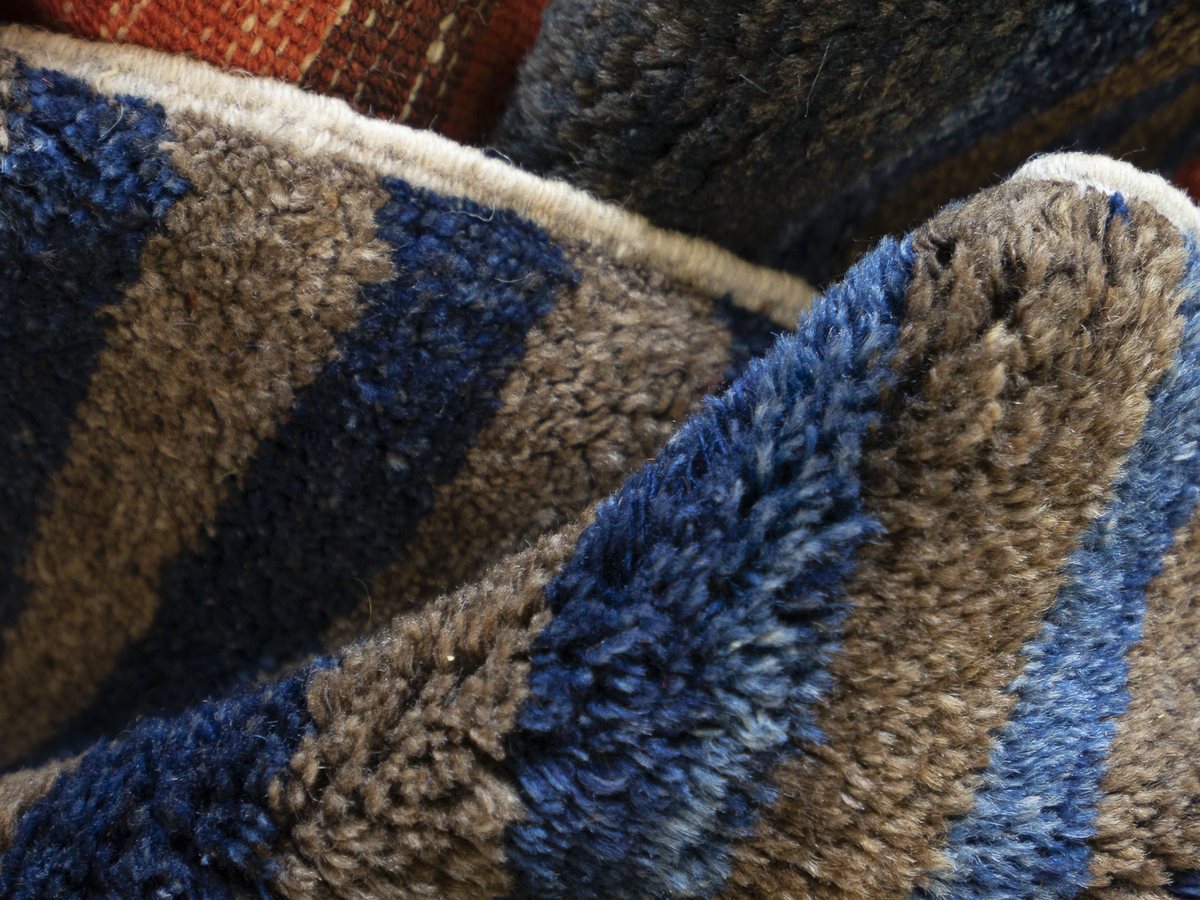
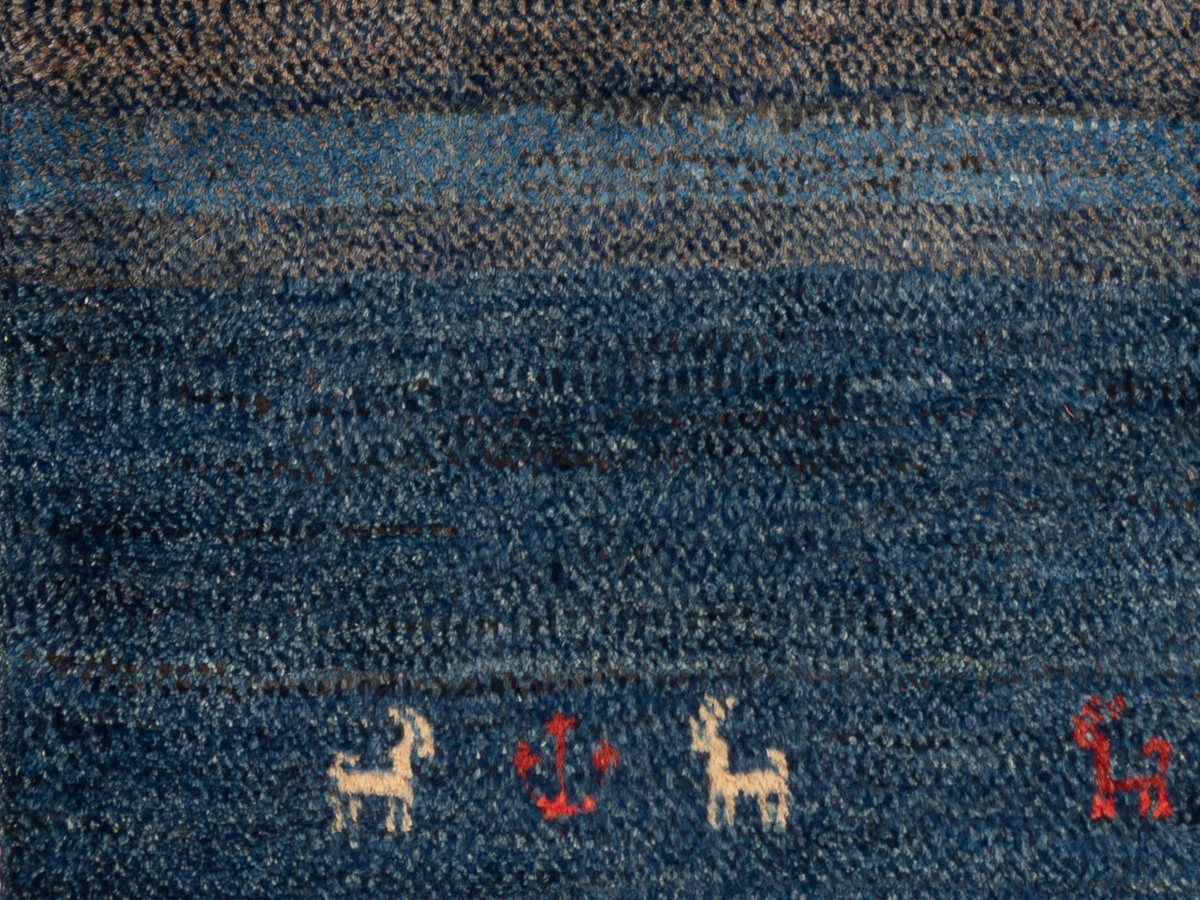
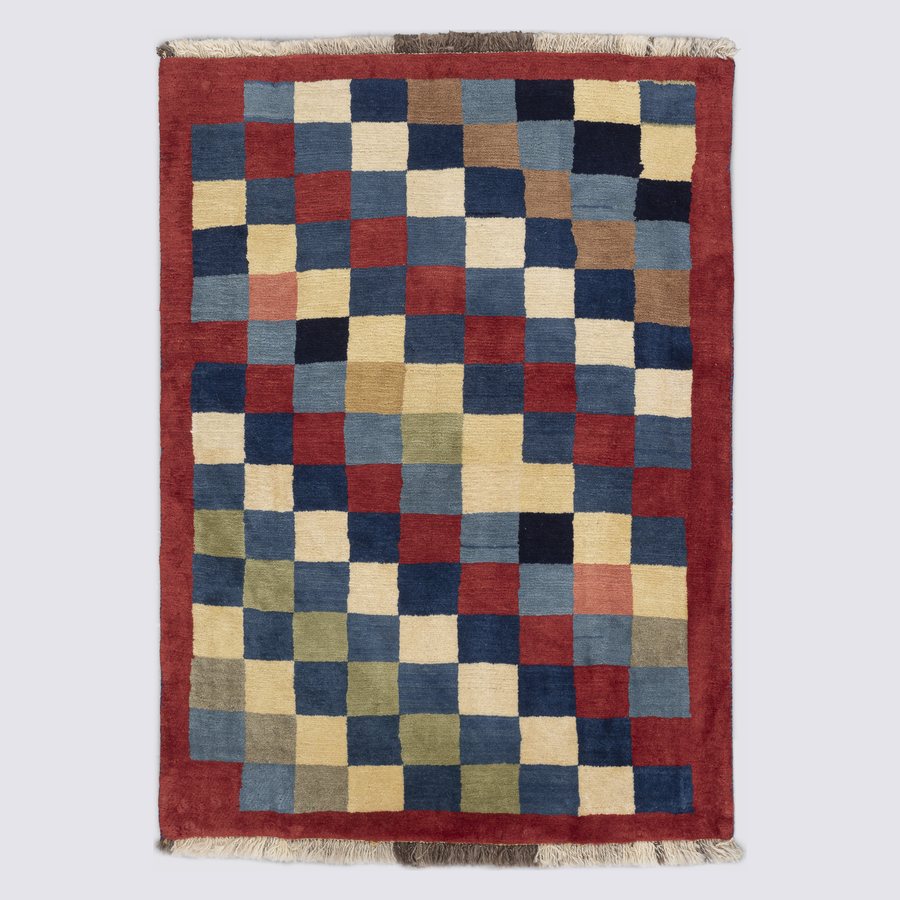
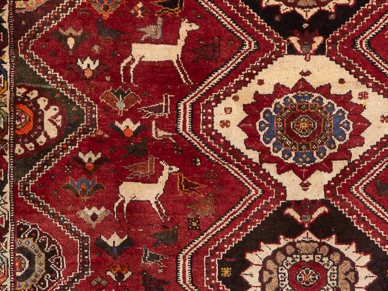
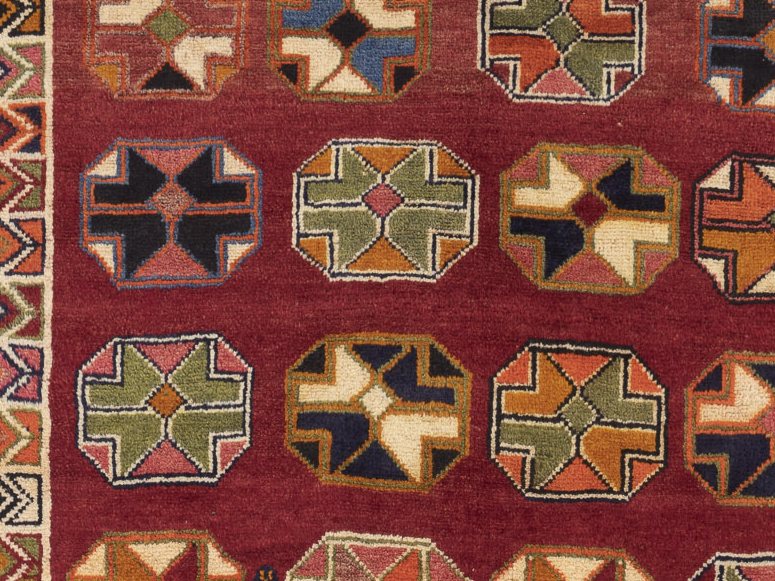
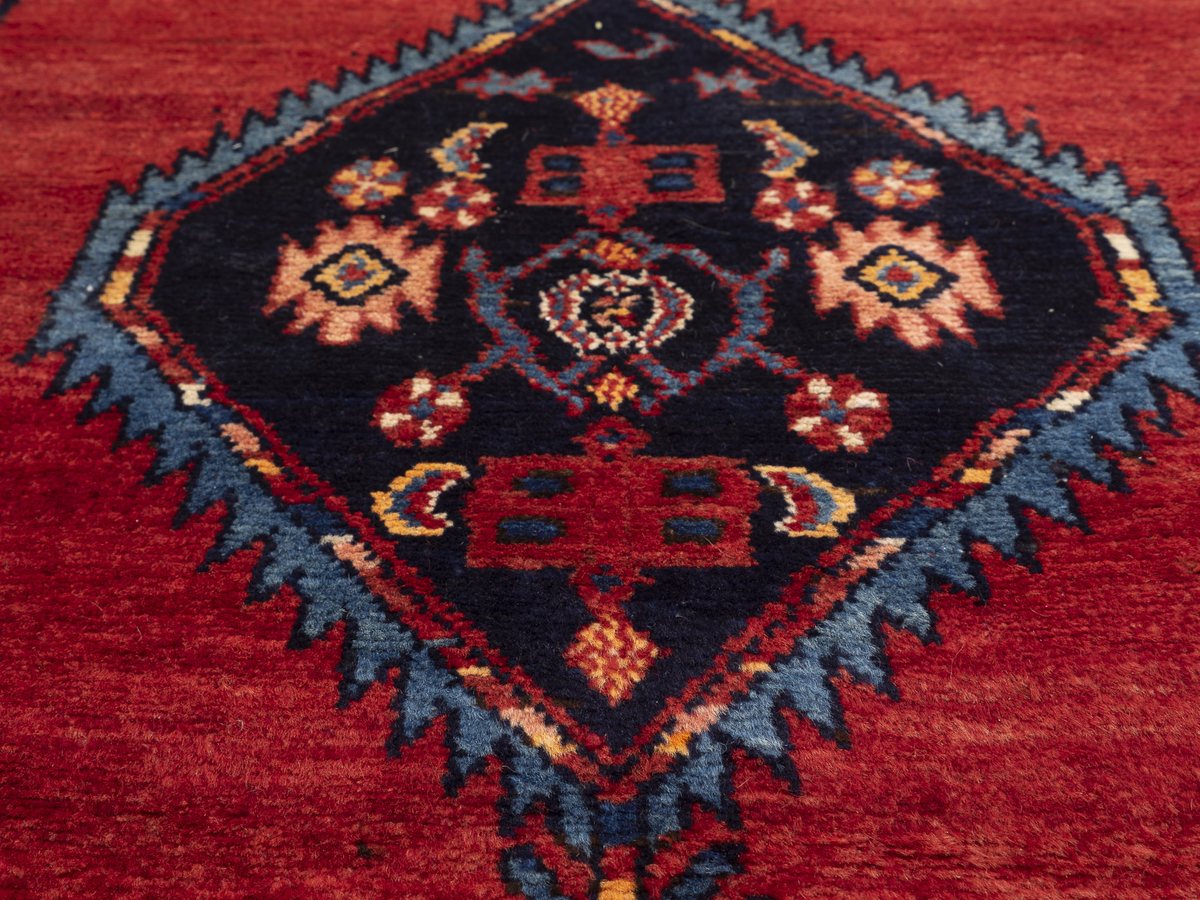
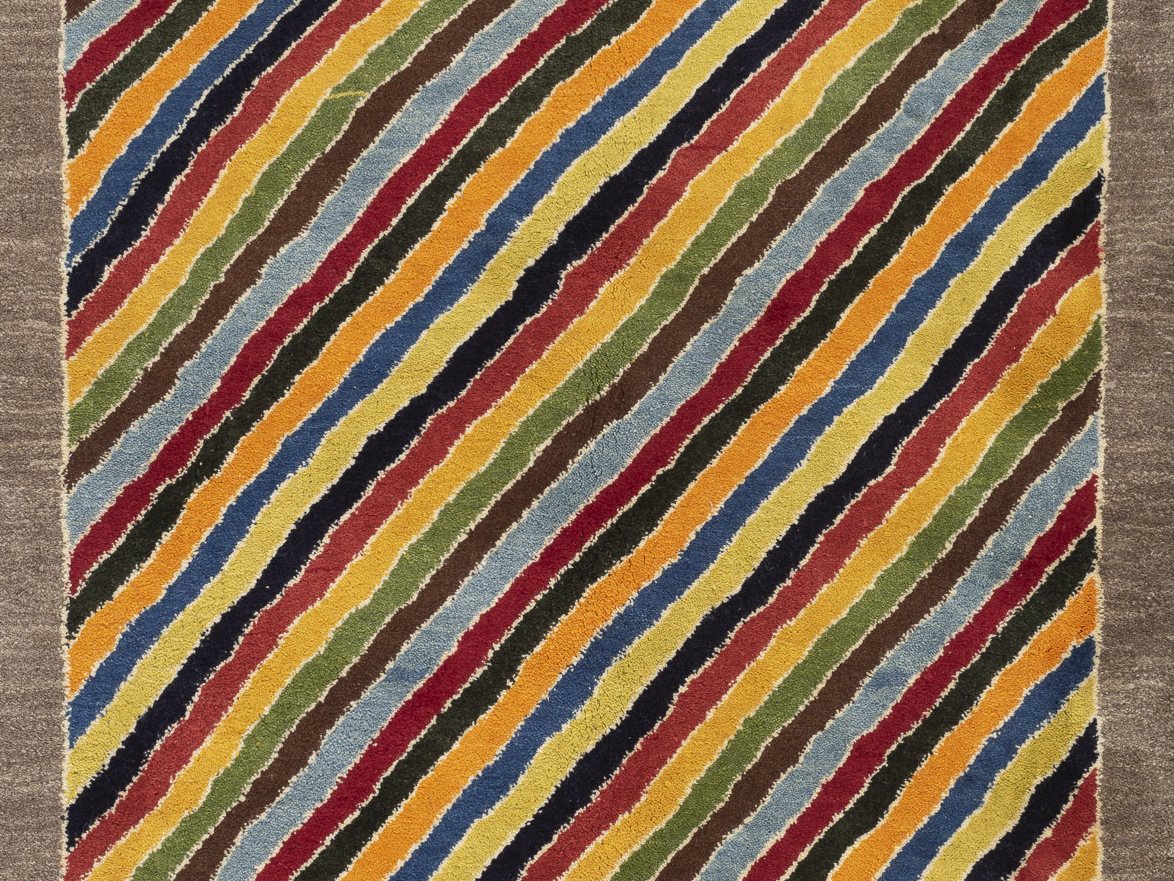
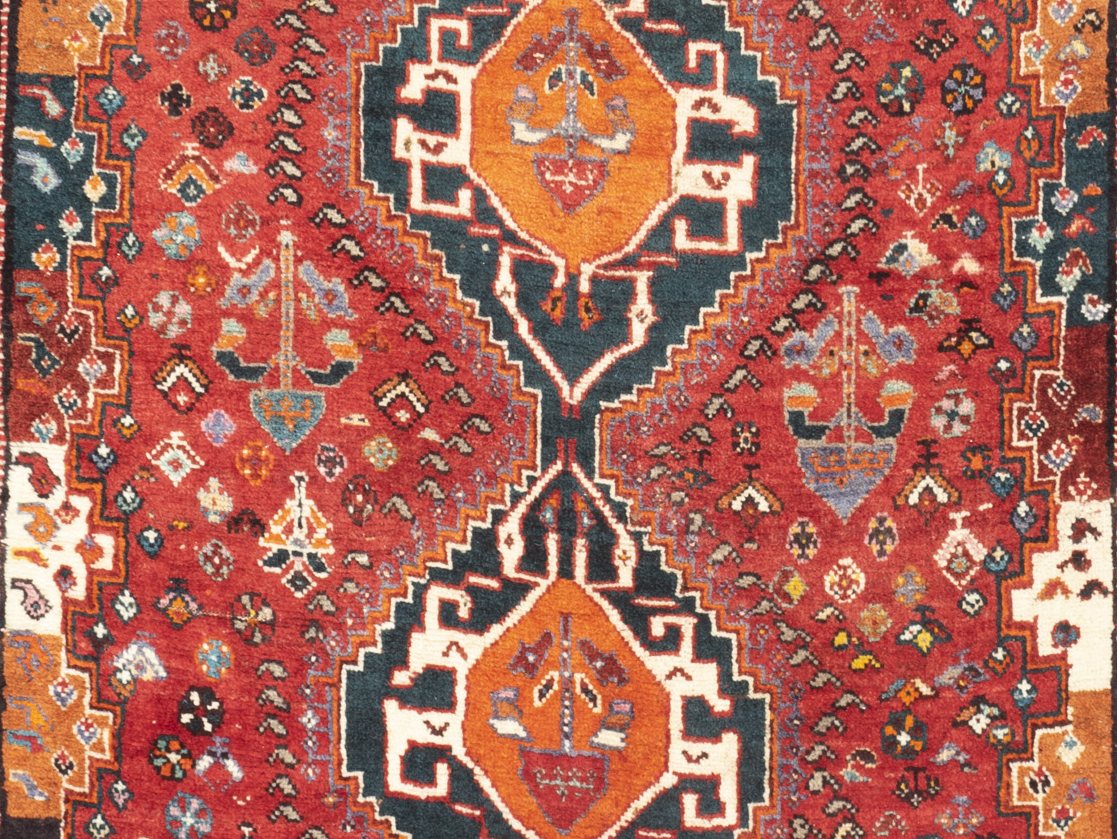
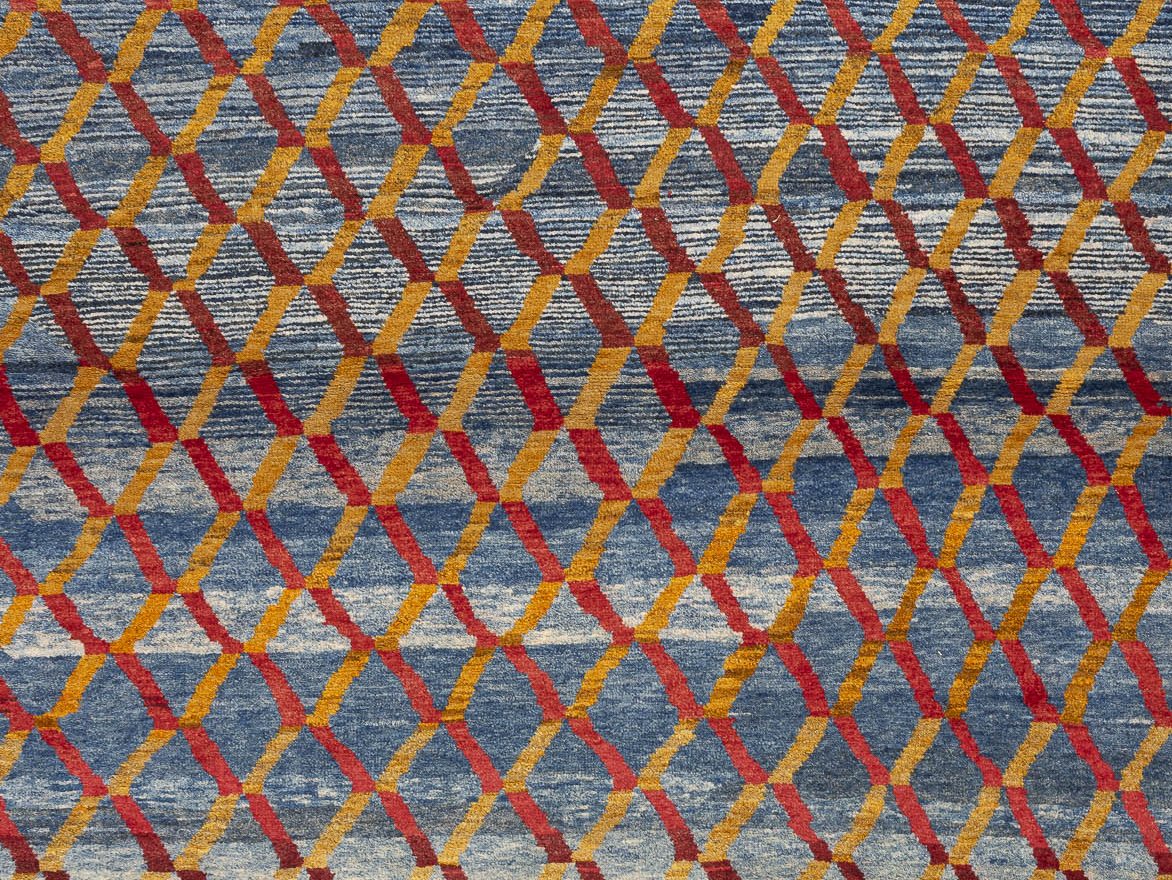
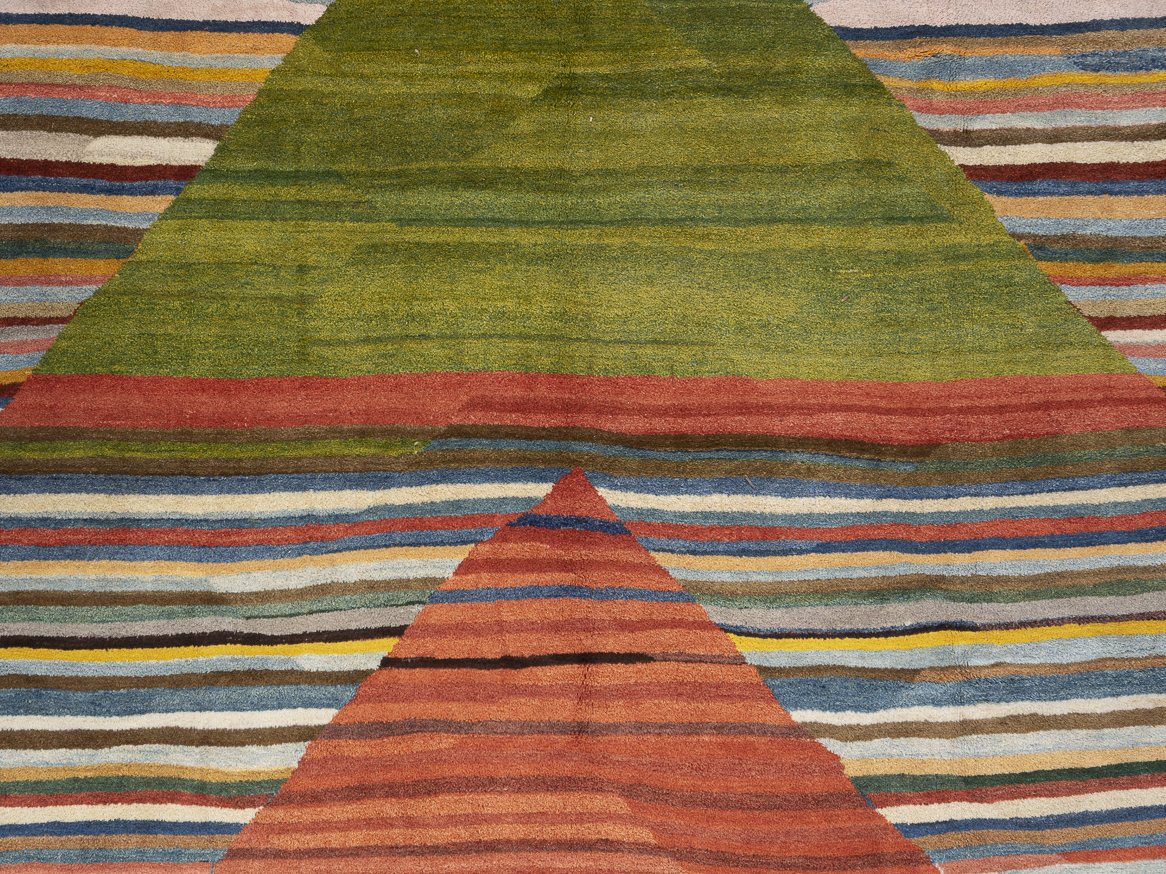
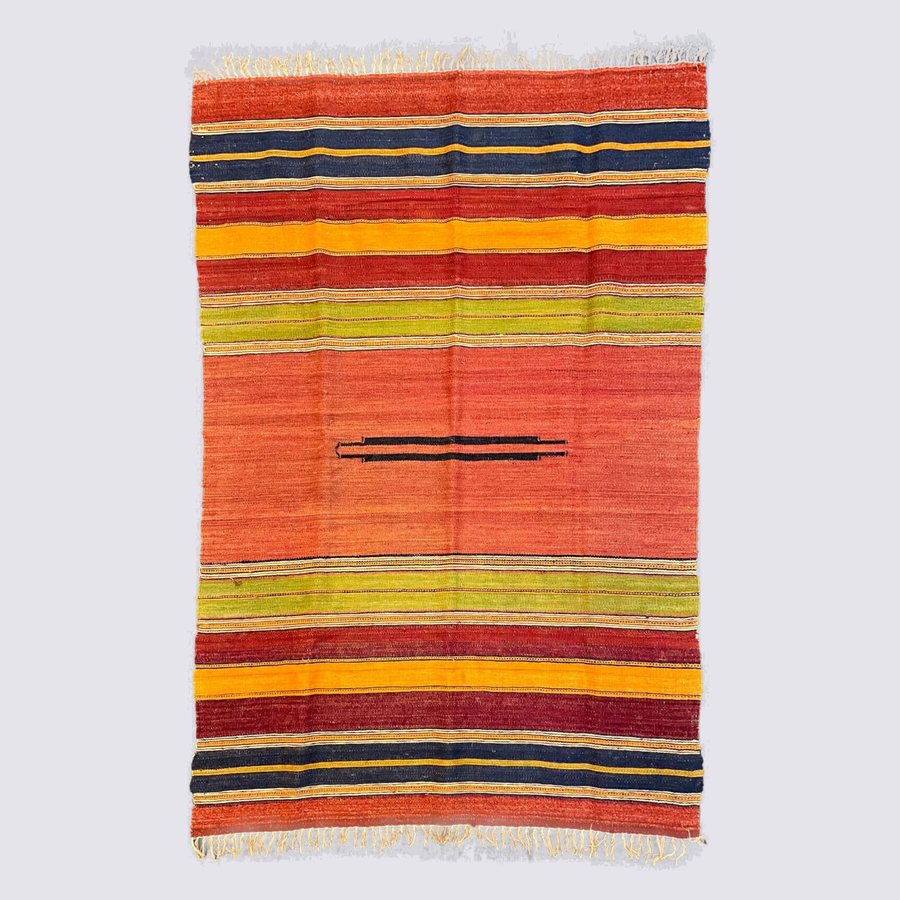
A thick, loosely woven pile rug of the Zagros tribes, among them the Qashqai, Lori-speaking groups and Kurds, with long pile, low knot density and several rows of weft between each row of knots. Designs are spare: open fields of colour, simple geometry, now and then a stylised animal. Gabbehs were woven for the household, as sleeping rugs and floor covers, rather than for sale.
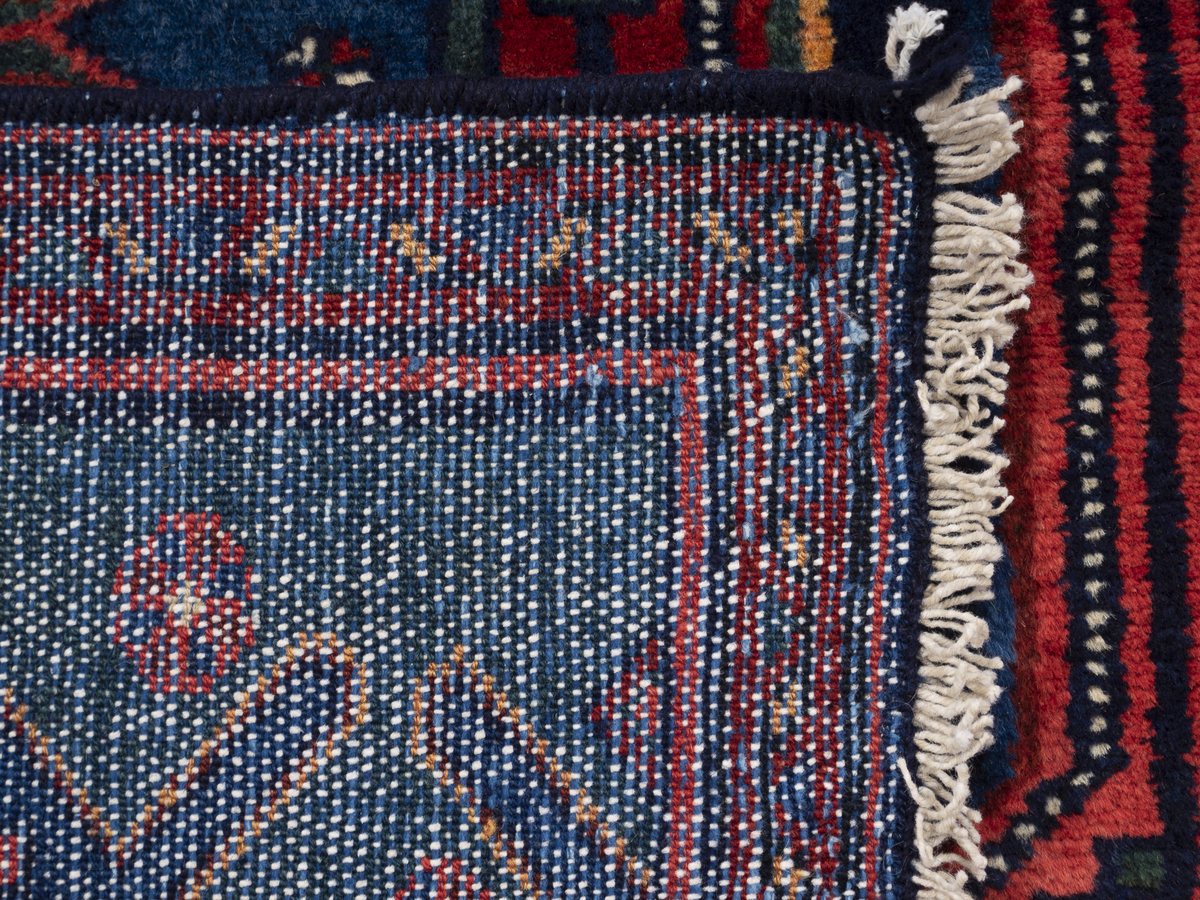
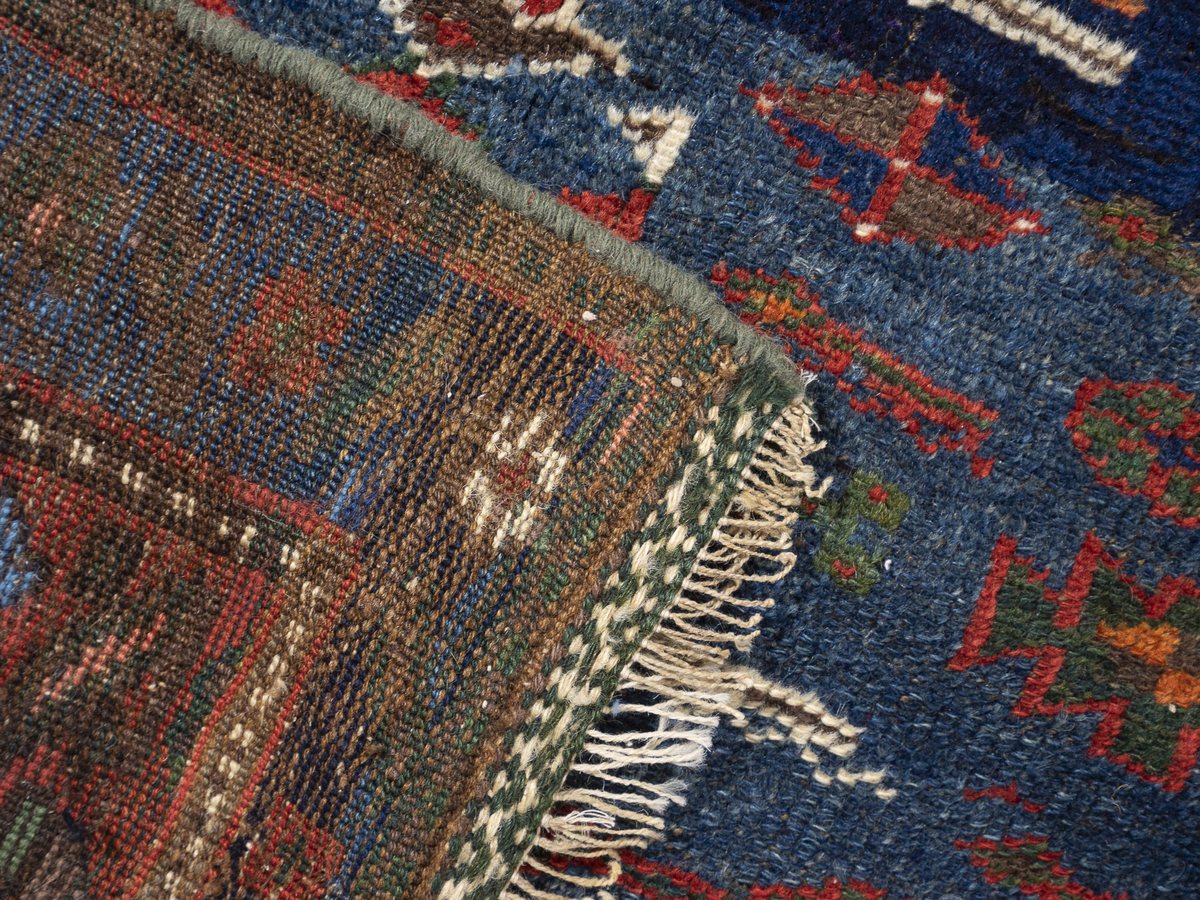
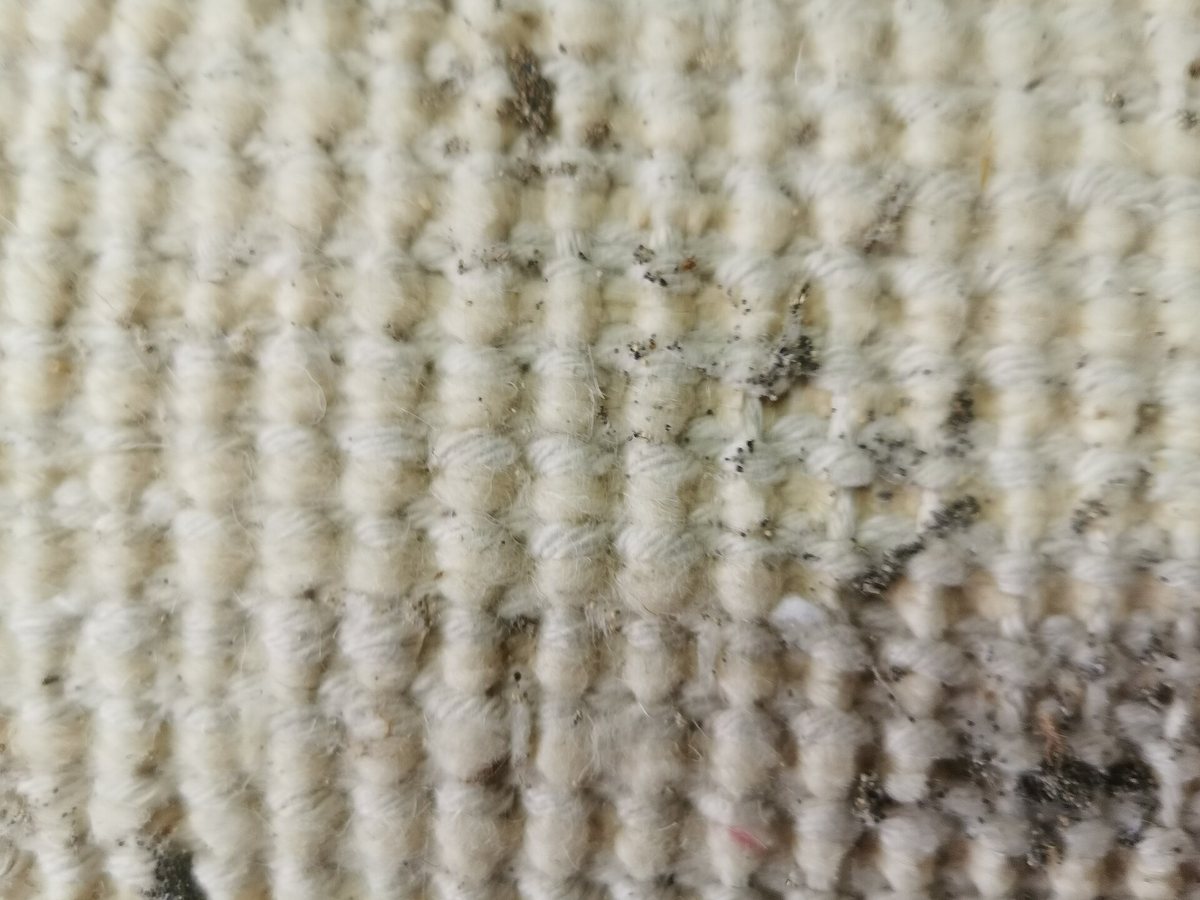
A hand-tufted rug is made by shooting yarn through a cloth stretched on a frame with a hand-held tufting gun; nothing is knotted. The loops are left or cut to form the pile, latex is spread over the back to hold them, and a second cloth covers the latex. A plain cloth back that hides the design usually means tufting; a knotted rug shows its rows of knots.
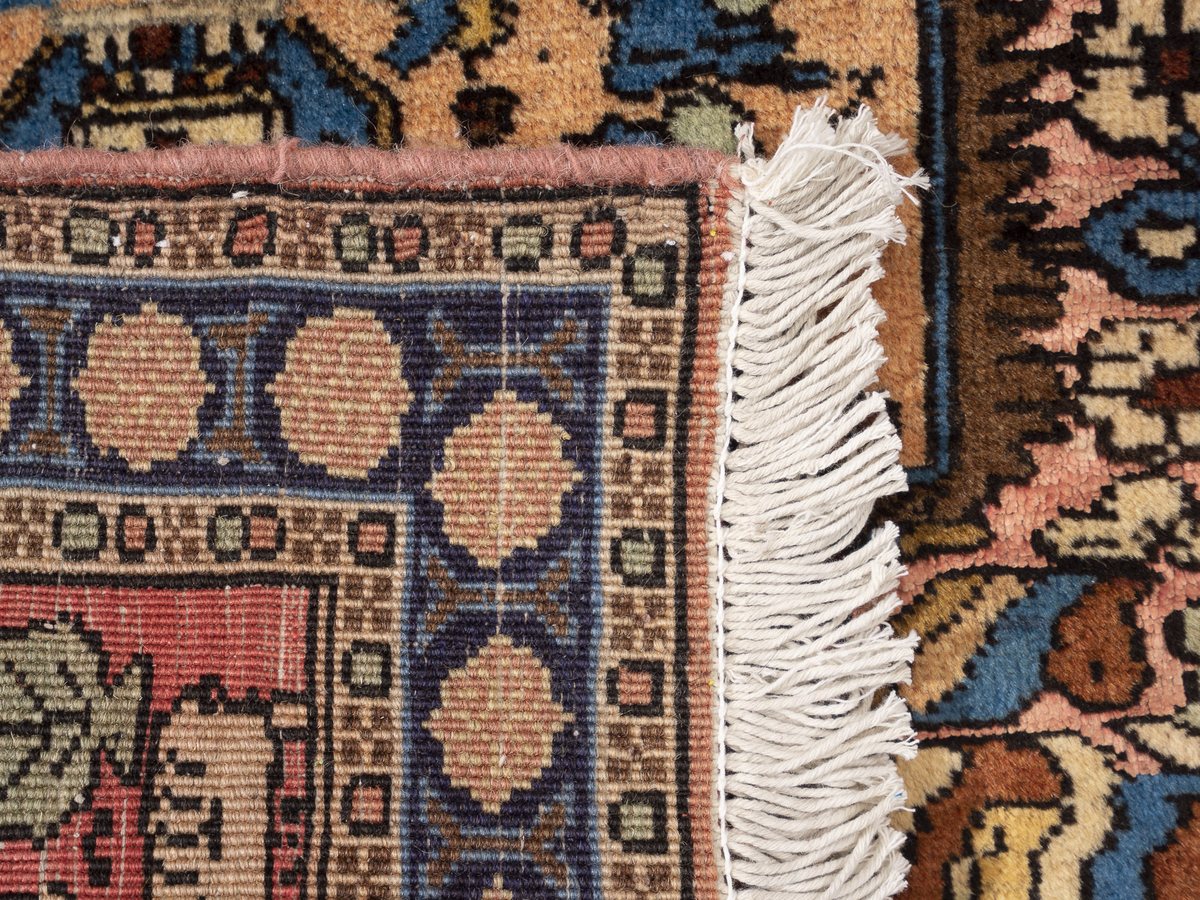
A machine-made rug is woven on a power loom, which forms the pile and foundation mechanically. Dealers look for a very regular weave on the back, machine-finished edges and a fringe attached afterwards, where the fringe of a hand-knotted rug is usually the ends of its warps. No single sign is proof, because machines can copy hand-knotted designs, so the signs are read together.
ALSO MACHINE-WOVEN · POWER-LOOMED · POWER-LOOM RUG · MACHINE RUG
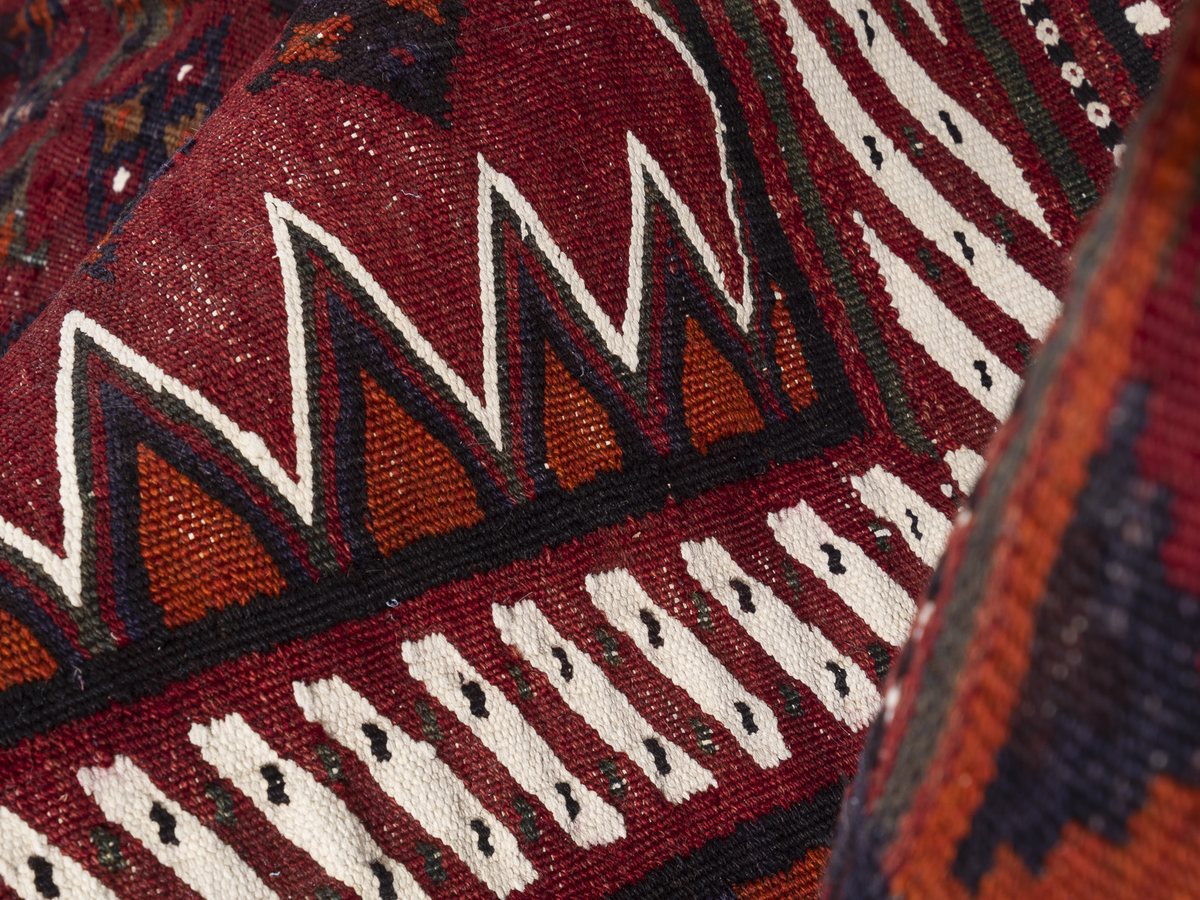
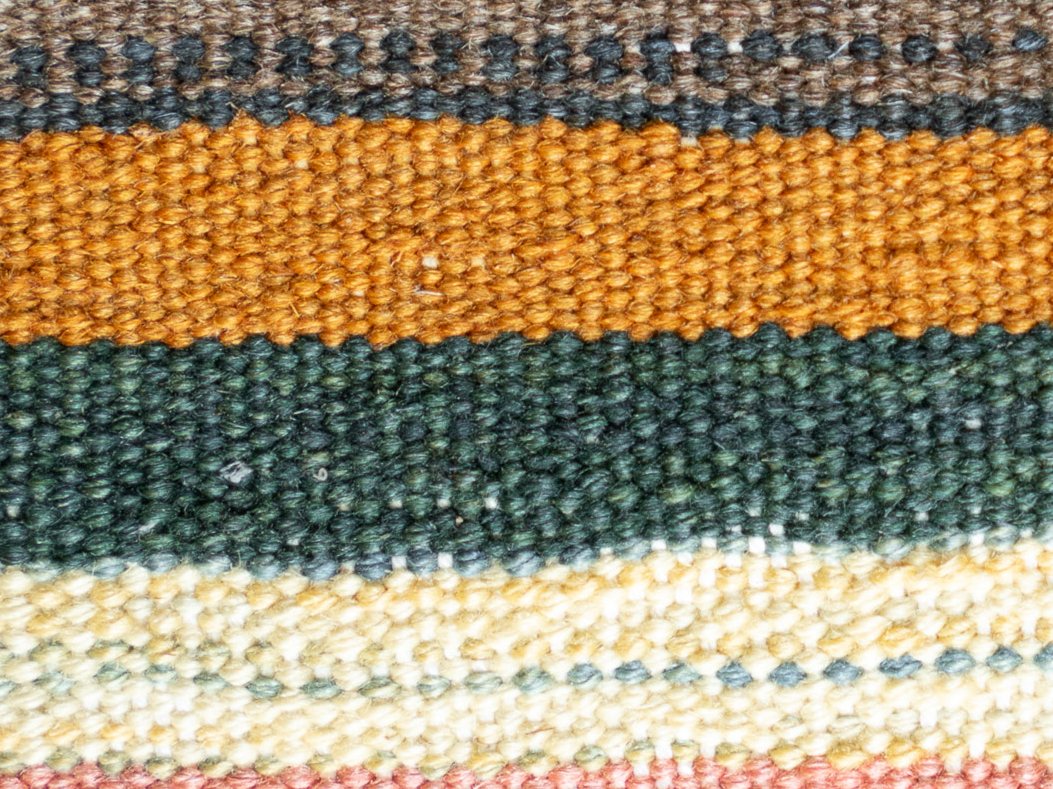
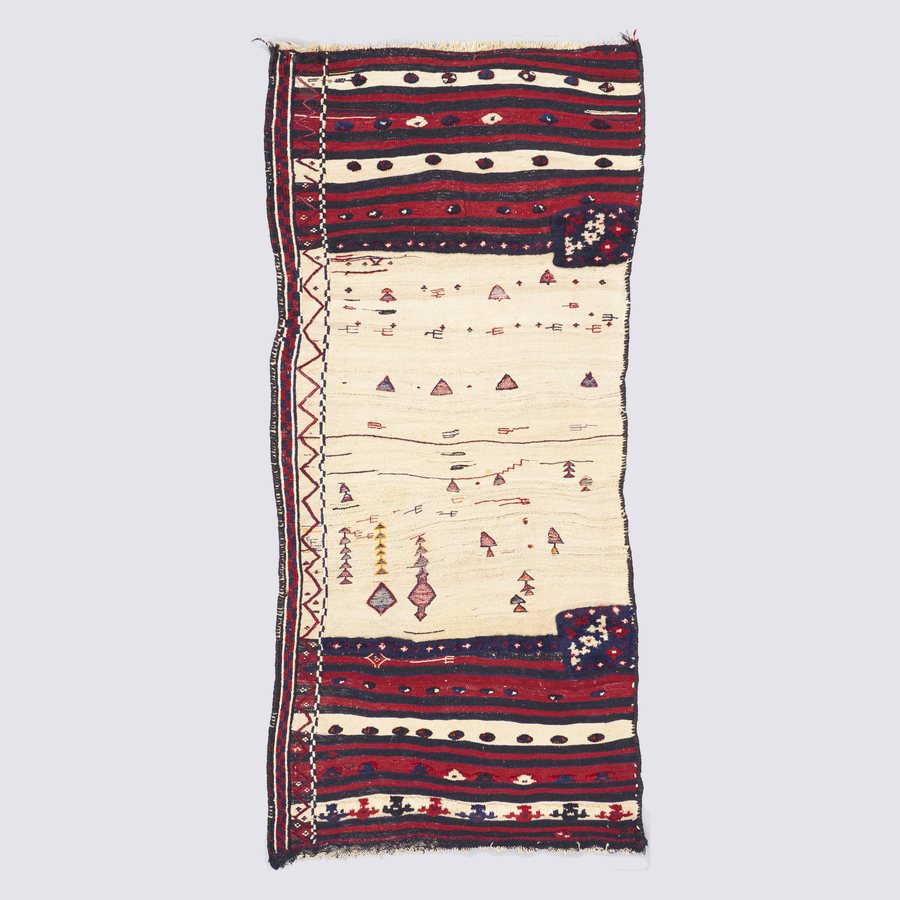
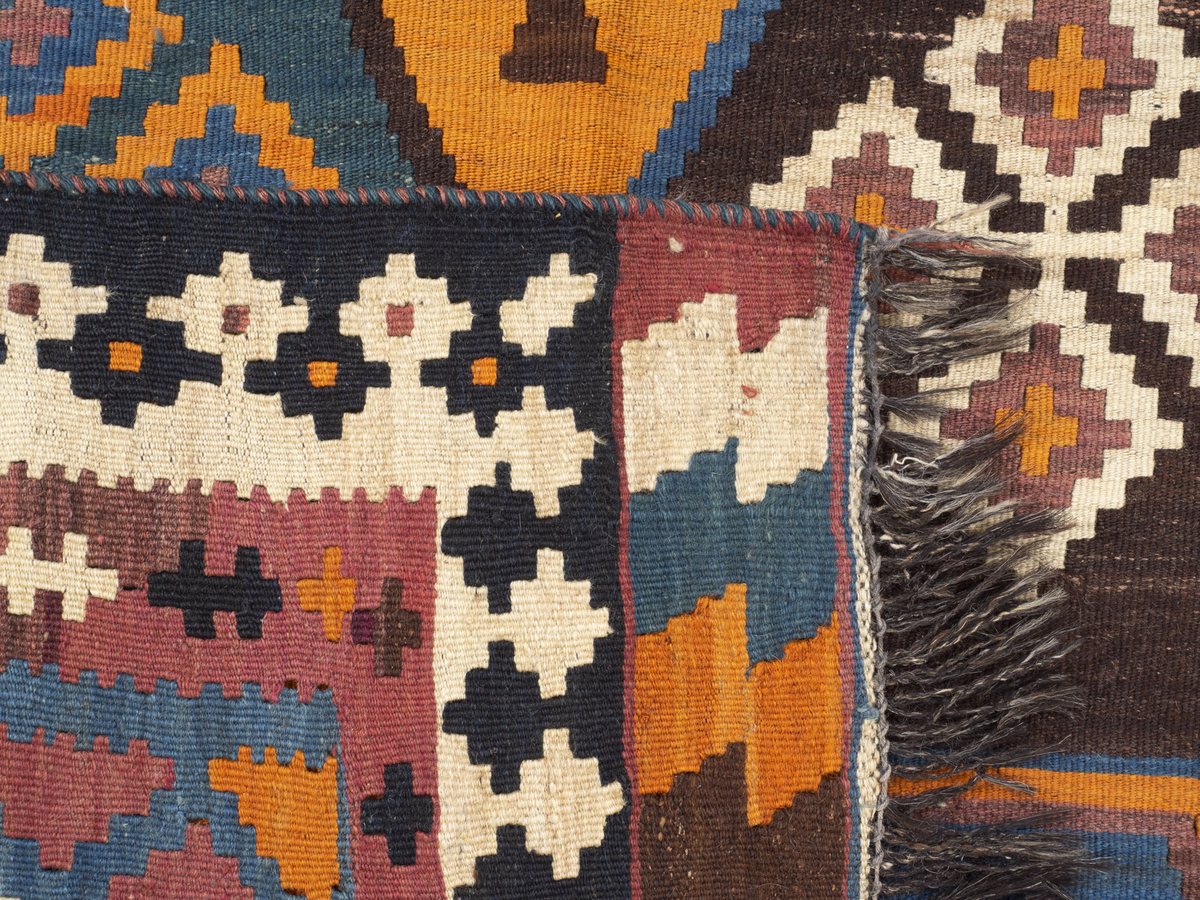
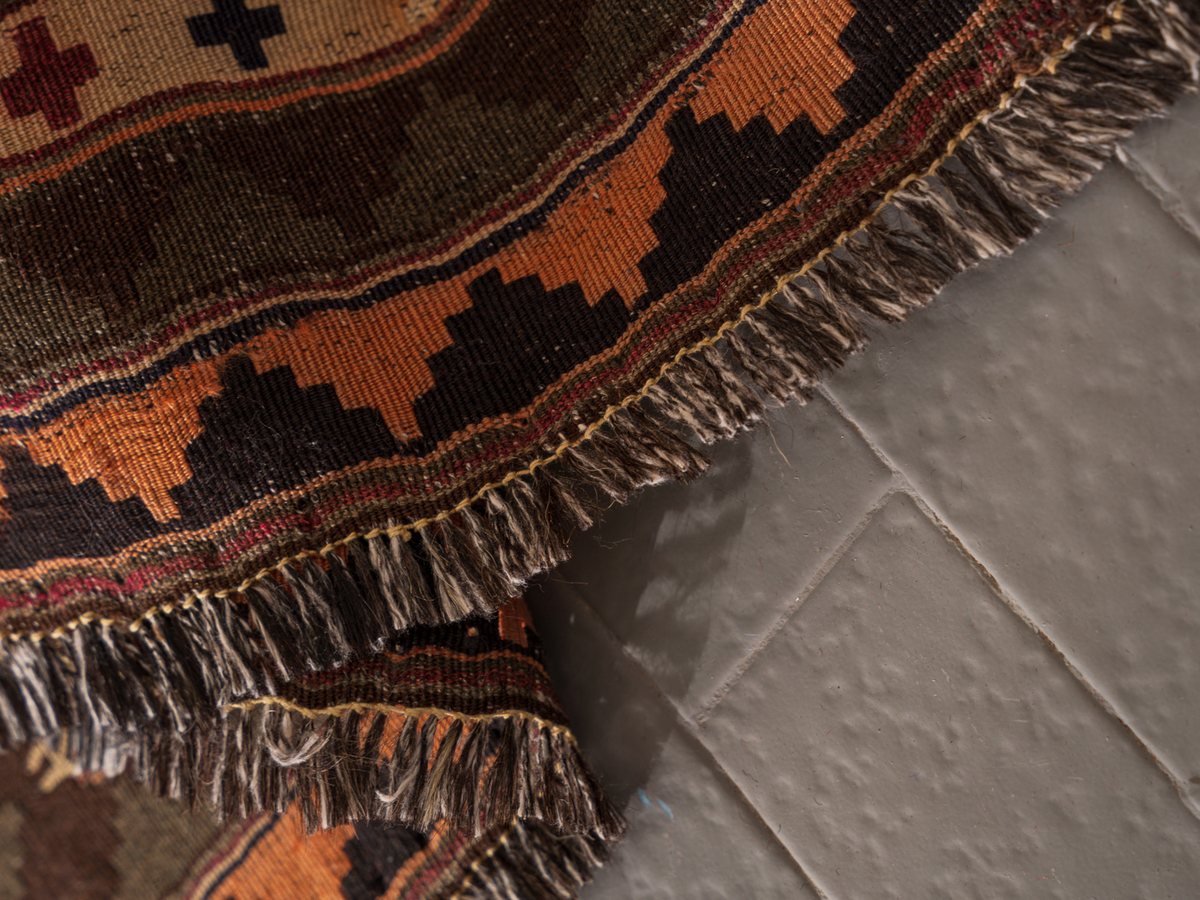
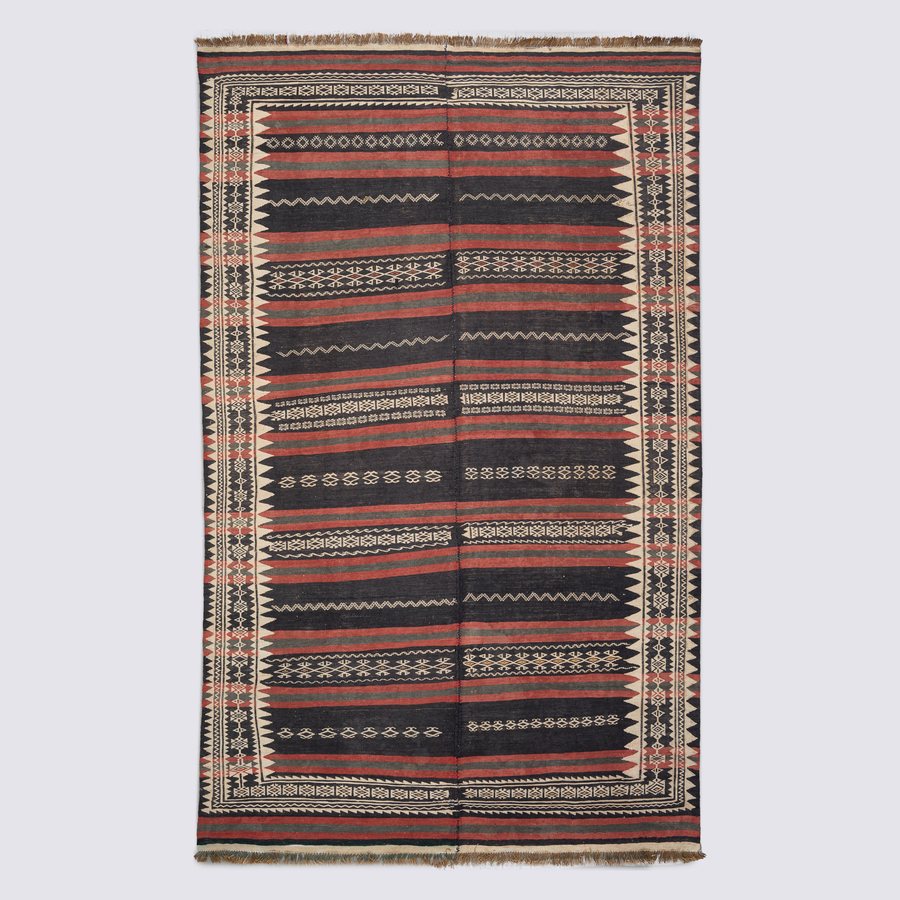
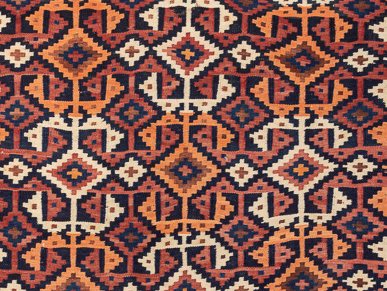
Any rug or textile woven without a pile. The pattern comes from the warps and wefts themselves, or from extra yarns floated or wrapped across them. Kilim, soumak, jajim and ziloo are all flatweaves, each with its own structure.
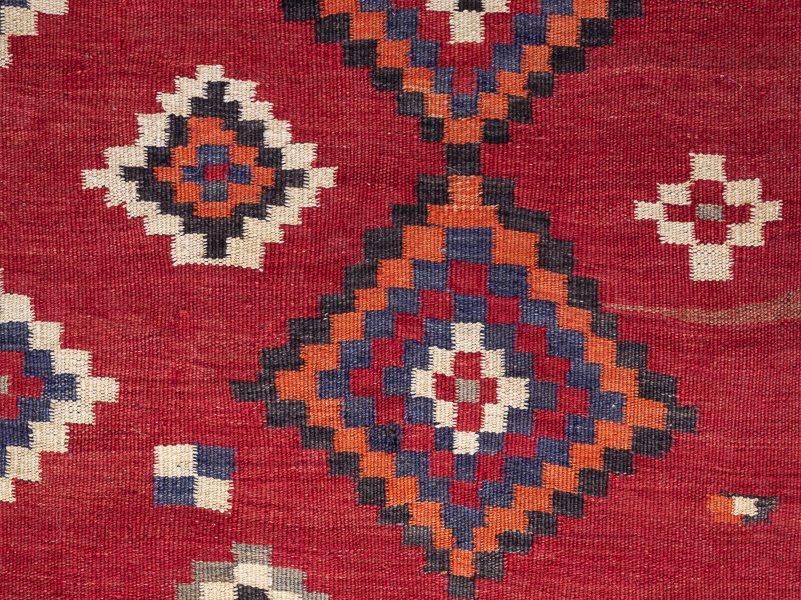
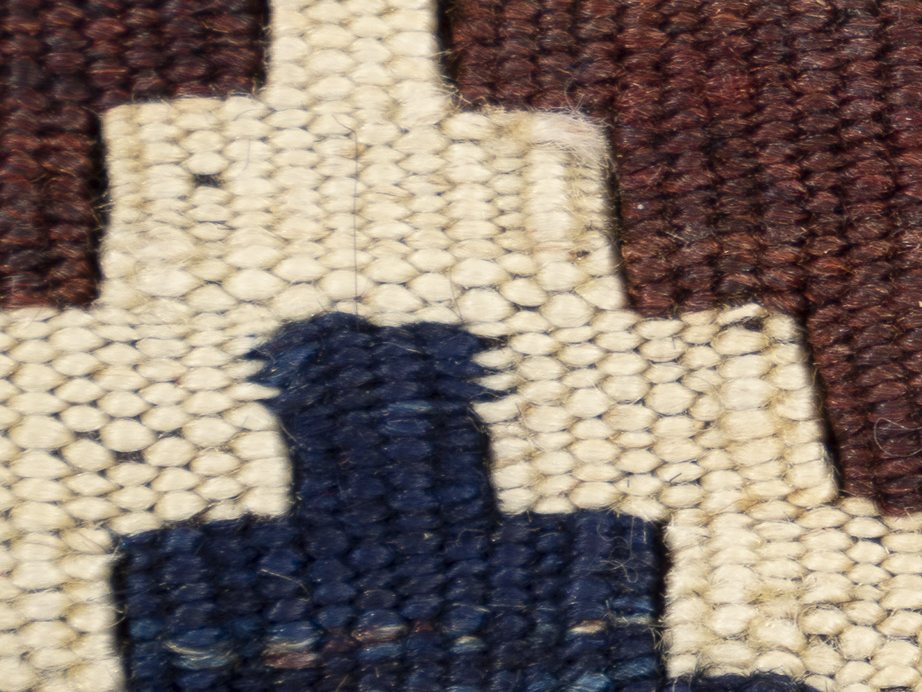
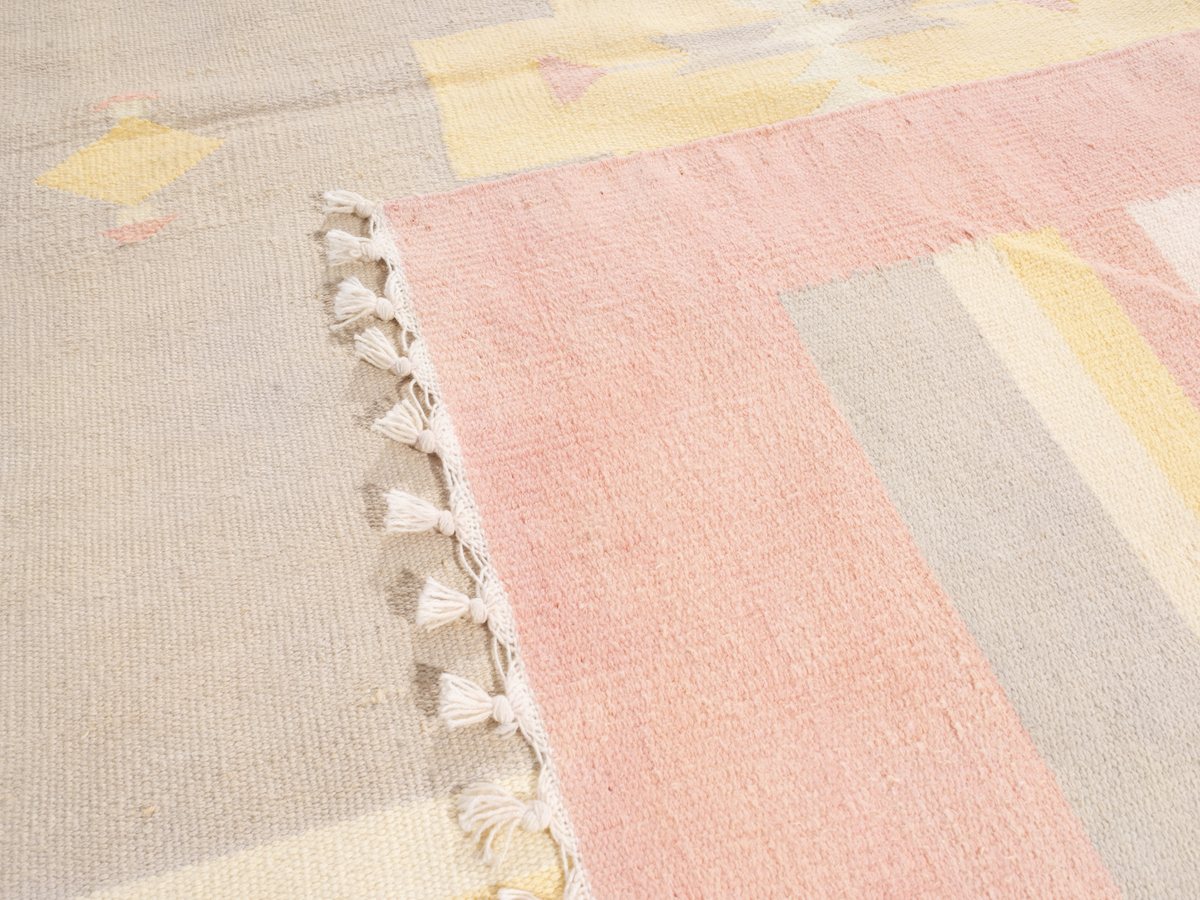
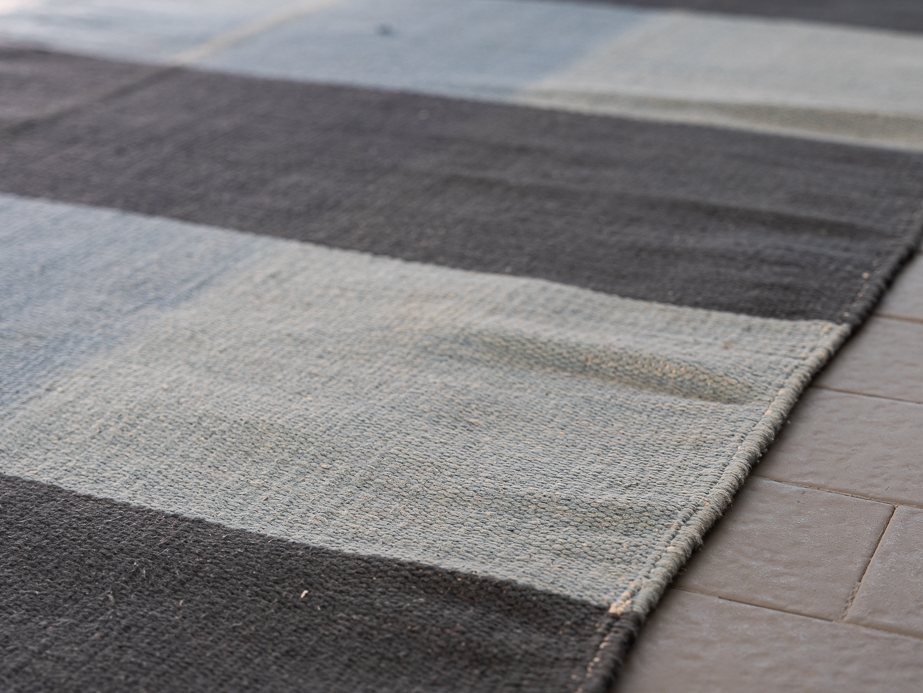
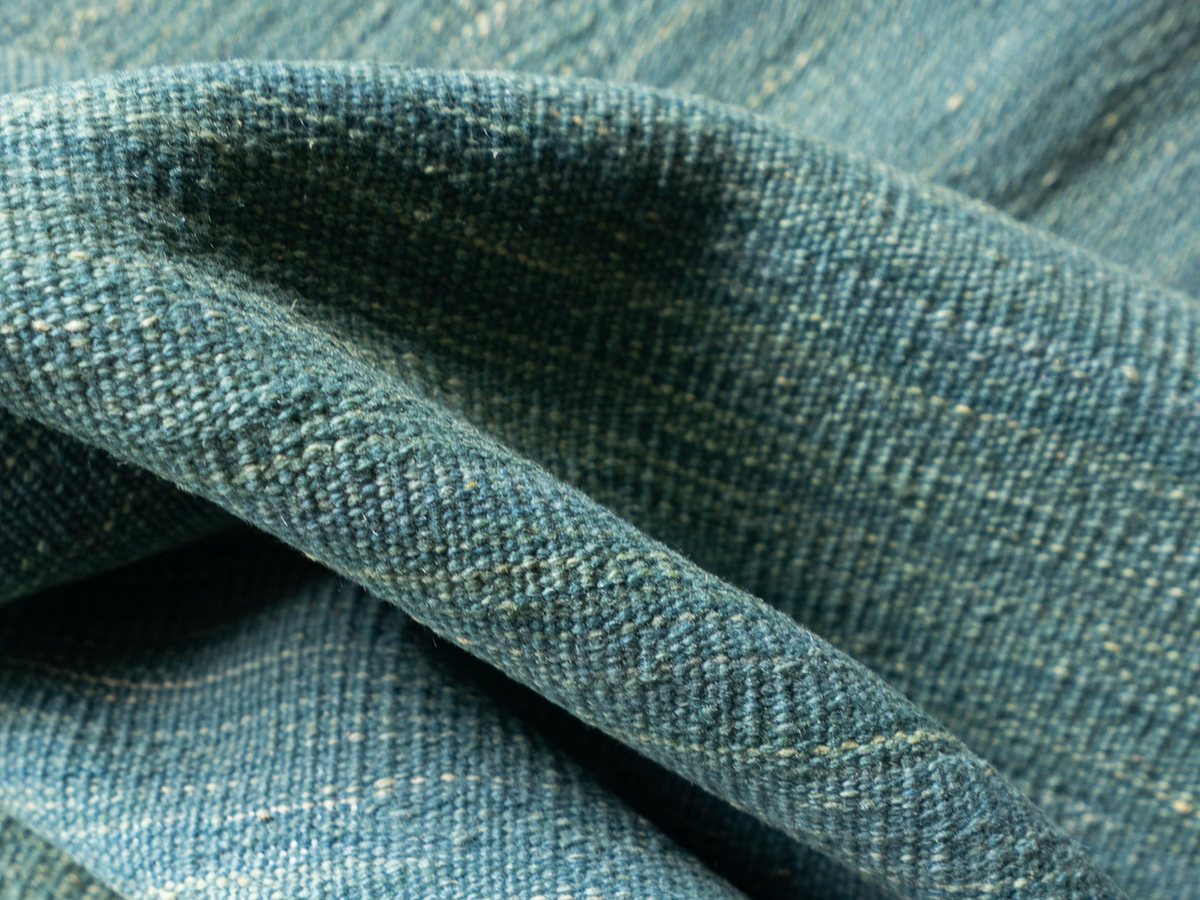
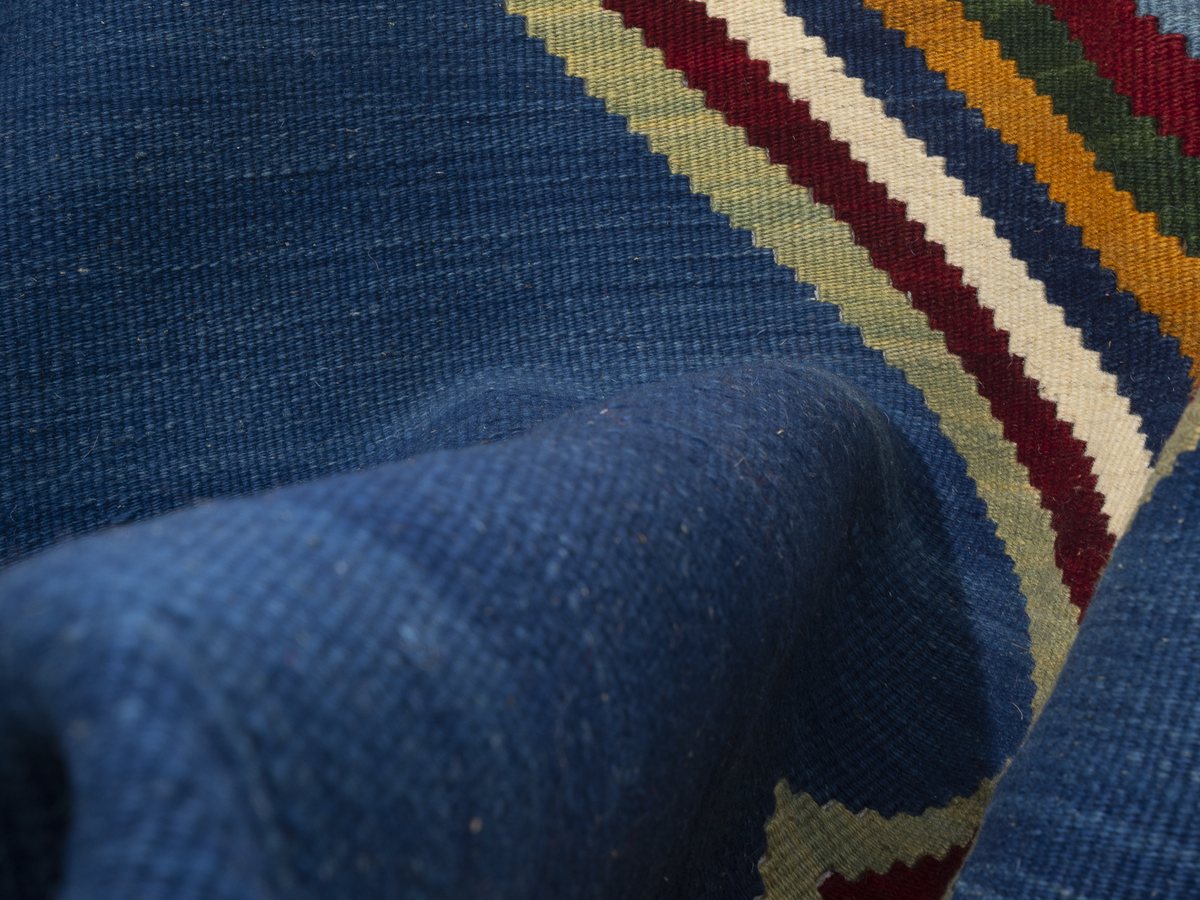
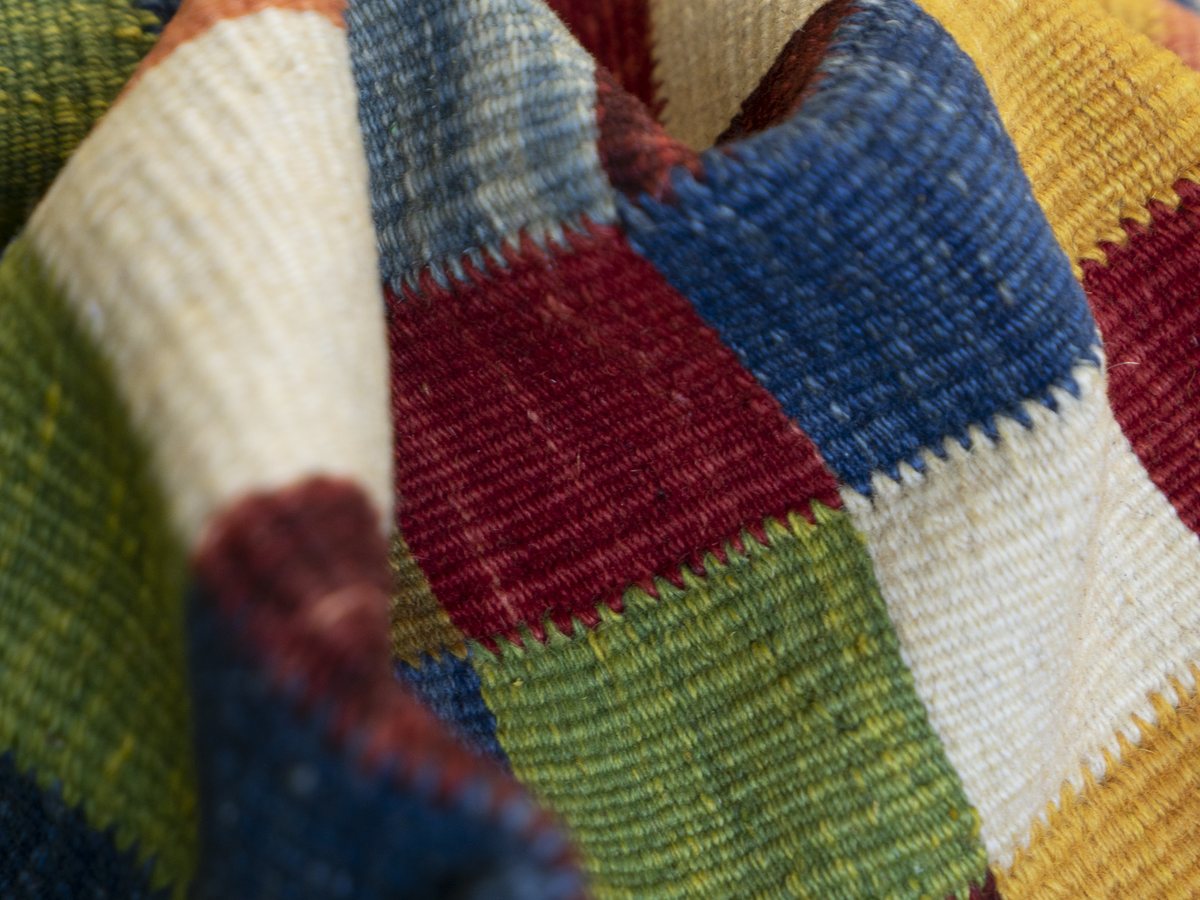
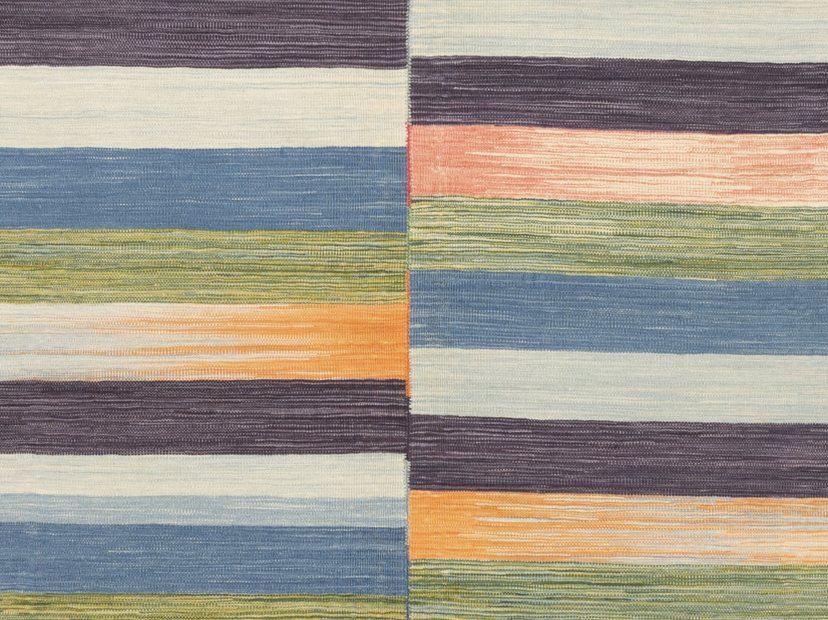
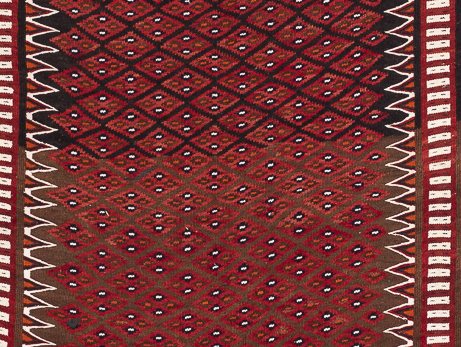
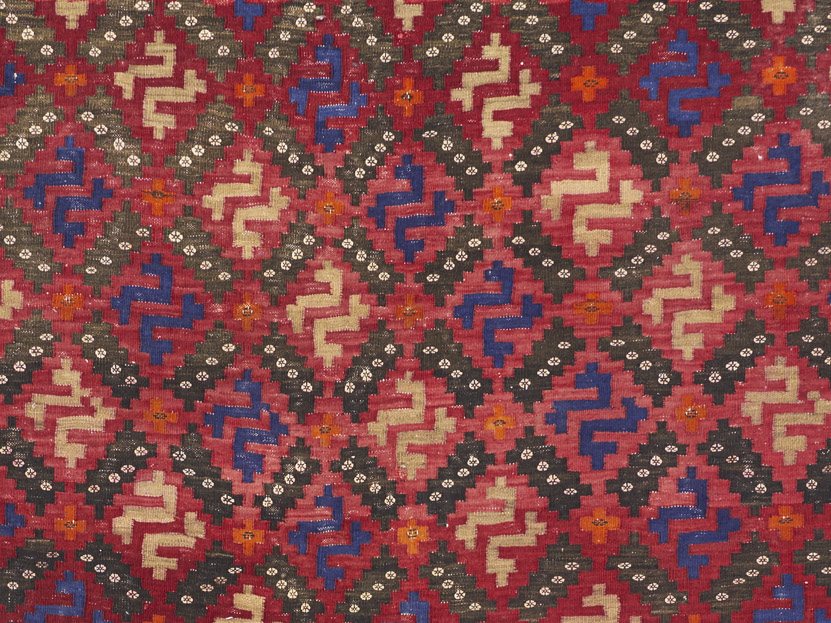
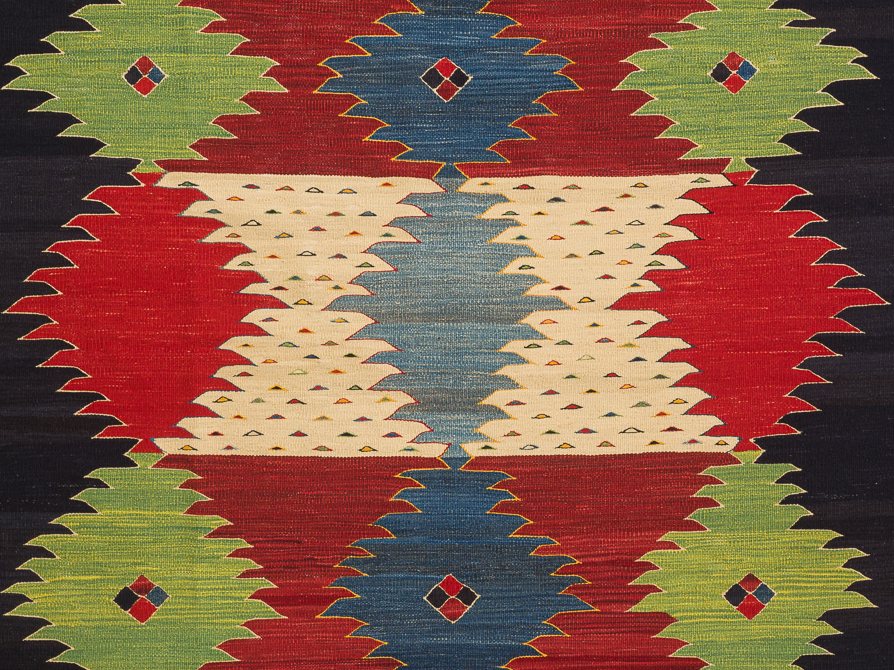
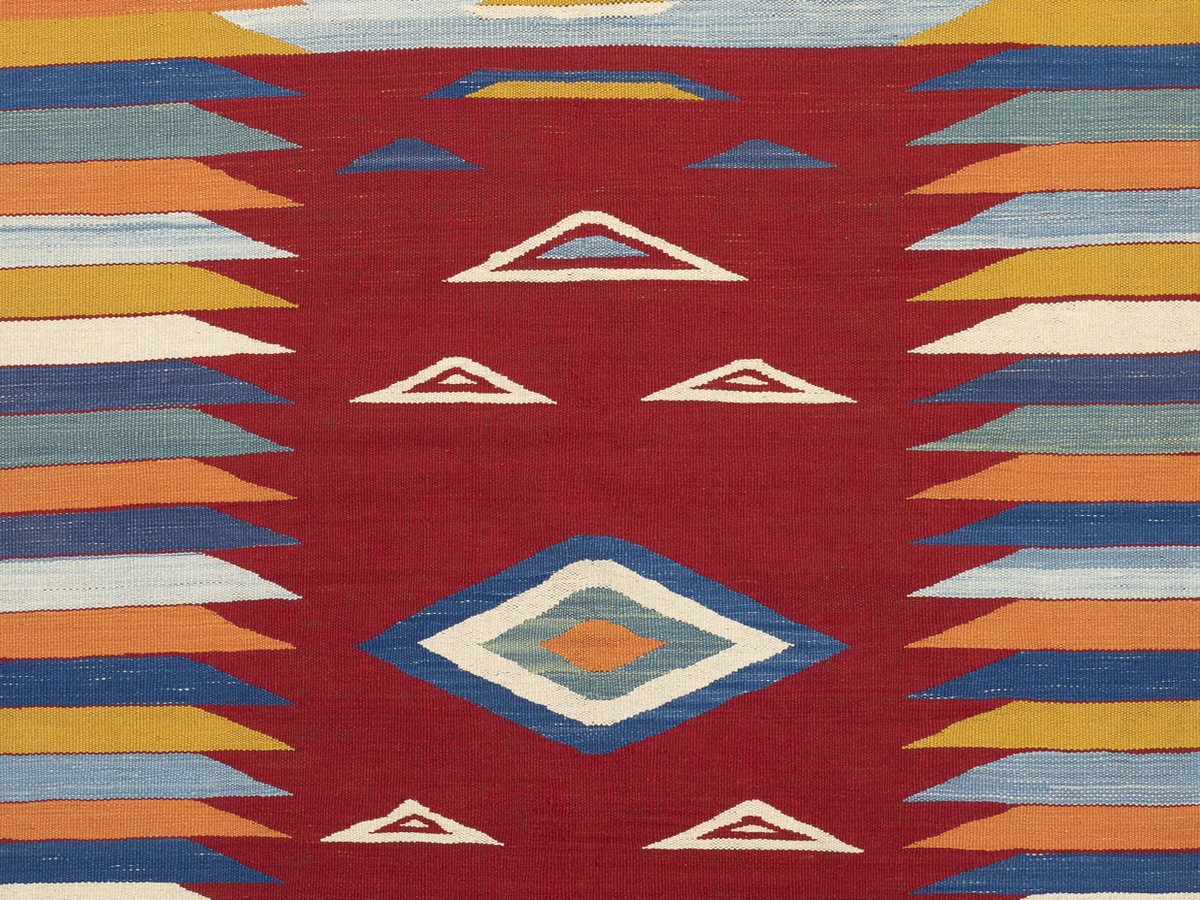
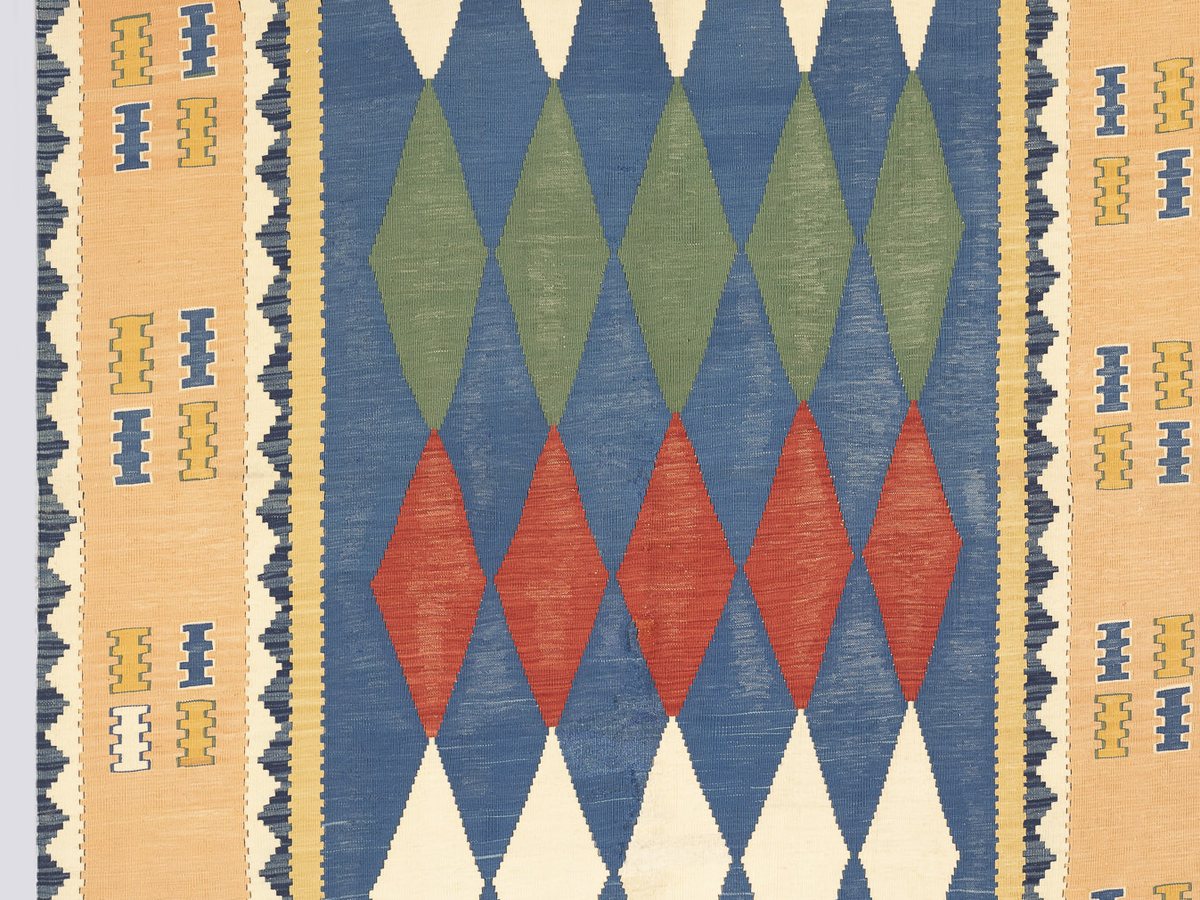
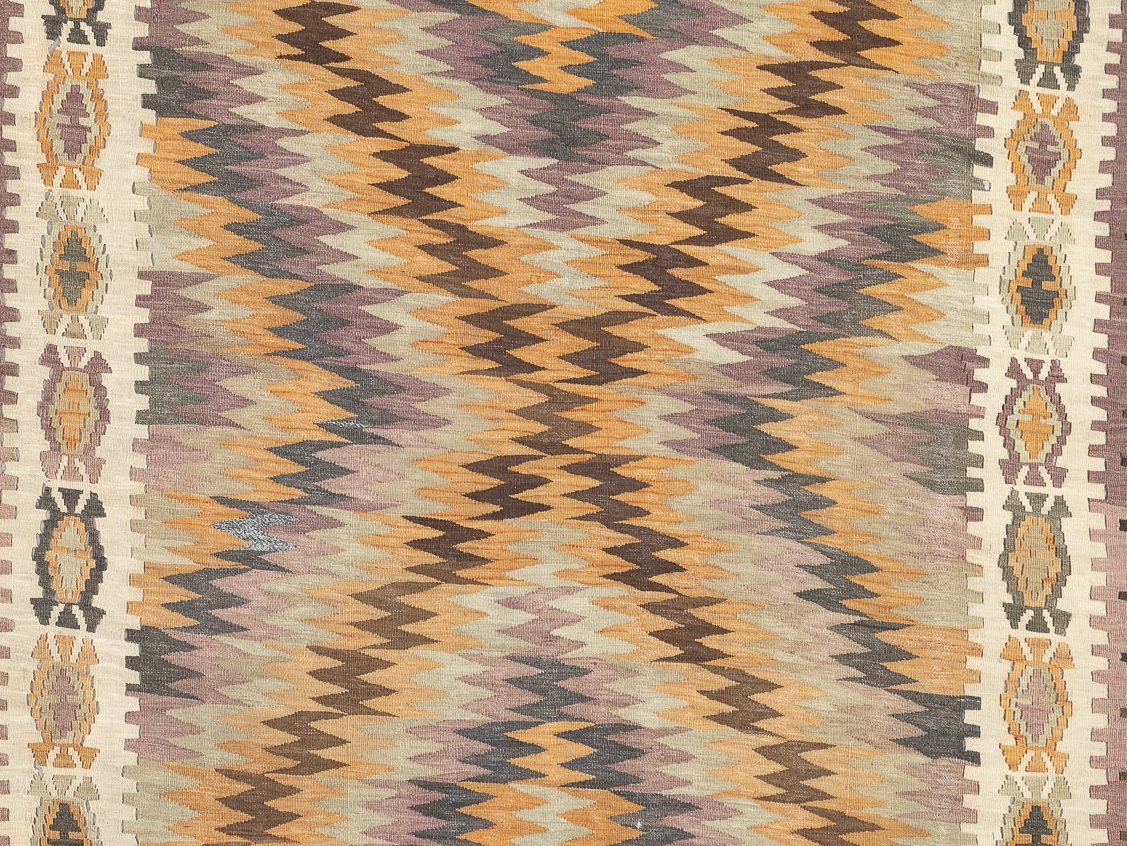
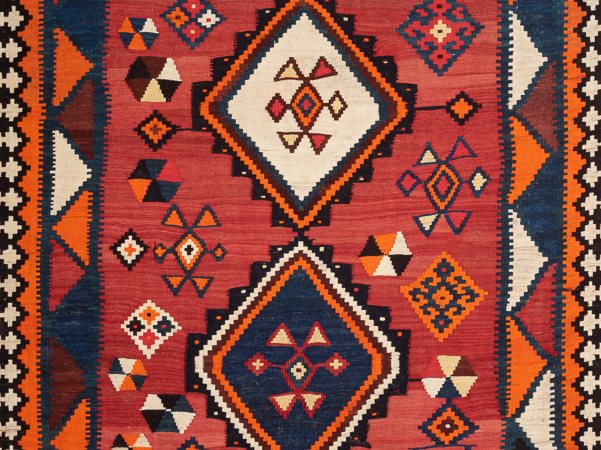
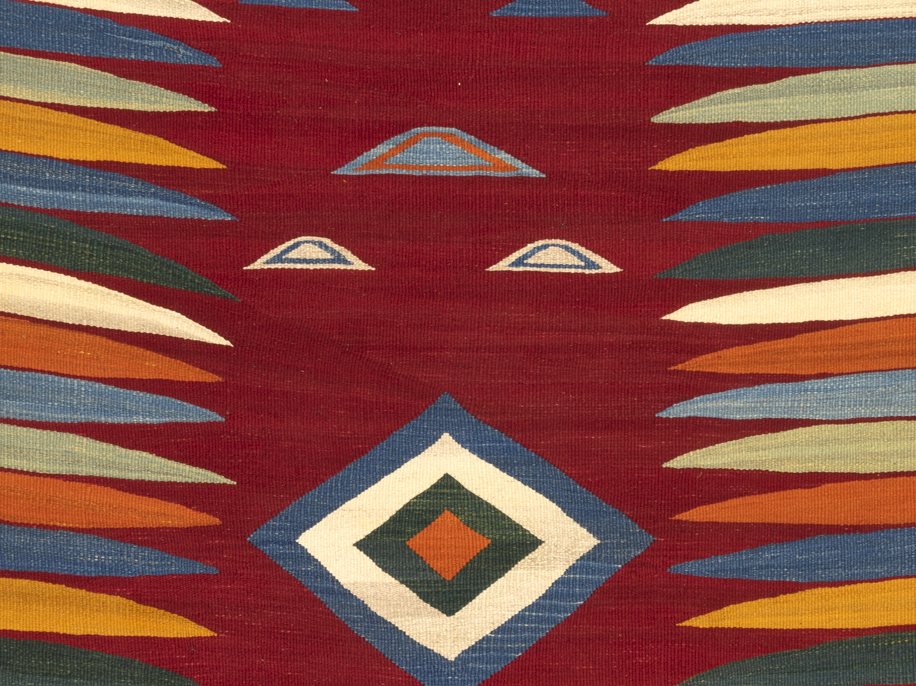
A flatweave in weft-faced plain weave, also called tapestry weave: the wefts are packed so tightly that they hide the warps, and each colour of weft is worked back and forth only where the design needs it. Gelim is the Persian word and kilim the Turkish form used in the trade. Most kilims look the same on both faces.
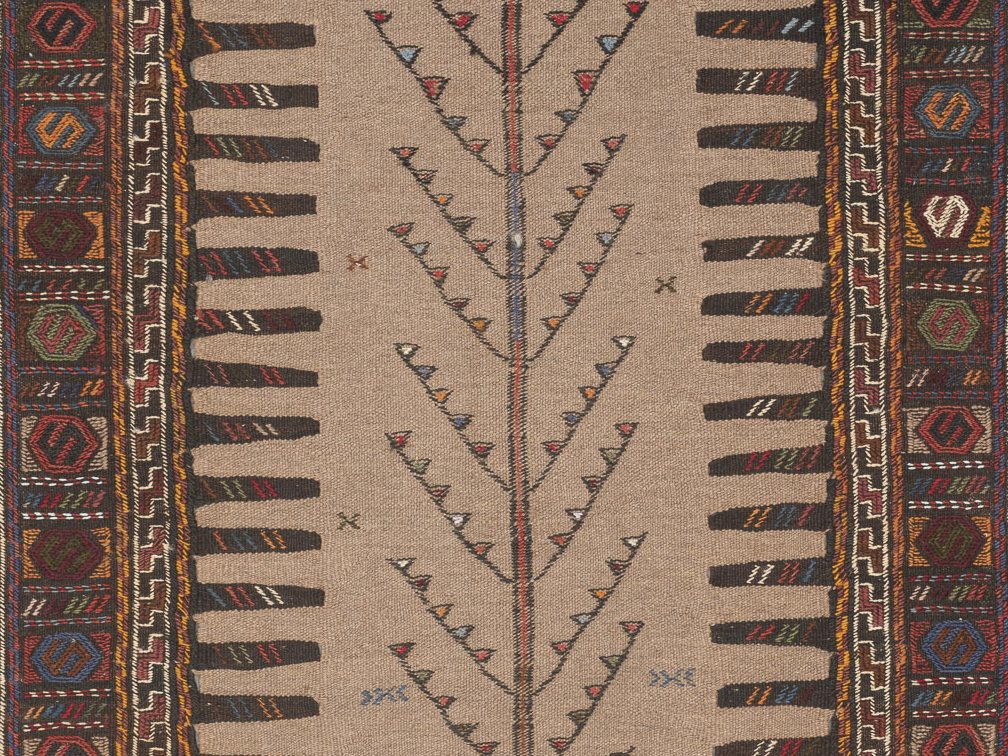
A kilim structure in which two weft colours meeting along a vertical line each turn back around their own last warp, leaving a small slit between them. Long slits weaken the cloth, so weavers avoid long vertical lines and step their outlines instead, which gives slit kilims their crisp, stepped edges.
ALSO SLIT-TAPESTRY WEAVE · SLIT KILIM · SLIT-WOVEN
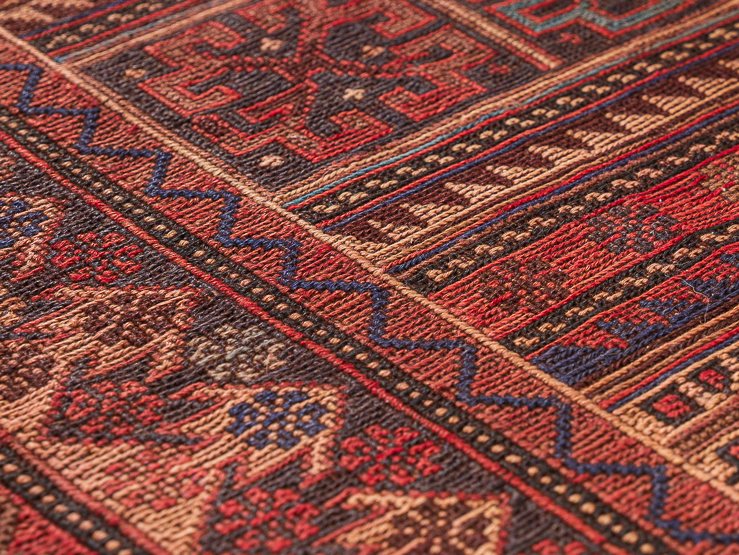
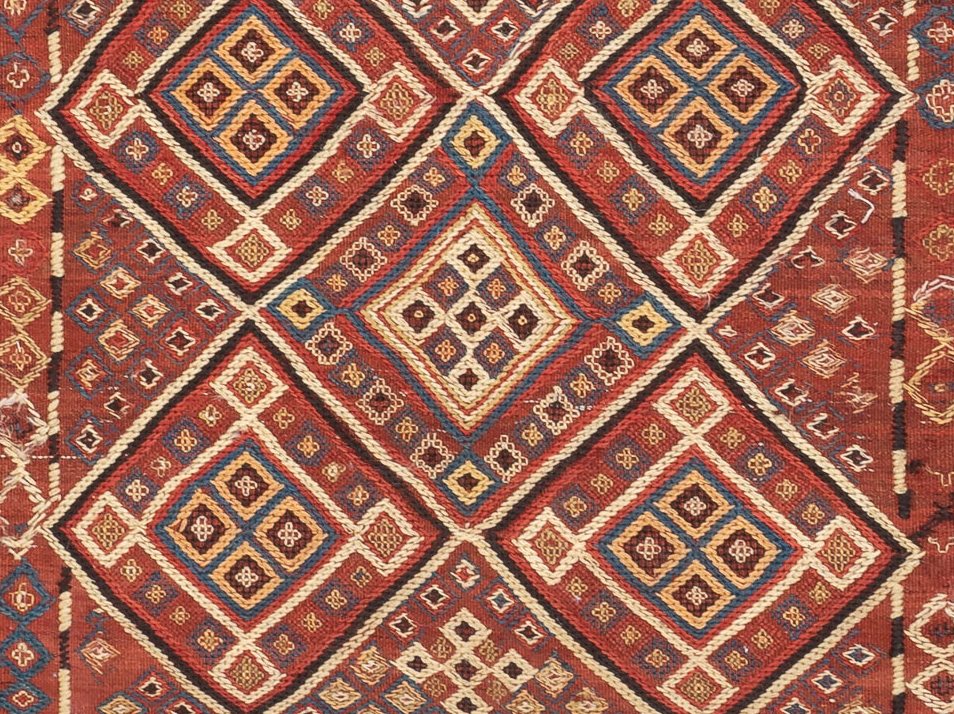
A flatweave built by weft wrapping: a pattern weft is wound forward over several warps and back under fewer, row after row, often with a plain ground weft between the rows. The wraps form slanting stitches across the face; where alternate rows slant opposite ways they make a herringbone, called countered soumak.
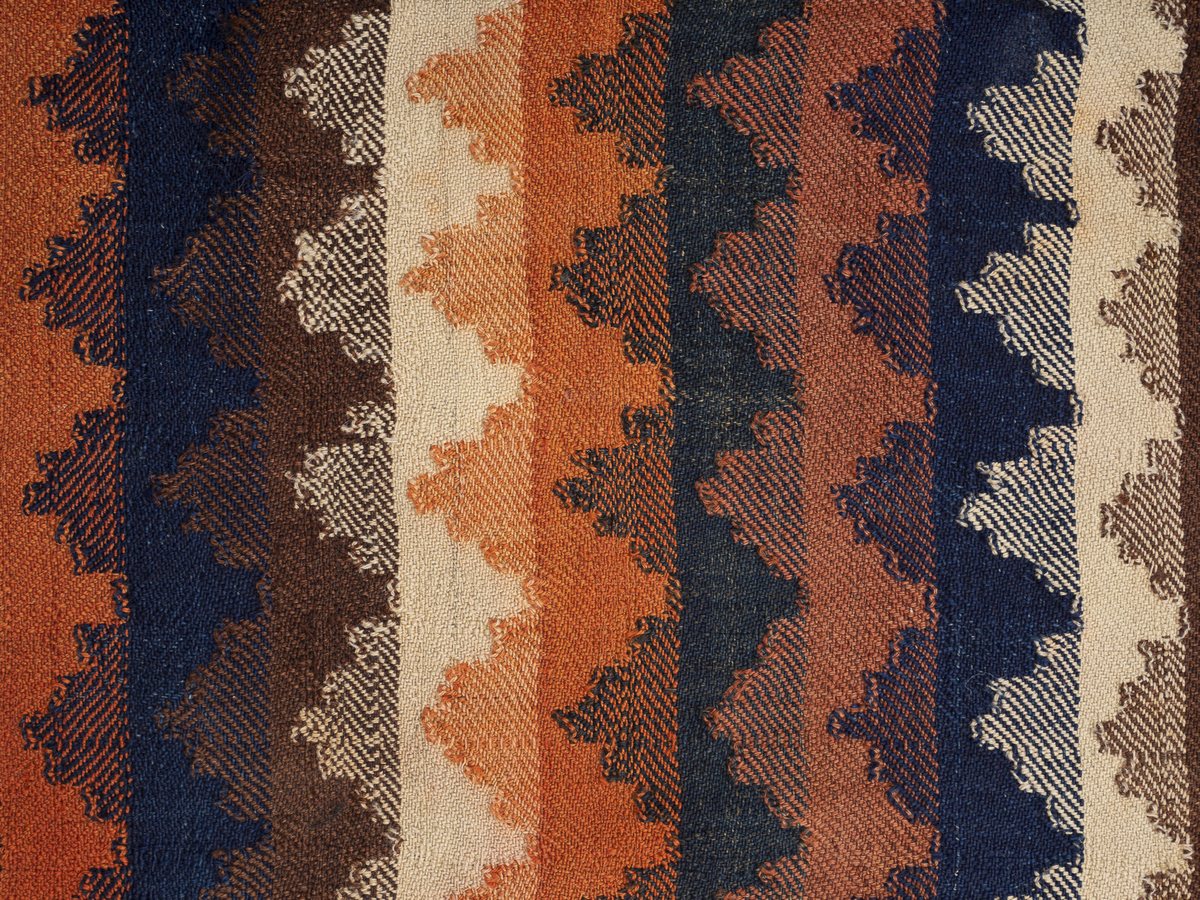
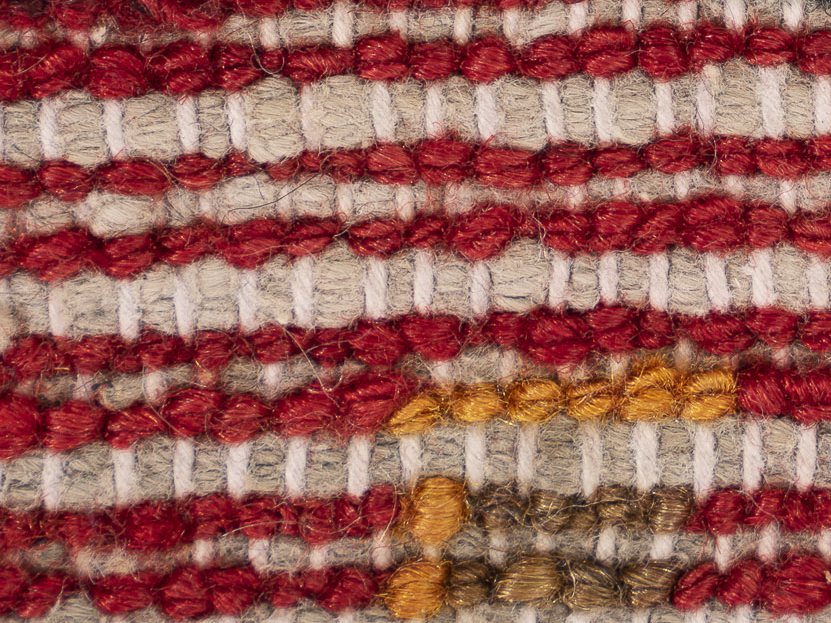
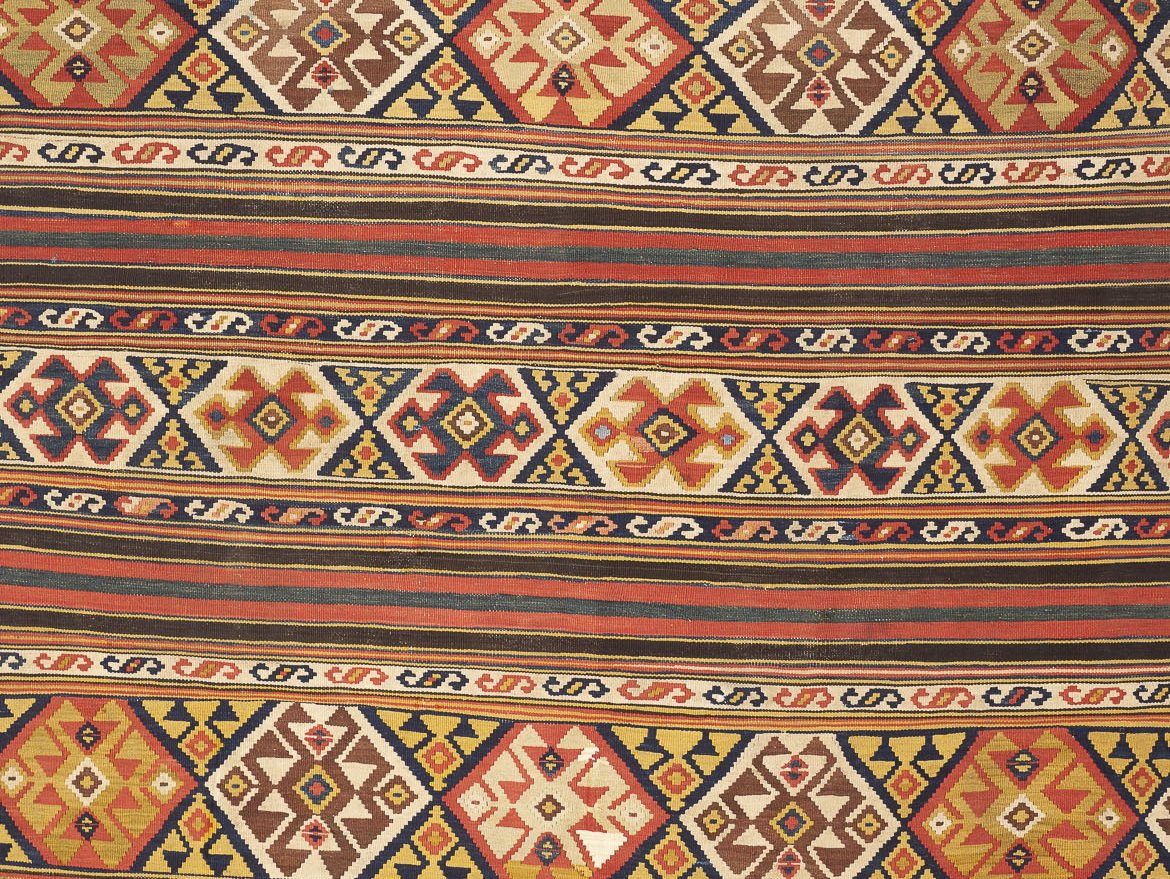
A flatweave in warp-faced plain weave: the warps are packed so closely that they hide the wefts, so the colours run as lengthwise stripes, sometimes enriched with extra pattern wefts floated across the ground. Persian dictionaries describe the jajim as a pileless spread of coloured wool or cotton yarn, thinner than a palas, used as a ground cover and to wrap bedding.
A Persian word for a plain, coarse flatweave. Dehkhoda's dictionary gives it as a thick woollen cloth, a spread like a jajim, and a coarse gelim. In the rug trade the word is also used for Caucasian flatweaves.
A flat-woven cotton floor covering from the Yazd region, above all Meybod and Ardakan. It is woven on a special loom in a compound weave with two sets of warps, so the pattern shows on both faces with the colours reversed. Ziloos have long been laid in mosques and houses, and mosque pieces often carry woven inscriptions and dates.
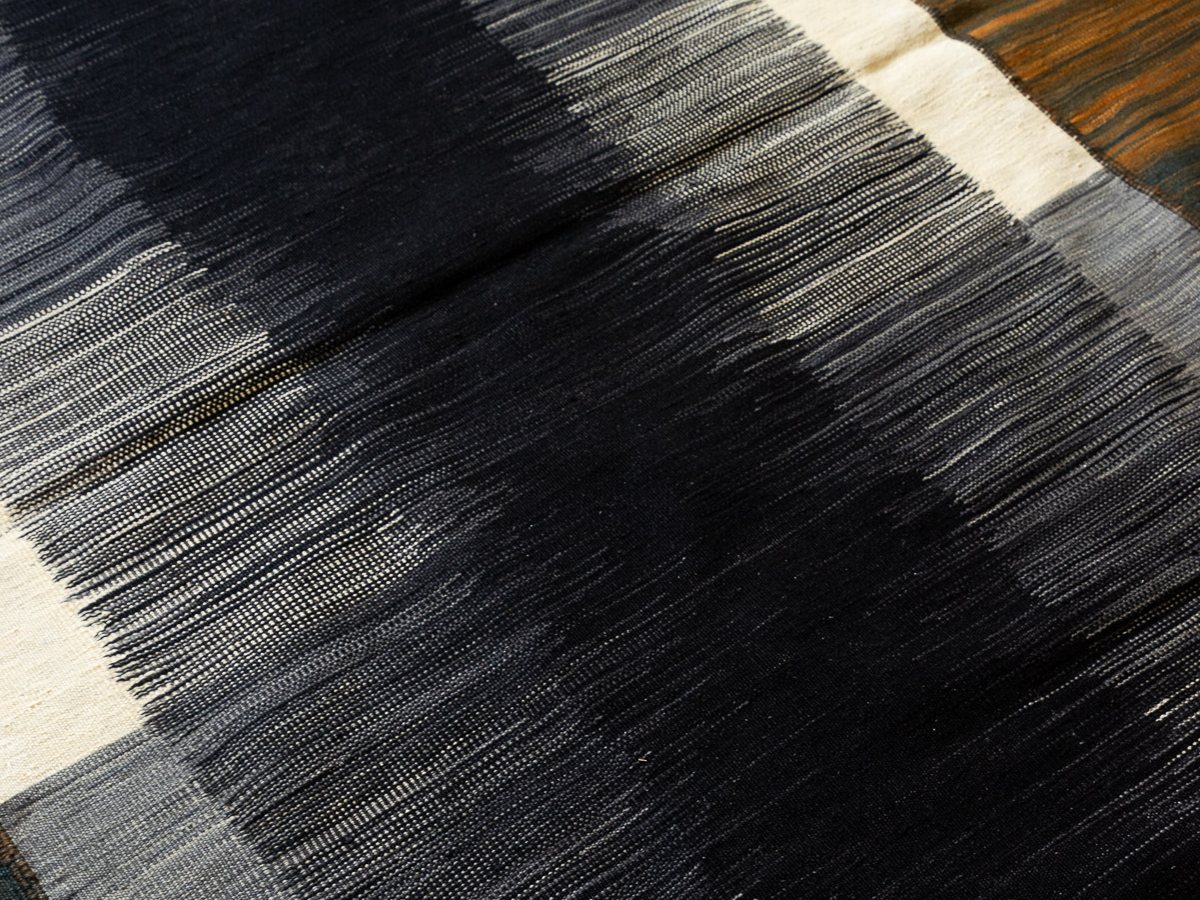
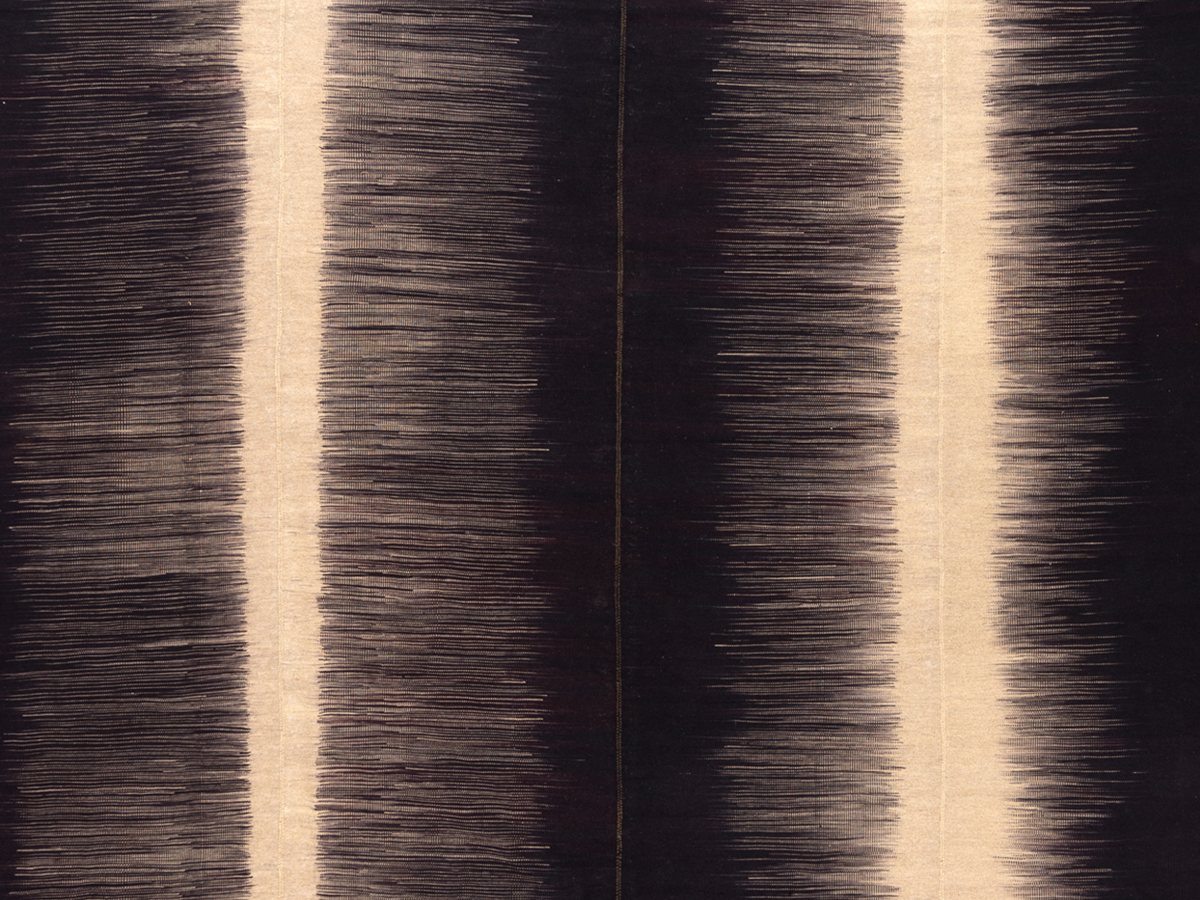
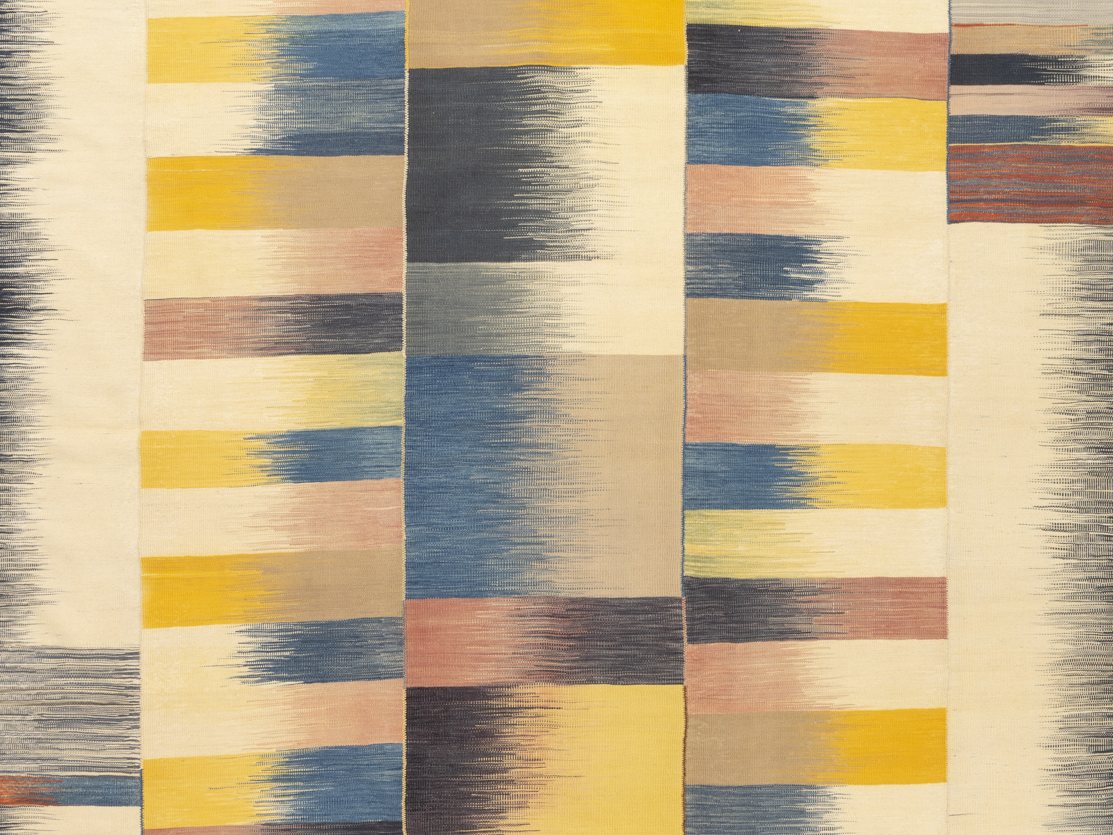
Ikat is a resist-dyeing technique: bundles of warp or weft yarn are tied and dyed before weaving, so the pattern is already in the yarn when it goes on the loom. In our listings, ikat names the blurred, feathered banding of some New Weave Mazandaran kilims, the look of ikat cloth.
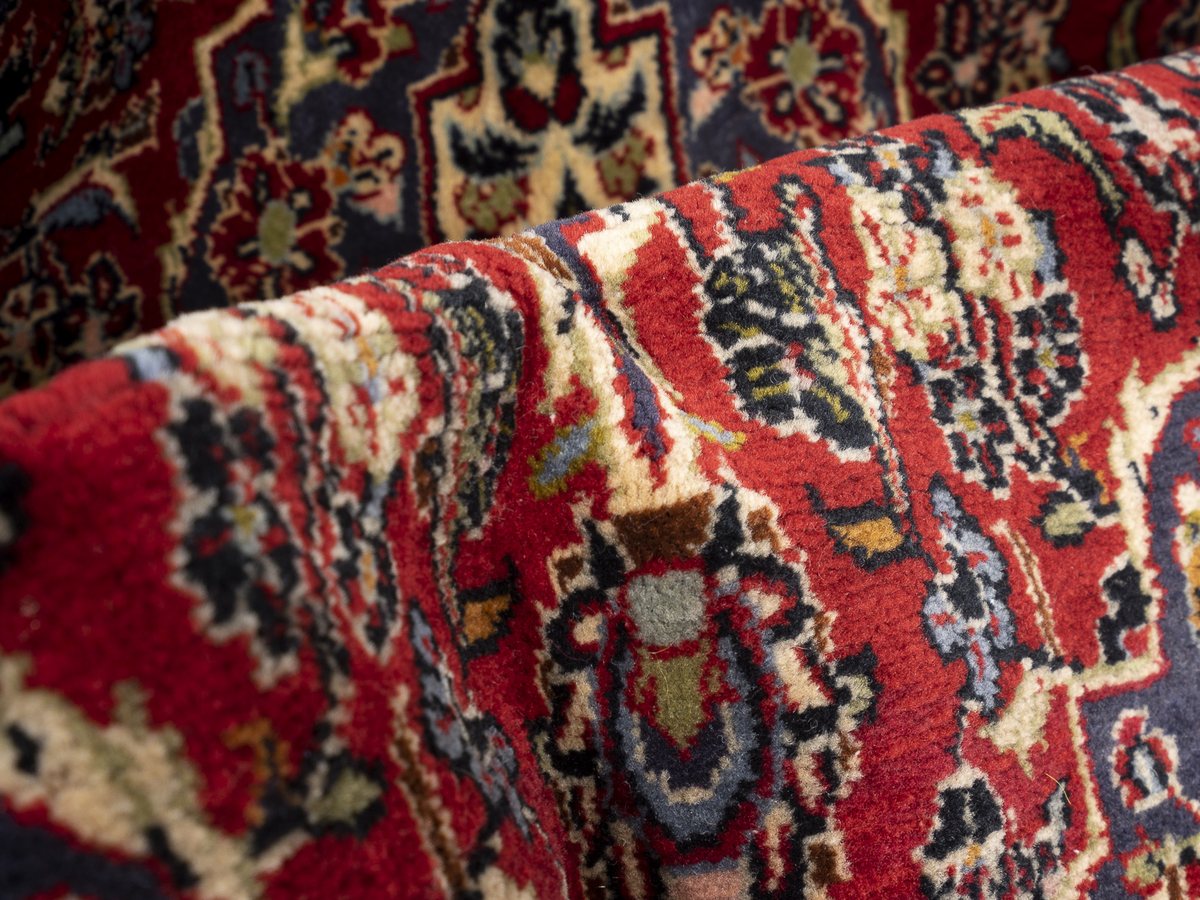
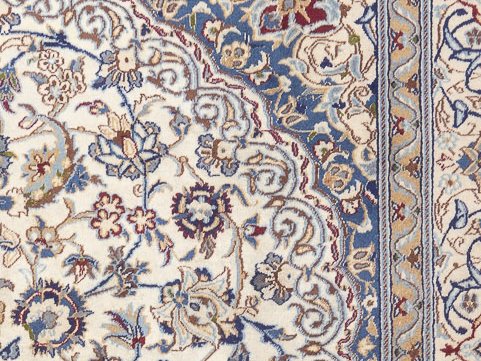
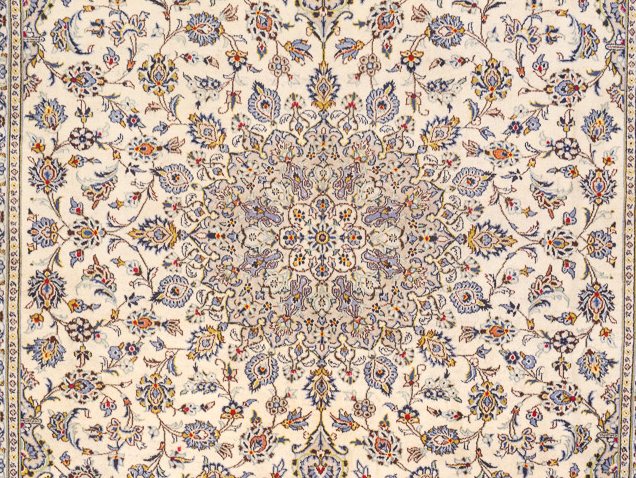
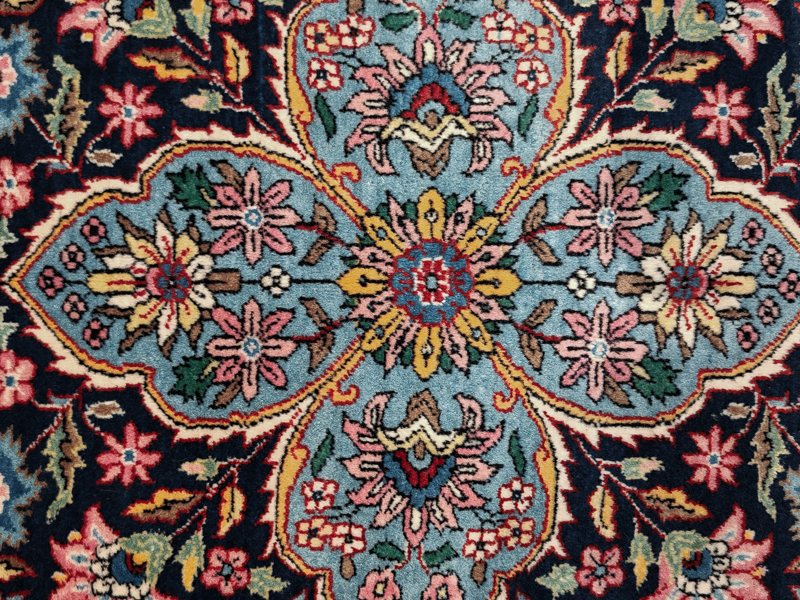
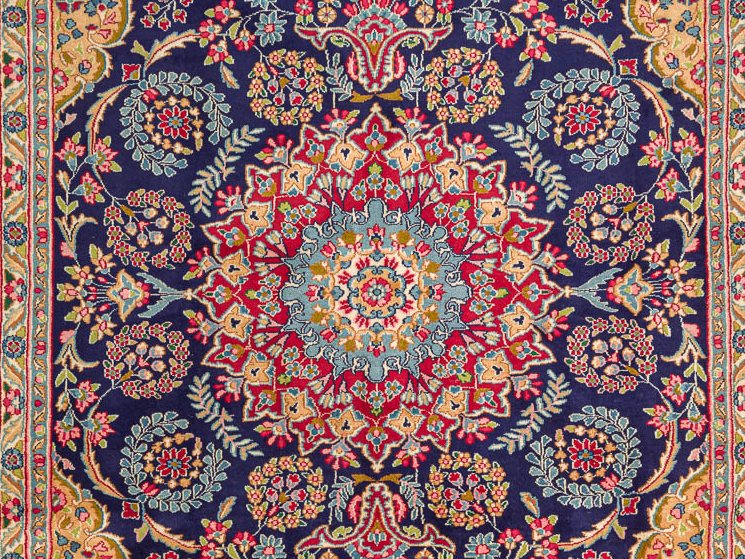
A city rug, or workshop rug, is woven to a designer's cartoon for a town-based maker or merchant, either in a town workshop or on contract in homes and villages around the town. City rugs are usually finely knotted, with floral designs, on cotton warps, which hold their shape better than wool. Kashan, Kerman, Isfahan, Tabriz and Mashhad are among the cities whose names they carry.
ALSO CITY CARPET · WORKSHOP CARPET · TOWN RUG · URBAN RUG · URBAN CARPET · CITY WEAVE
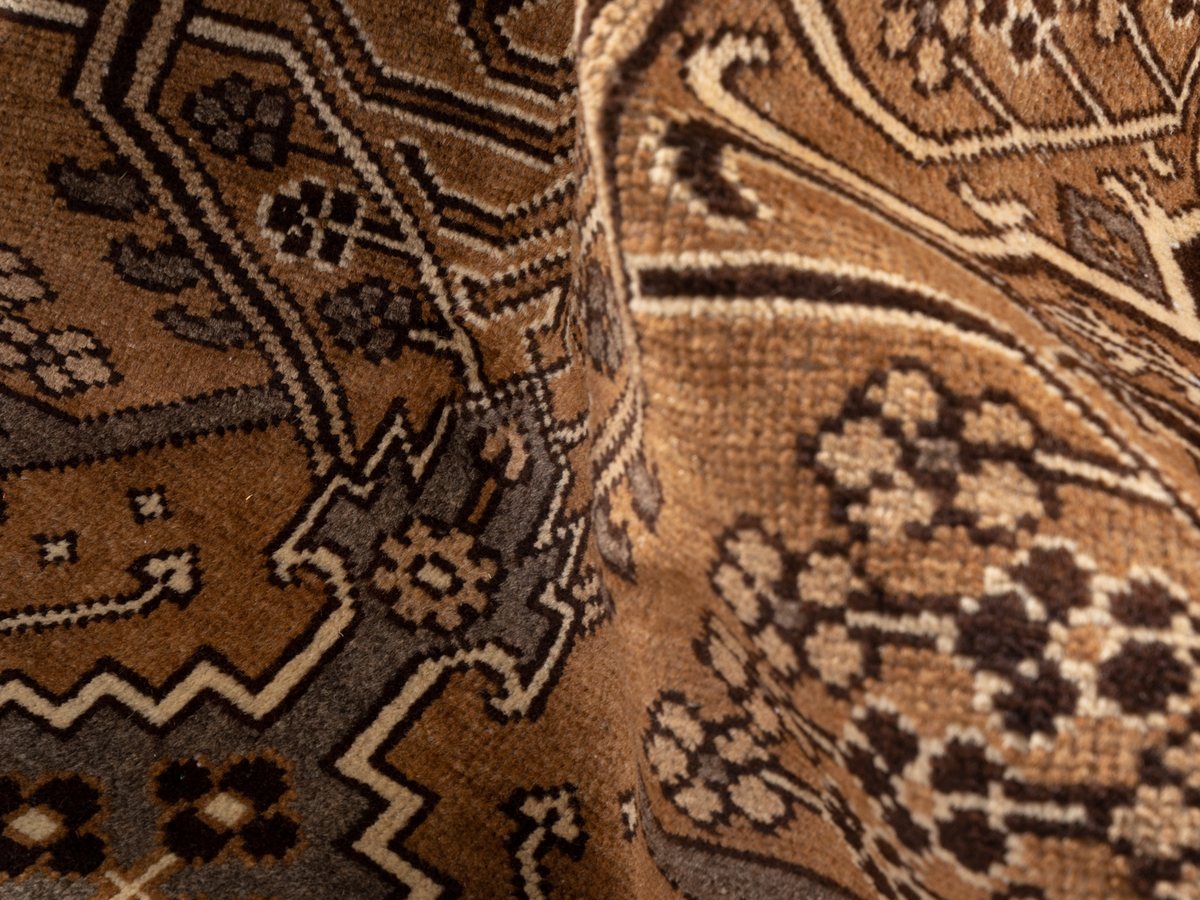
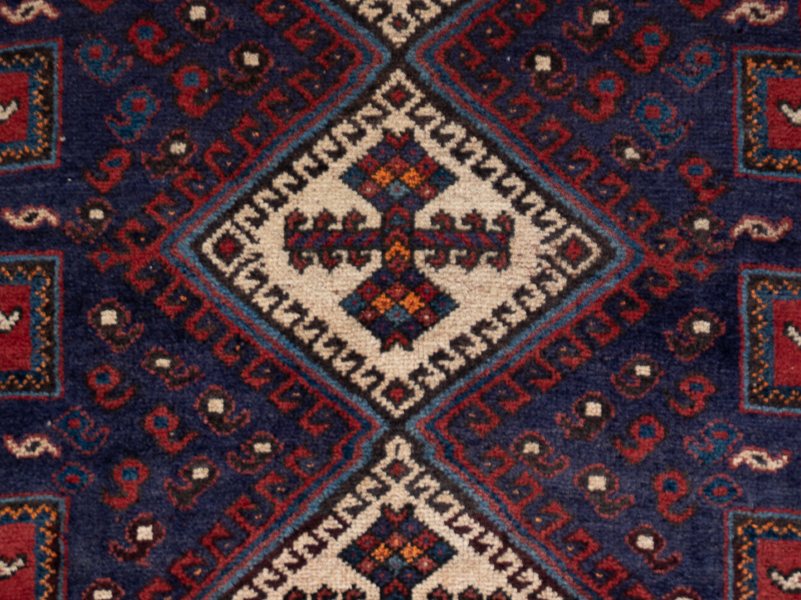
A village rug is woven by settled villagers, usually at a vertical loom fixed in place. Many village rugs are traditional designs woven without a drawn pattern, though villages near the weaving towns also weave to merchants' cartoons. A single label can cover both village and nomadic work: the Met notes that large Bakhtiari pile carpets are mainly village work, while Bakhtiari bags are woven by nomads.
ALSO VILLAGE CARPET · VILLAGE WEAVING · RURAL RUG · COTTAGE RUG
A tribal rug belongs to the weaving traditions of a tribal community. Its weavers may be nomadic, semi-nomadic or settled. Nomadic describes a way of life, so the two terms are not exact synonyms. Rugs, bags, covers and animal trappings can belong to the same weaving tradition.
A Persian rug is a rug woven in Iran, historically called Persia. The name describes its geographical origin. Persian weaving includes many regional and community traditions, with both knotted pile rugs and flatweaves. A design alone does not establish where a rug was woven.
Persian-design describes a rug whose pattern draws on Persian weaving traditions. Rugs with these designs are also made outside Iran. The design description and the stated place of manufacture answer different questions, so both should be read when identifying a piece.
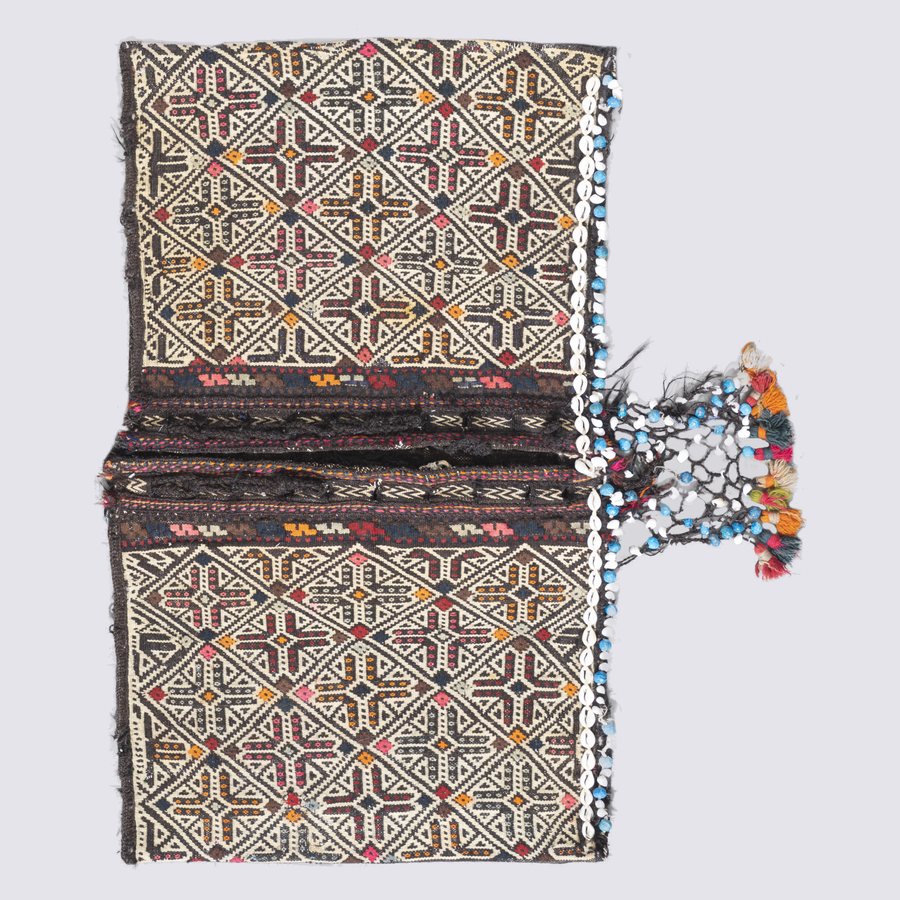
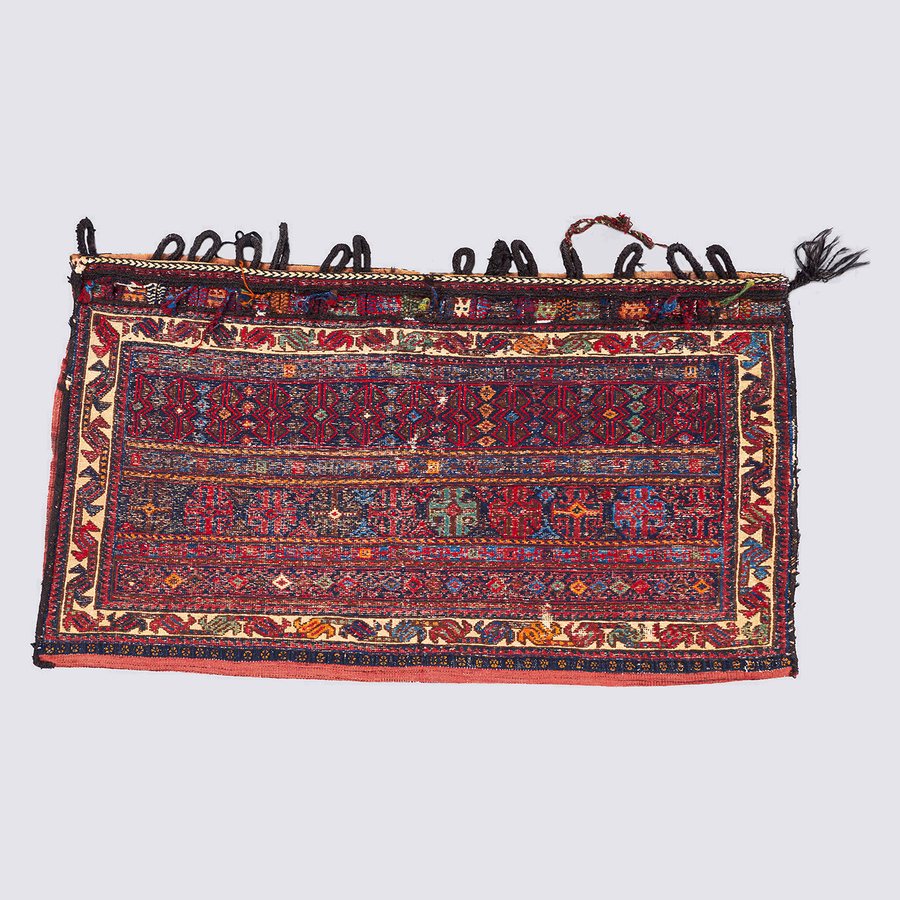
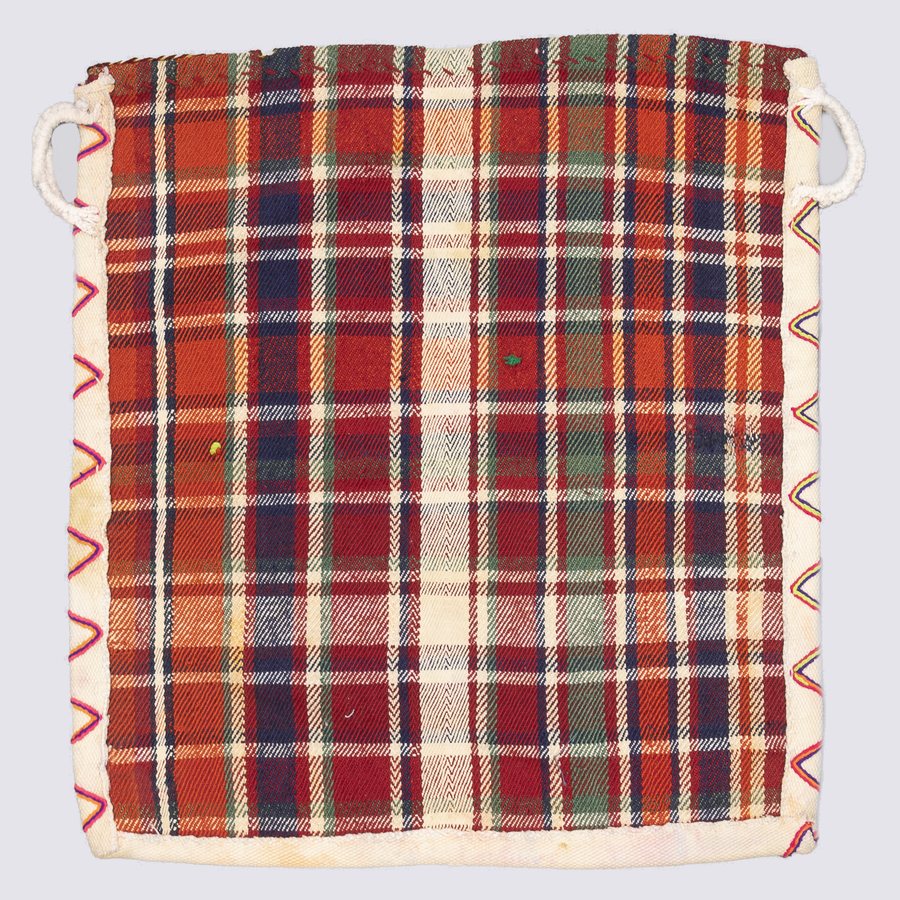
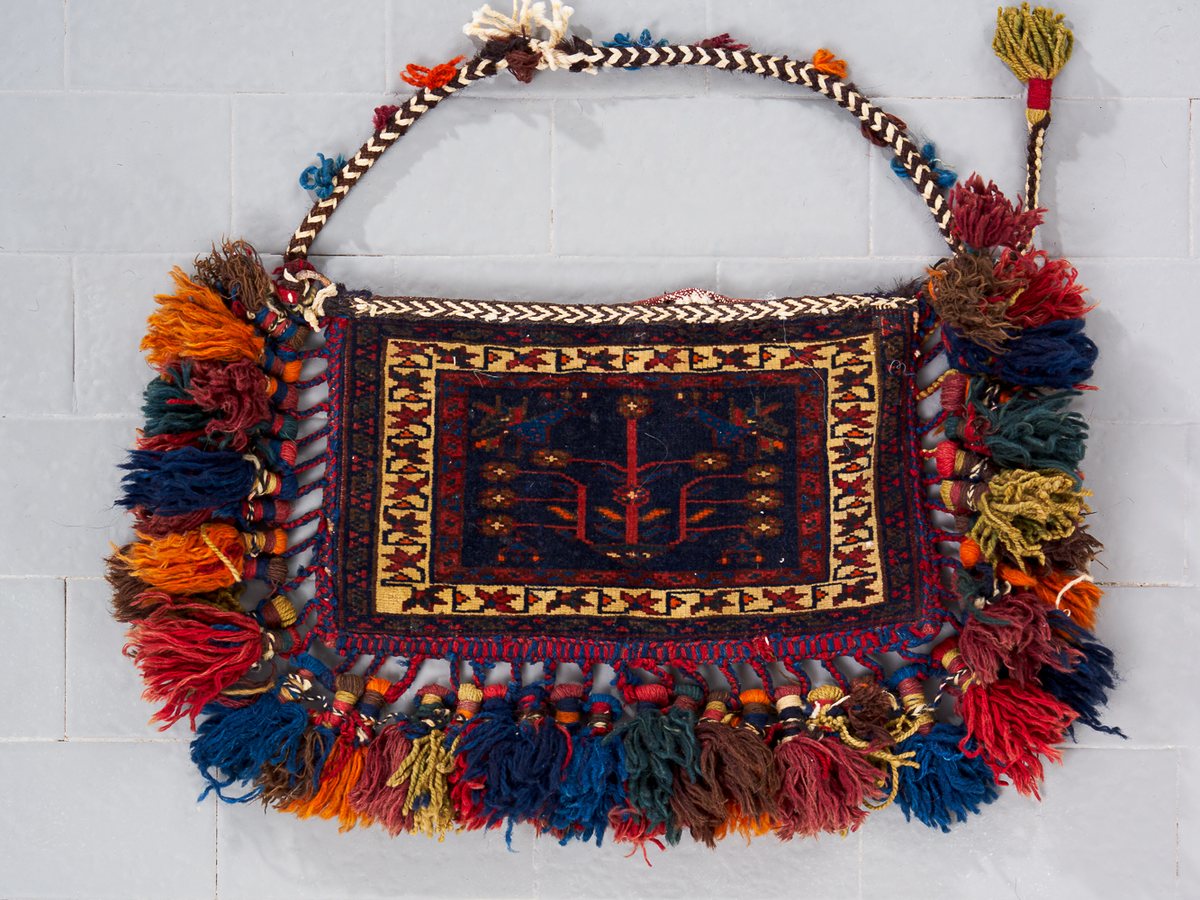
A double bag: two pouches joined by a band so the pair can hang either side of a horse, mule or camel. Dehkhoda defines it as two sacks joined at one side. The two faces are usually the decorated part, in pile, soumak or kilim, while the backs are plainer weave.
ALSO KHURJIN · KHORDJIN · KHURJEEN · KHORJEEN · DOUBLE SADDLEBAG · DOUBLE BAG
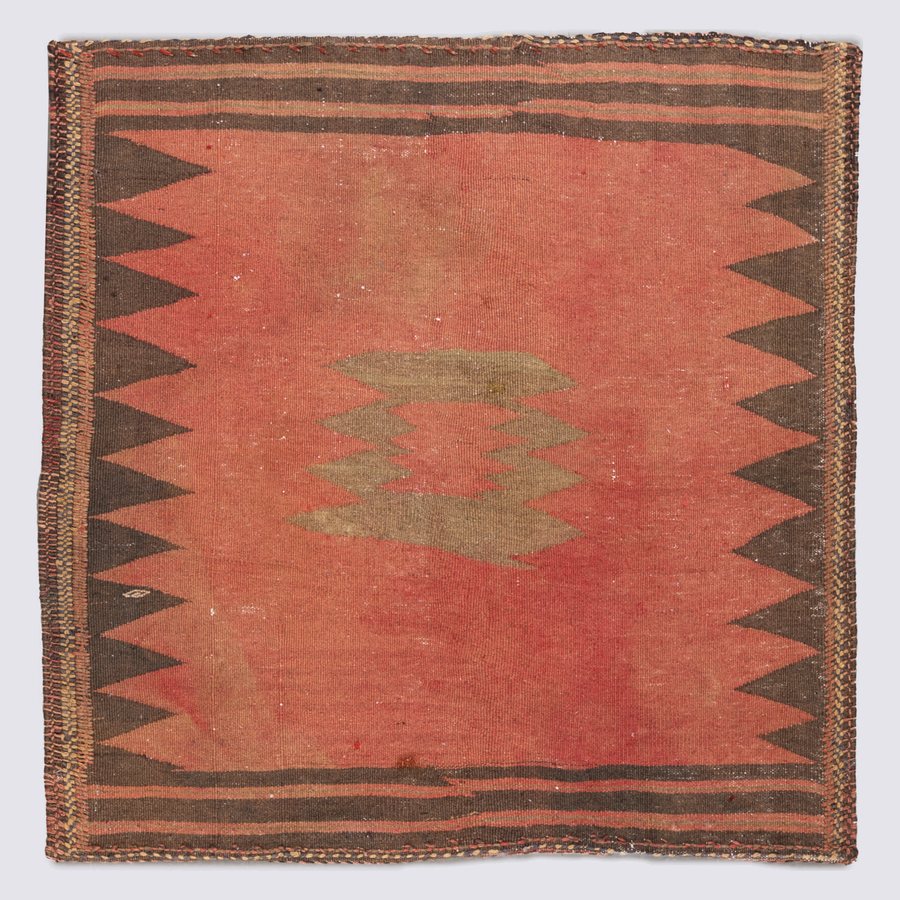
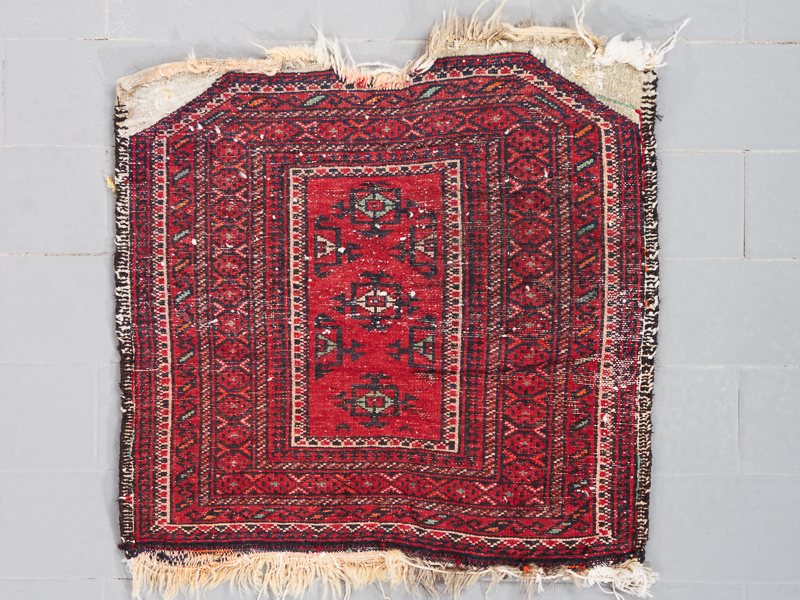
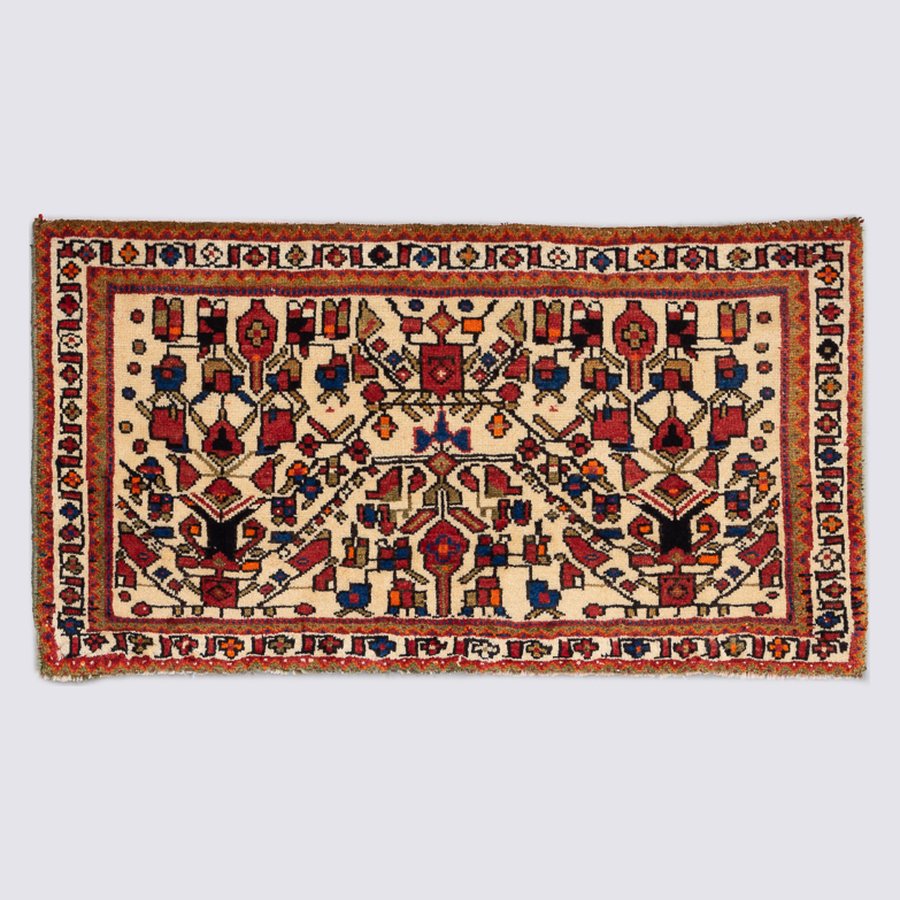
The decorated front panel of a woven bag, shown without the rest of the bag. On most tribal bags the design is on the face, in pile or soumak, while the back is plain weave, so a face may be one half of a khorjin or the front of a single bag.
ALSO SADDLEBAG FACE · KHORJIN FACE · TACHEH FACE · TOUBREH FACE · OPENED BAG
A small bag or pouch for personal things. Dehkhoda's dictionary describes the chanteh as a dervish's bag, often made from a piece of rug sewn into a pouch, edged with leather and hung from the neck.
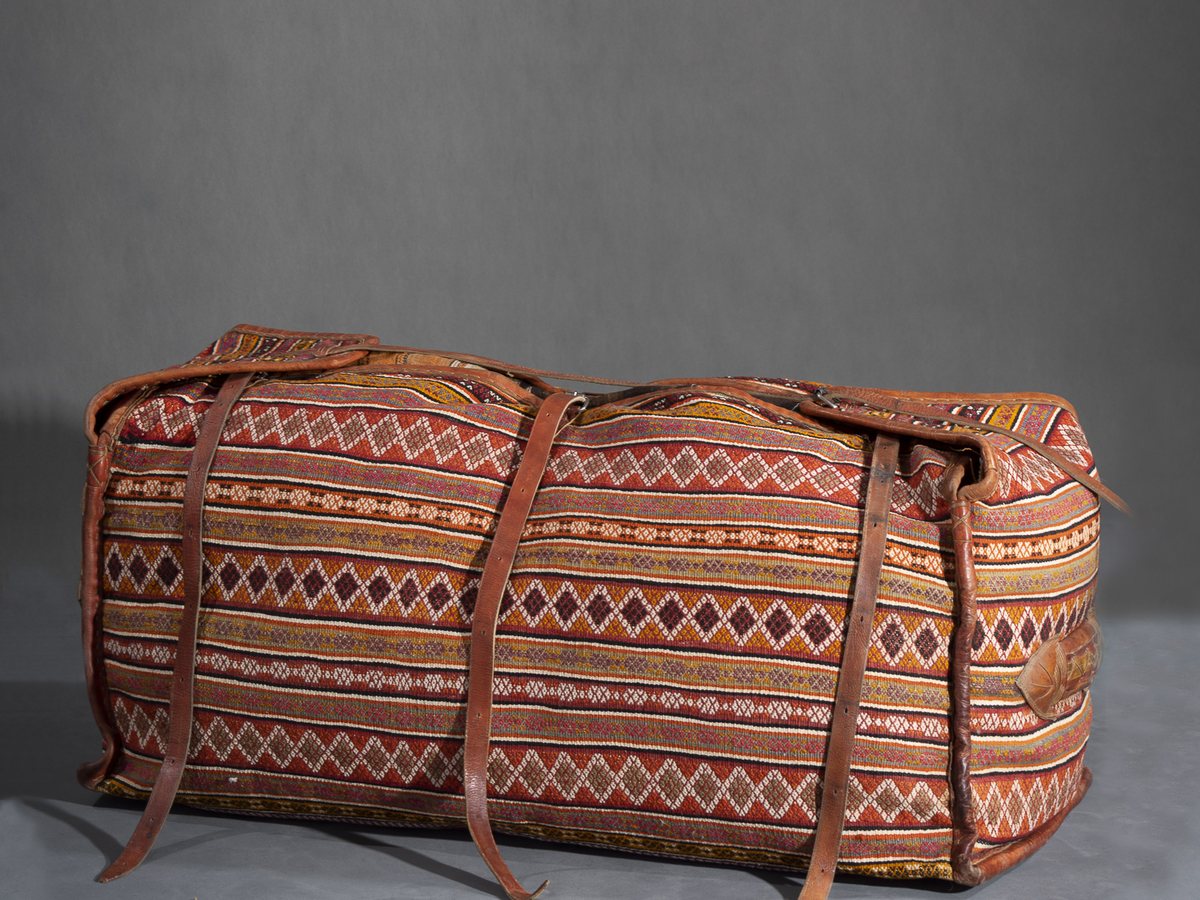
A large box-shaped bag for quilts, blankets and other bedding, made of four woven panels sewn to a plain-woven base. It is a transport pack, loaded on animals during migration. The Shahsavan of north-west Persia are best known for them, usually patterned in soumak. Turkmen use the same word for a much smaller bag.
ALSO MAFRACHE · MAFRASCH · MAFTASH · BLANKET BOX · BEDDING BAG
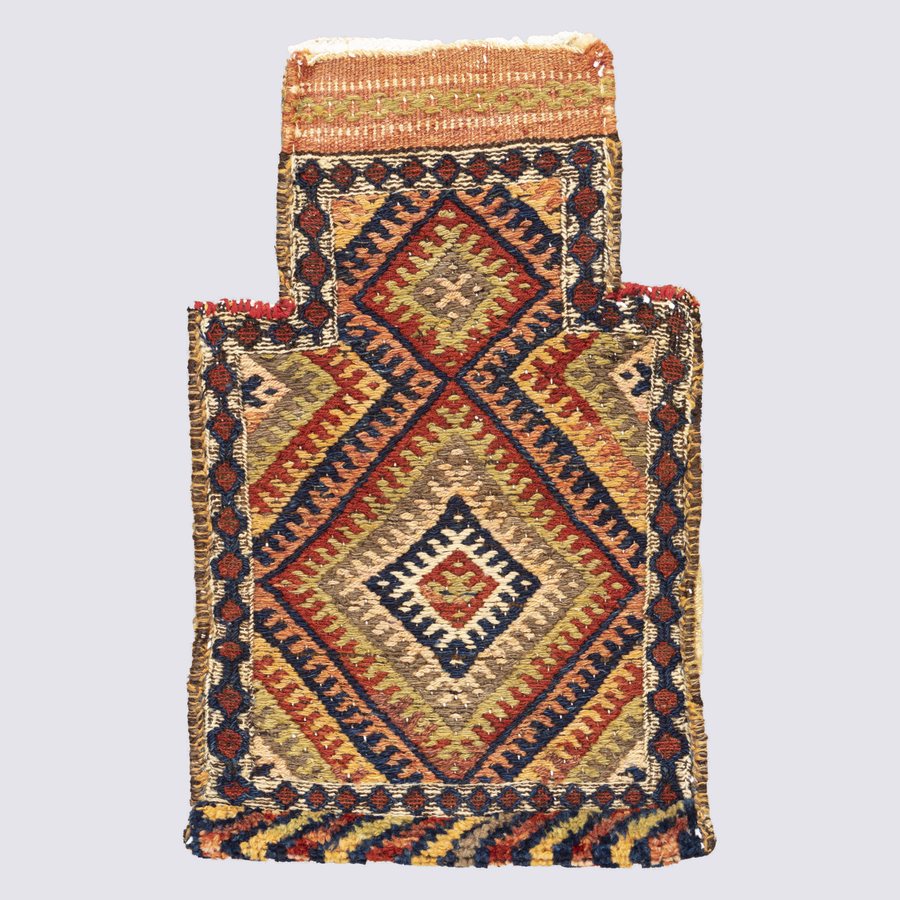
A woven bag of distinctive shape used by nomads and villagers to keep salt, an essential staple; similar bags held other foods. The face is often in pile or soumak. In Persian, namakdan means any salt container.
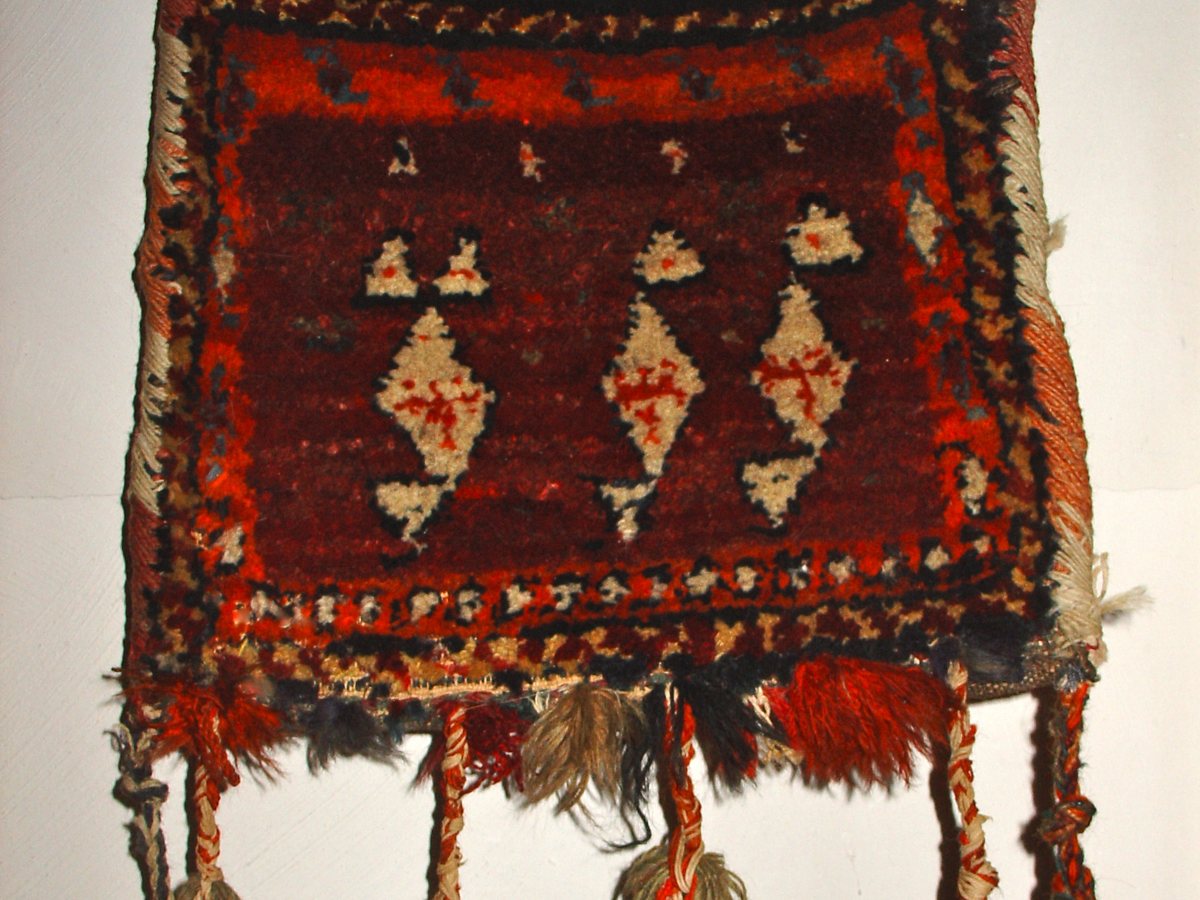
A Persian word for a sack, first of all the feed bag hung from a horse's or mule's head; Dehkhoda also lists the hunter's bag. In rugs, toubreh is used for medium-sized woven storage bags; the Turkmen name for a similar bag is torba.
ALSO TOBREH · TUBREH · TORBA · TORBEH · NOSE BAG · FEED BAG
A sack that makes one side of a pack load: Dehkhoda gives tacheh as a small sack or half-load, one side of a khorjin. In rugs the word names the large grain and flour bags of the Bakhtiari villages of Chahar Mahal, west of Isfahan.
ALSO TAACHE · TACHEH FACE · TACHEH KILIM · TACHEH RUNNER · GRAIN BAG · FLOUR BAG
A javal is a large woven sack. Dehkhoda's dictionary defines it as a container woven from wool to hold goods, and Amid's as a large bag of thick yarn or coarse cloth made for carrying loads. A study of Qashqai weaving lists the javal among the bags the Qashqai weave. Our Javal cushions are whole javals made up as cushions.
A cloth spread on the floor to hold food at meals; in everyday Persian the word also covers a tablecloth. Tribal weavers make flatwoven sofrehs as ground cloths for meals and for bread.
A saddle cover is a woven piece laid over a horse's saddle, often with slits so that it fits round the pommel; Persian calls it zinpush. Turkmen and Persian weavers knotted them in pile, and the V&A holds nineteenth-century pile examples from Iran and Central Asia. Dealers also use 'saddle rug' for pieces laid under the saddle, as horse covers are.
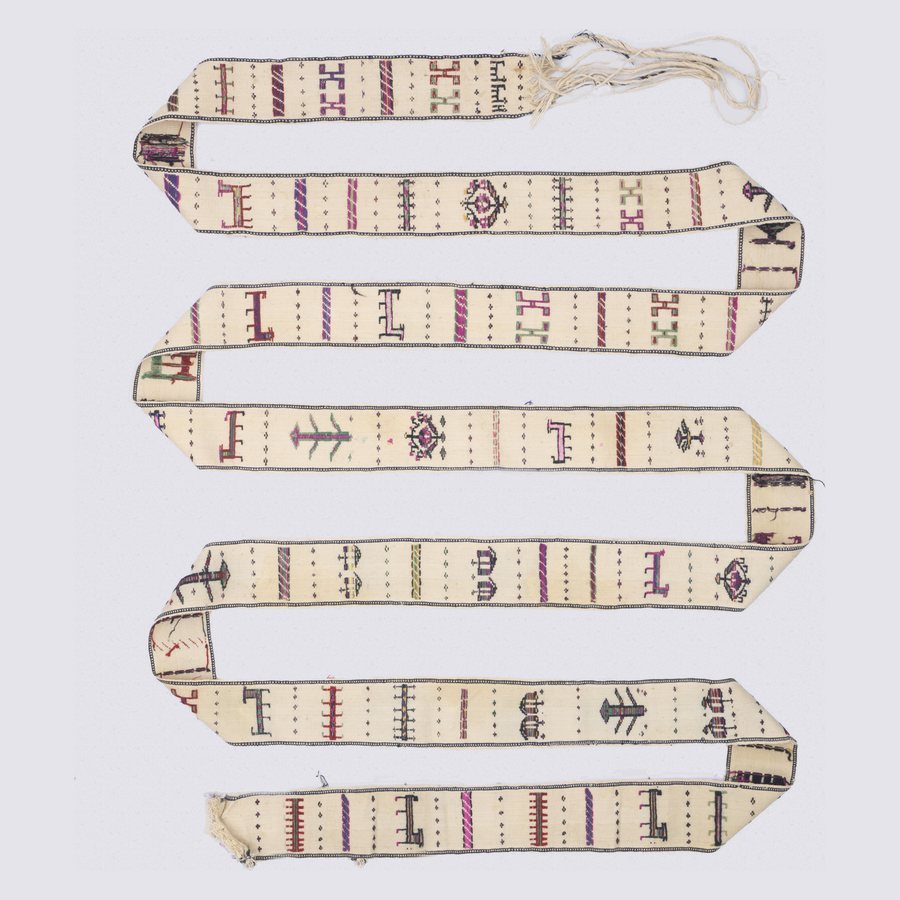
A long, narrow band woven by nomadic weavers. Depending on its length, a band was used around the tent or to tie loads and animal trappings on the move. Iranica describes Yomut Turkmen tent bands 11 to 20 metres long and 20 to 75 cm wide, the finest warp-faced on a white ground with knotted decoration.
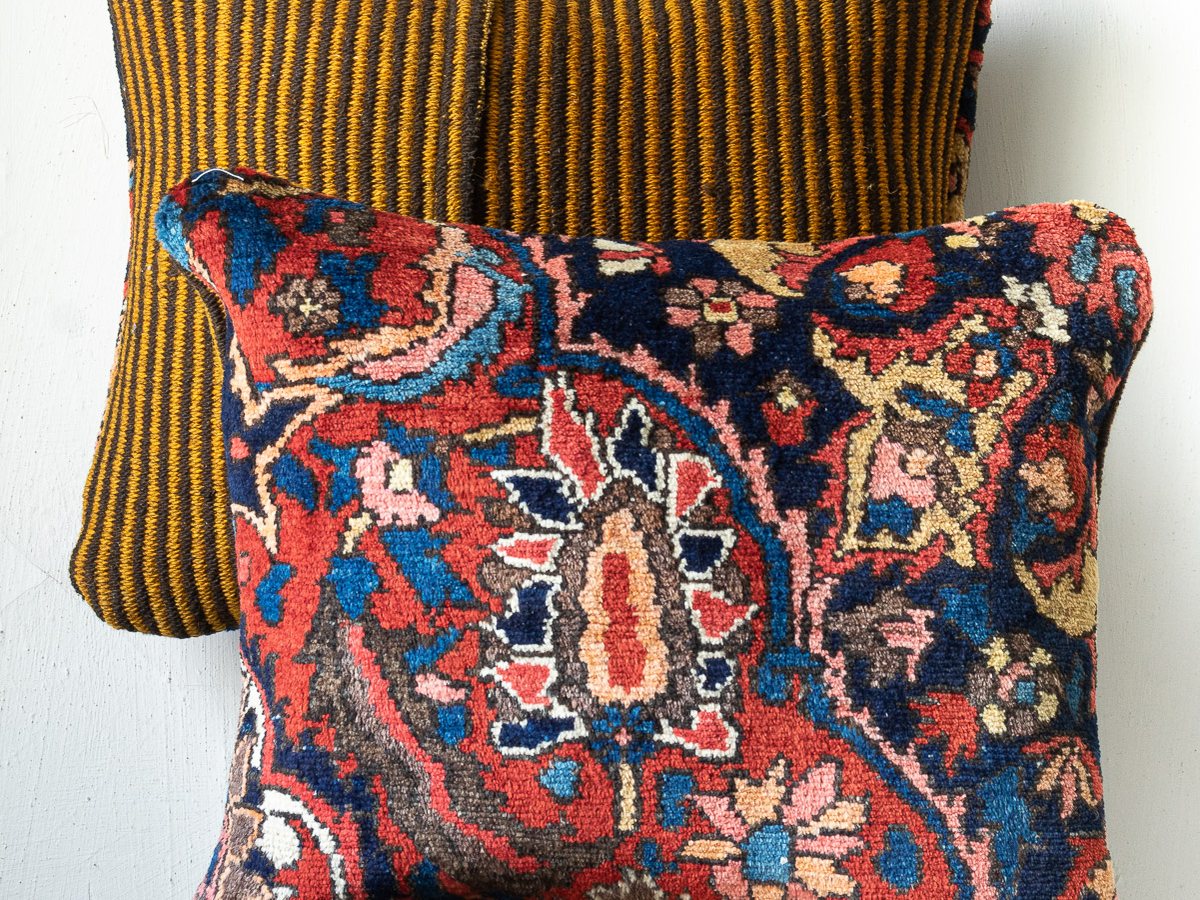
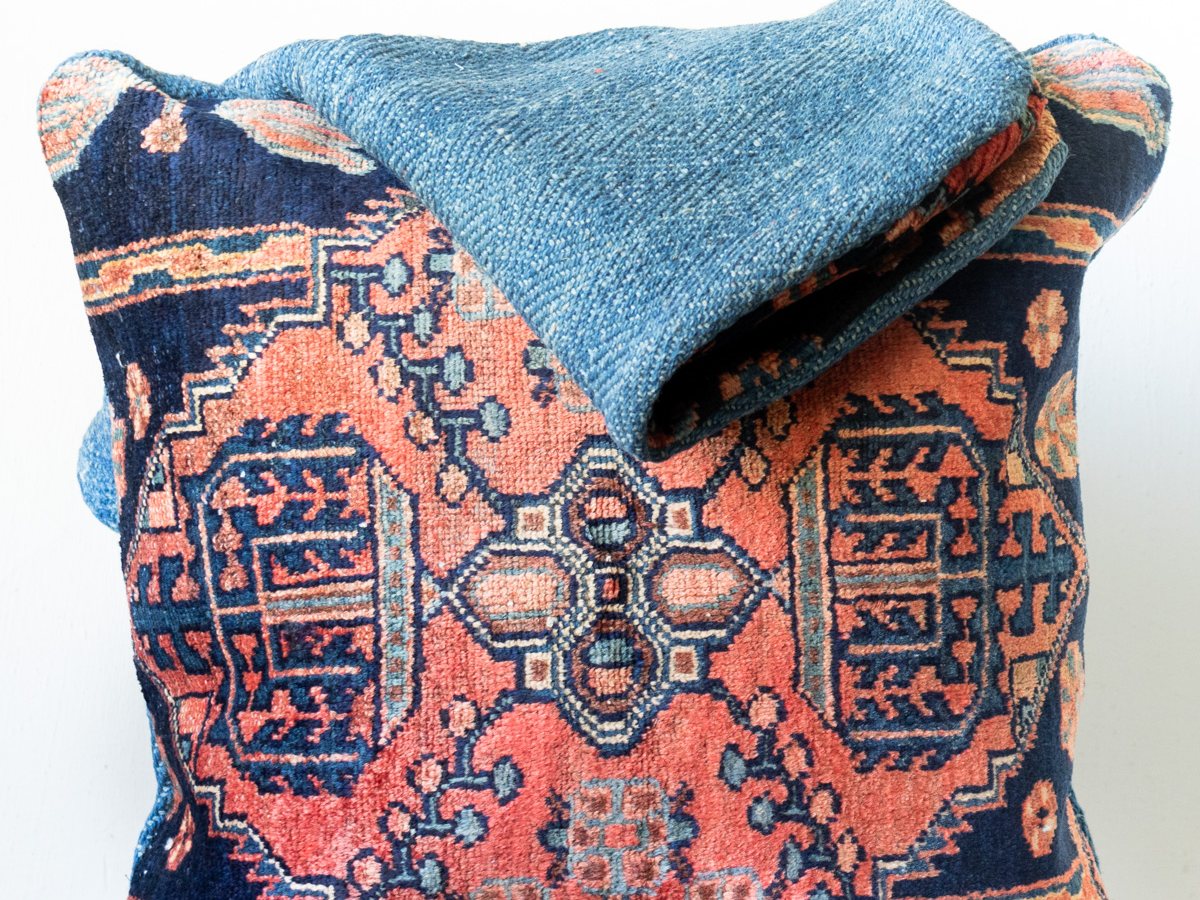
A cushion whose face is cut from an older handwoven rug, kilim or bag face, restored and backed with a separate handwoven cloth. The age given for such a cushion is the age of the rug it came from, not of the cushion.
ALSO RUG CUSHION · KILIM CUSHION · OVERDYED CARPET CUSHION · MADE FROM VINTAGE RUGS · MADE FORM ANTIQUE AND VINTAGE RUGS
Cushions and other pieces sewn from sections of older rugs, kilims and bag faces. The weaving is old; the cushion is new, so the age a listing gives is the age of the weaving.
ALSO MADE FROM ANTIQUE AND VINTAGE RUGS · RUG CUSHION · KILIM CUSHION
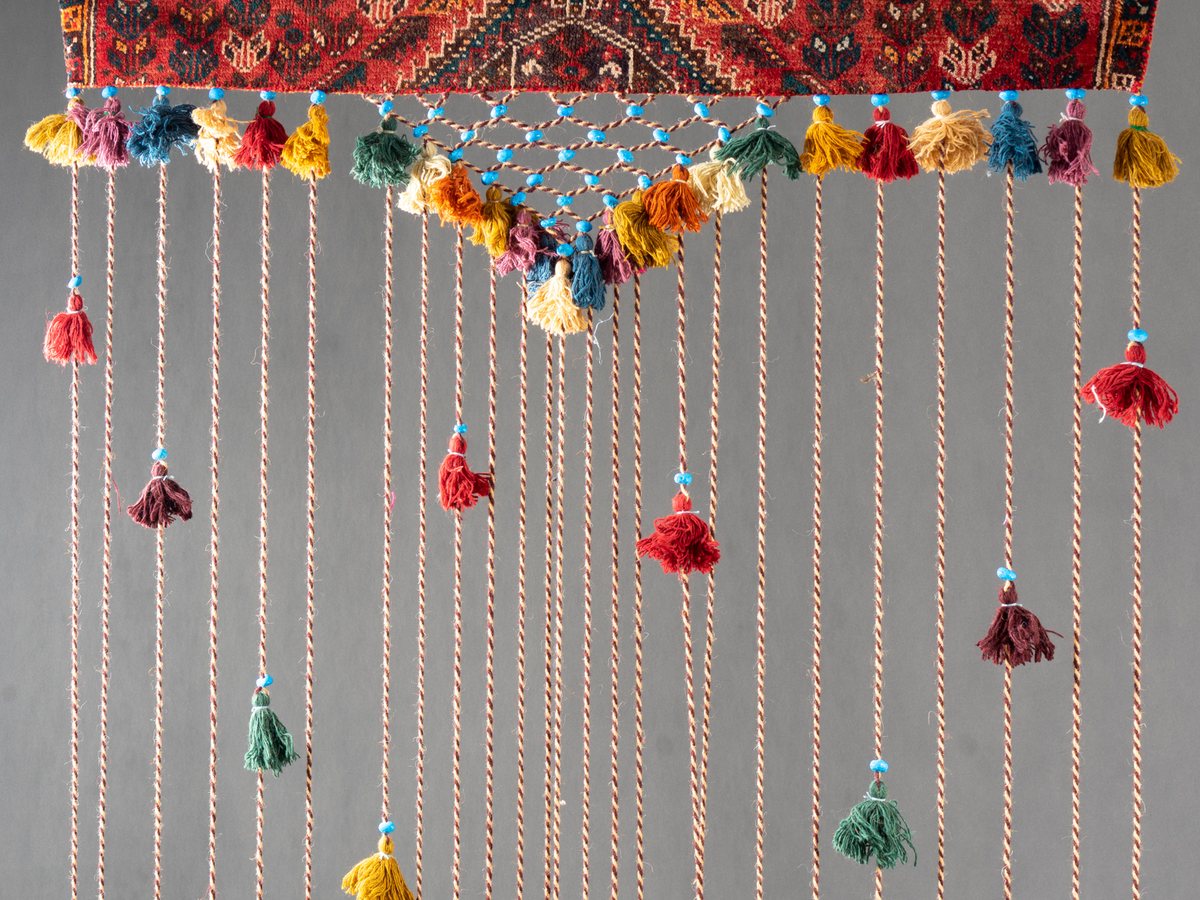
A decorative hanging made from a narrow strip of pile rug, gabbeh or kilim, finished with long wool tassels strung with blue khar mohreh (خرمهره), the large beads traditionally tied on donkeys' necks in Iran. Some strips are woven new for the purpose; others are fragments of older rugs.
ALSO PEARL & TASSEL WALL HANGING · DECORATIVE HANGER · DECORATIVE WALL HANGING · PEARL AND TASSEL WALL HANGING · KHAR MOHREH · TURQUOISE BEAD & TASSEL WALL HANGING
The foundation is the woven grid of warps and wefts that holds the knots. Descriptions name its fibre separately from the pile: "wool pile on a cotton foundation" means wool knots on cotton warps and, usually, cotton wefts. Workshop weavers prefer cotton warps because cotton is less elastic than wool and holds its shape better; nomads normally use their own wool throughout.
ALSO GROUND WEAVE · WARP AND WEFT · FOUNDATION FIBRE
The warps are the lengthwise threads strung on the loom before weaving begins. They run from one end of the rug to the other, the knots are tied around them, usually in pairs, and their free ends become the fringe. In Persian rugs warps are most often cotton, usually wool in nomadic weaving, and silk in some very fine pieces.
Wefts are the crosswise threads passed over and under the warps from side to side. In a pile rug one or more weft shoots go in after each row of knots and are beaten down to lock the knots in place; warps and wefts together make the foundation. How many shoots follow each row is a regional trait, and it is read at an end or a raised edge, never from the back.
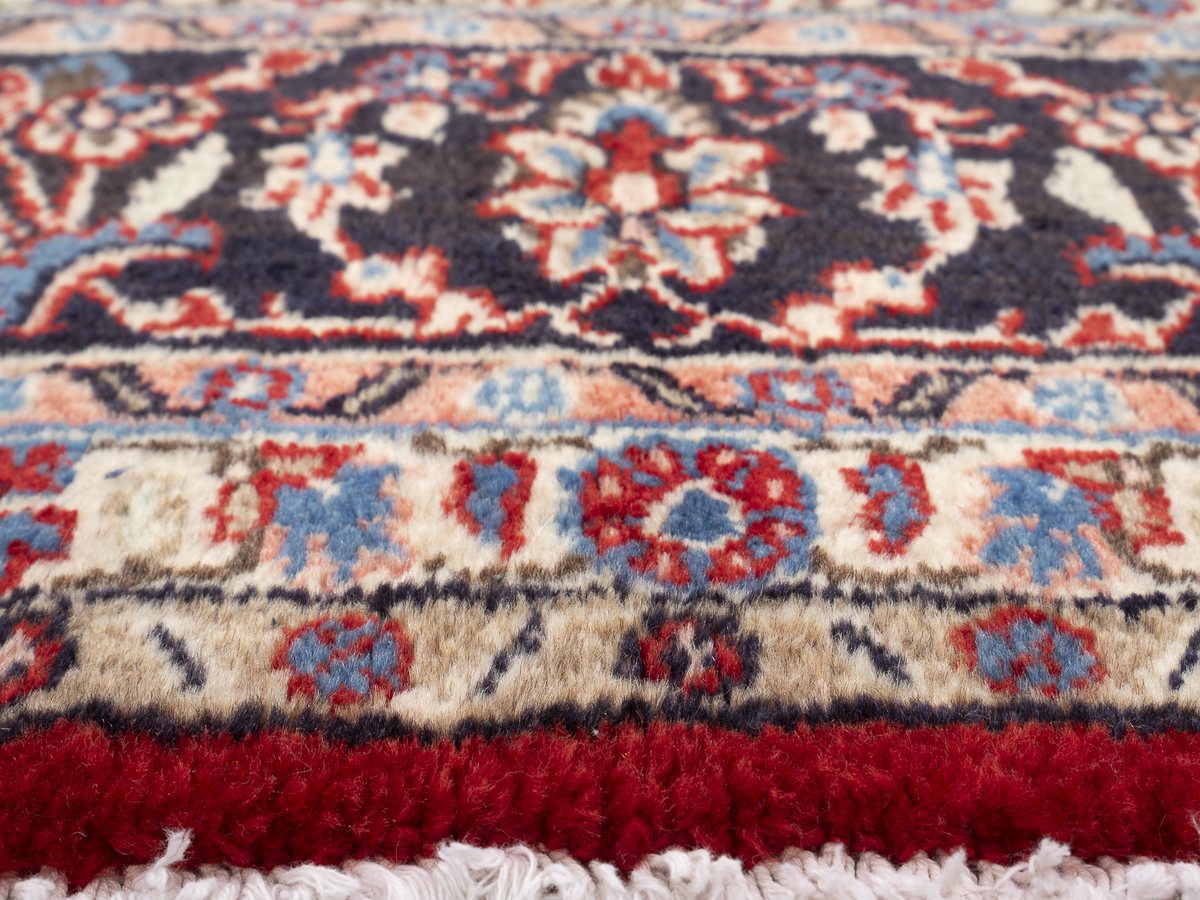
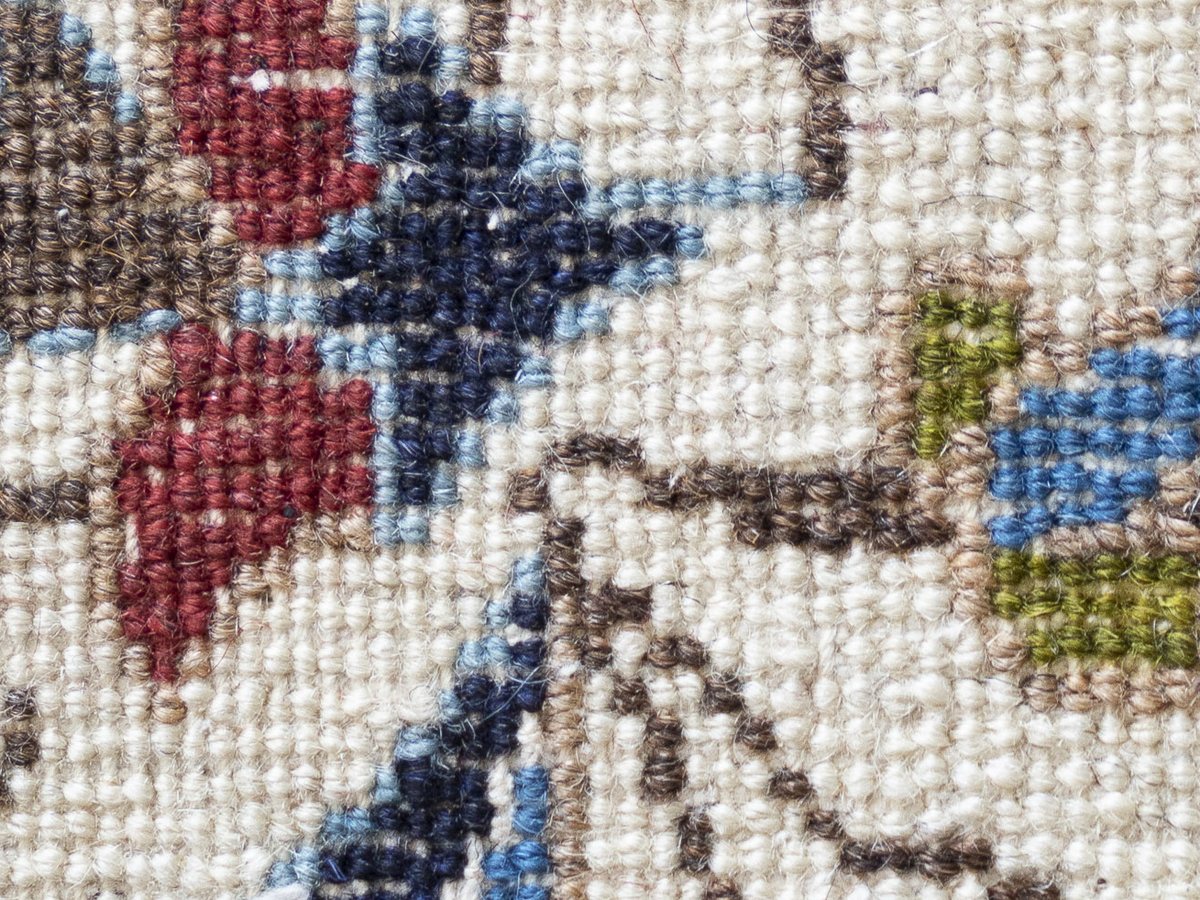
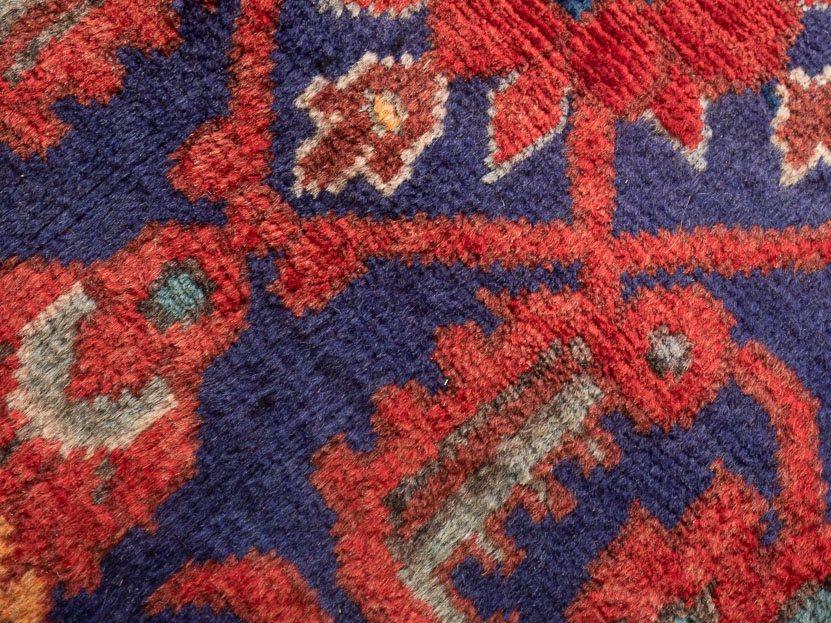
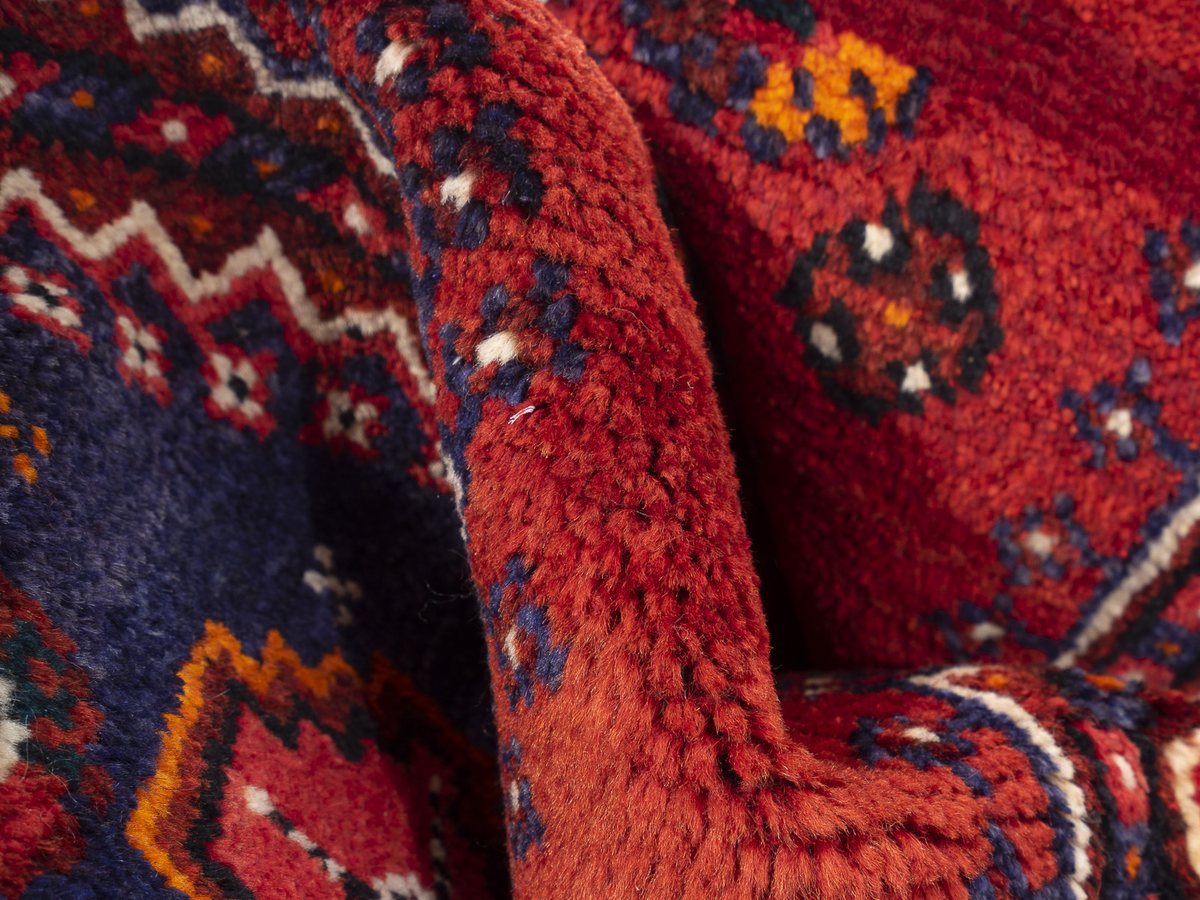
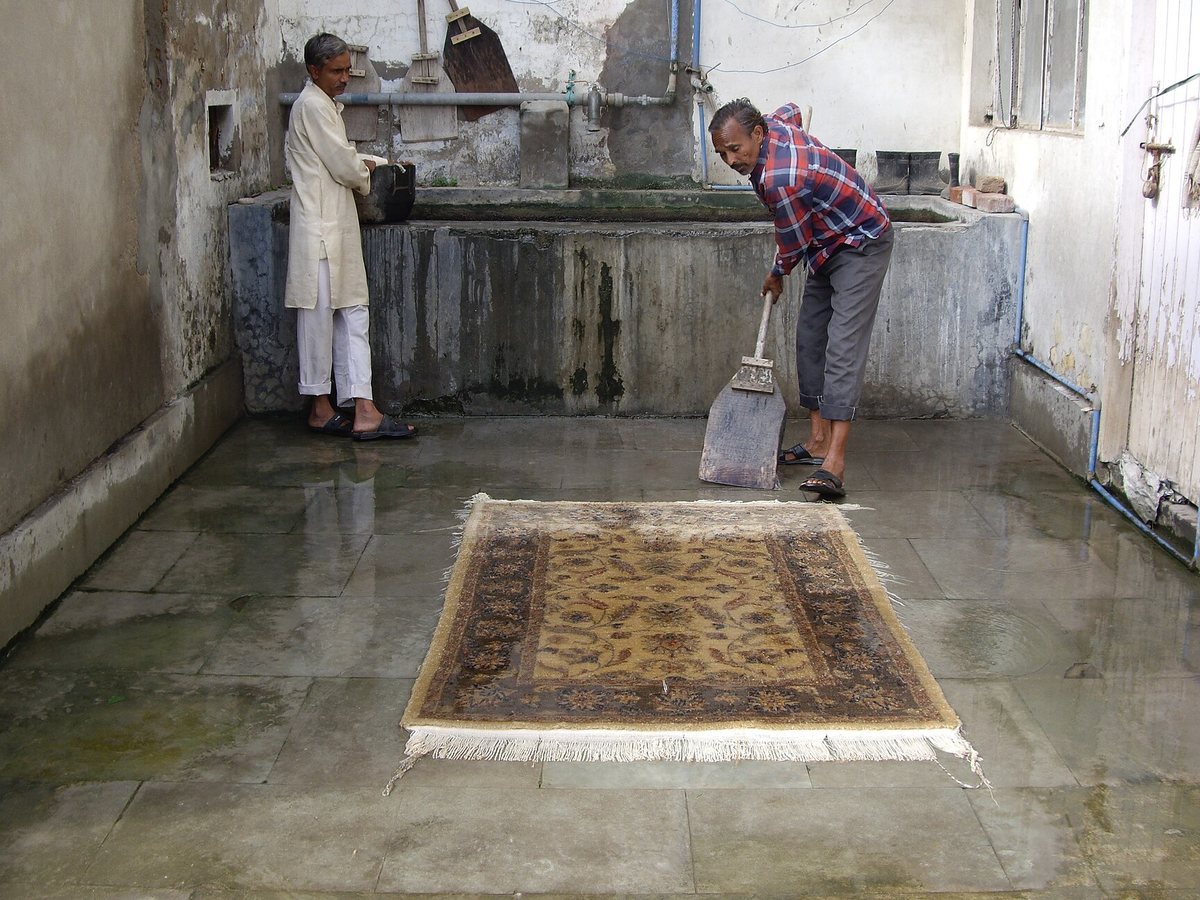
The pile is the face of a knotted rug: the cut ends of the knotted yarns, standing up from the foundation and forming the design. It is usually wool, sometimes silk, or wool with small silk details, and it is clipped level after weaving. Every rug in the gallery has been professionally washed and sheared before export, so a full, even pile says nothing about age.
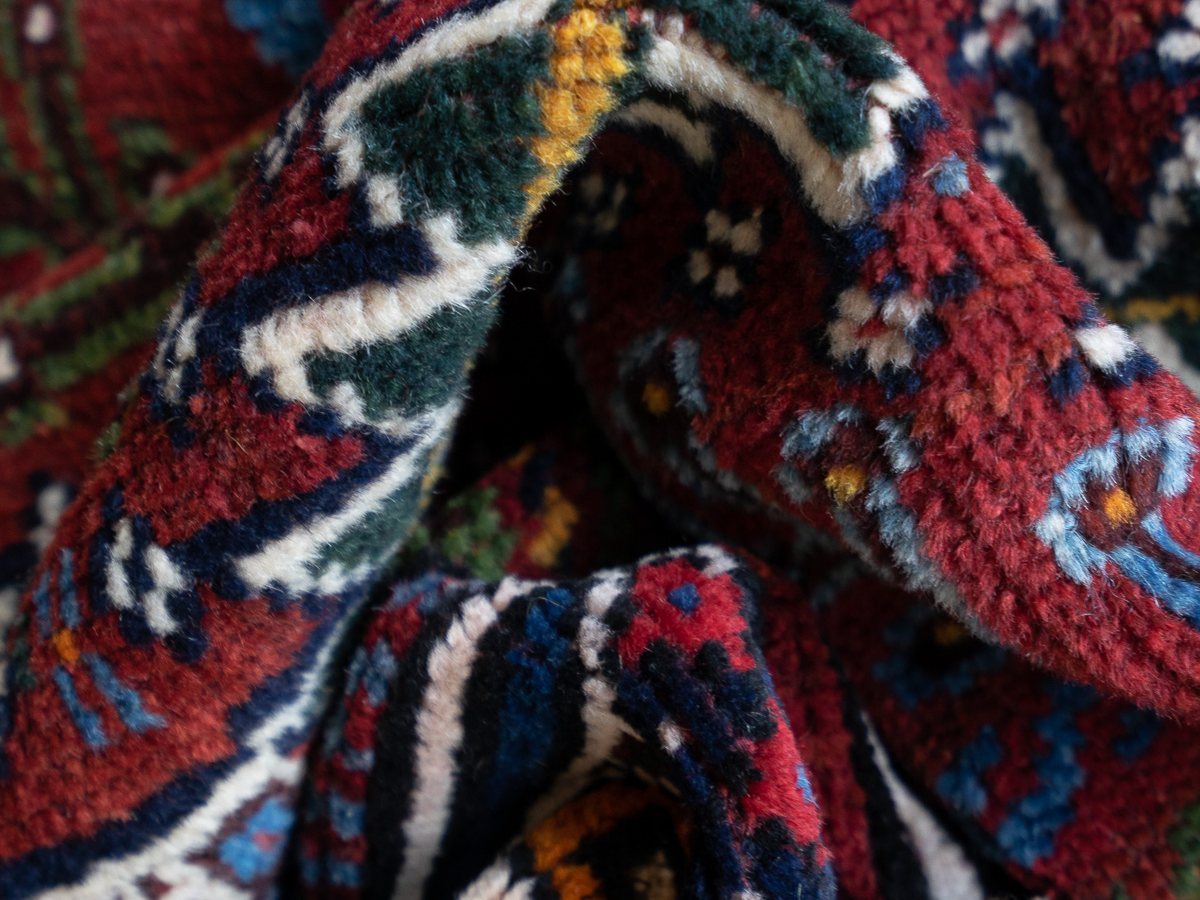
Pile direction, or nap, is the direction in which the pile fibres lie. Light reflects differently from their sides and tips, so the same rug can look lighter from one end and darker from the other. View a rug from both ends when judging its colour.
A single-wefted rug has one weft shoot after each row of knots. It is a regional trait: Iranica gives it for the Qaragozlu rugs of the Hamadan area, in contrast to double-wefted Sarab rugs, and the Brooklyn Museum's Senneh rug is single-wefted. A photograph of the back cannot settle the count, because a second, inner weft may never show; check it at an end or a raised edge, in the hand.
A double-wefted rug has two weft shoots after each row of knots. When one shoot is pulled tighter than the other, alternate warps are pushed to a lower level (see depressed warps). Iranica contrasts double-wefted Shahsavan rugs from Sarab with single-wefted Hamadan pieces, and notes three shoots in some Bijar and Kerman rugs. As with any weft count, it is read at an end, not from the back.
ALSO TWO WEFT SHOOTS · MULTI-WEFTED · TRIPLE-WEFTED
Warps are depressed when alternate warps lie on a lower level than their neighbours, because one weft of each pair is pulled tighter than the next: the weaver works the wefts, and the warps show the result. On the back one node of each knot is then partly hidden. If neither weft is pulled taut the warps lie level, or flat, and both nodes of every knot show. The degree of depression is one of the structural traits used to group rugs by region. The Persian grade names (takht-baft, nim-lool, lool-baft) describe how the rug is woven; English books name the result, in the warps.
ALSO OFFSET WARPS · WARP DEPRESSION · TWO-LEVEL WARPS
Takht-baft (تختباف, from takht, "level") describes a pile rug woven with its warps side by side on one level. The level comes from the wefts: Iranica calls such warps taḵt, woven with no weft pulled taut, so both loops of each knot show on the back. An Iranian study of Qashqai weaving adds that these rugs usually have one weft per row and are soft and supple. The word also covers flatweaves.
Nim-lool (نیملول, "half lool") describes a pile rug with half-depressed warps, between level takht-baft and full lool. As with every grade, the weaver sets it through the wefts and the warps show the result. An Iranian study of Qashqai weaving describes two wefts of equal thickness in each row, passed alternately, and a back on which the knots show one large loop and one small. Iranica notes that any depression of the warps partly hides one loop of each knot on the back.
Lool-baft (لولبافت) is weaving with depressed warps, and it is made with the wefts. In the three grades takht, nim-lool and lool, full lool (tamam-lool) means one warp of each pair lies almost directly behind the other: a thick weft is laid straight and beaten, then a thin one loosely, and the straight weft holds alternate warps back, so the knots on the back sit in one line and the wefts barely show. Heavy, stiff Bijar rugs have their warps set this way.
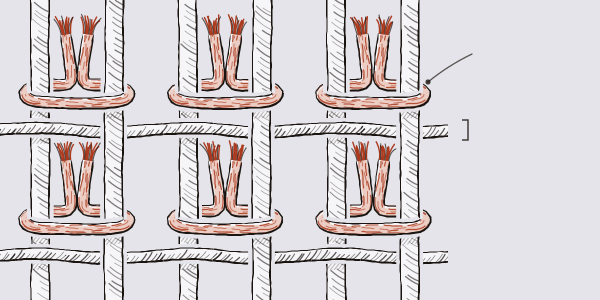
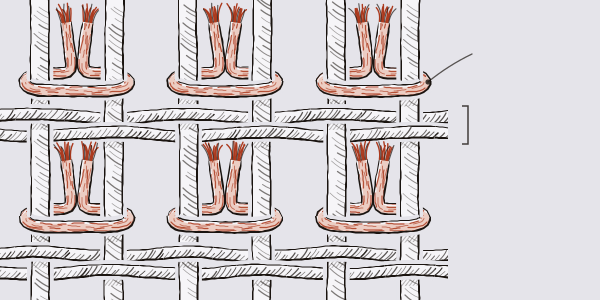
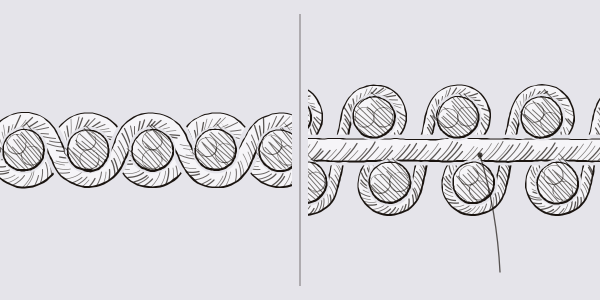
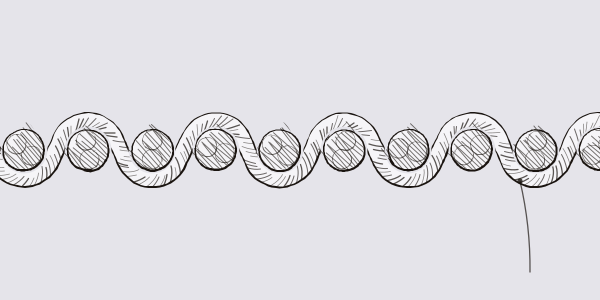
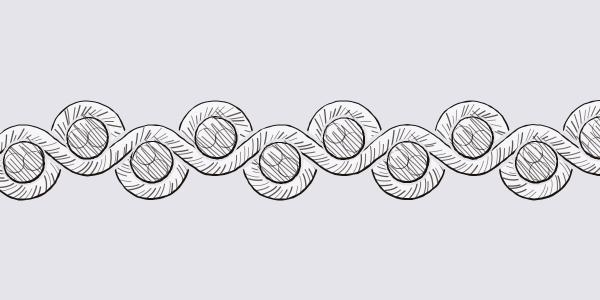
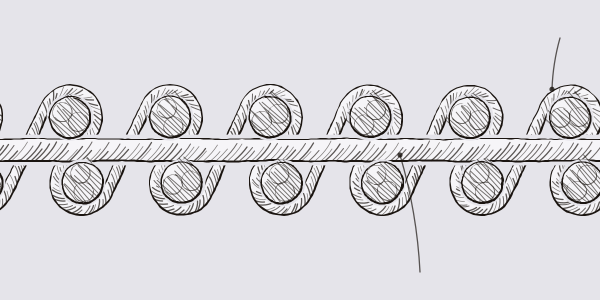
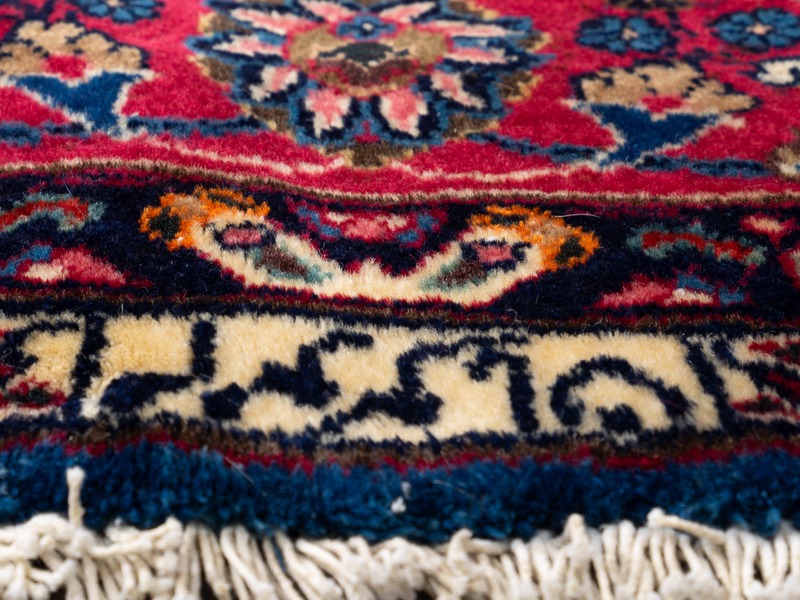
The selvedge is the finish along the two long sides of a rug; in Persian, shirazeh (شیرازه), a word that covers every kind of side finish. English books split it in two: overcasting, the simplest, wraps yarn around a single cord of warp yarn, while a selvedge proper wraps two or more cords or warps together (Iranica), though rug descriptions often say selvedge for both. The wrapping may be wool or another fibre: goat hair is favoured on coarser Baluch rugs. The Persian hashiyeh (حاشیه) means the border, not the selvedge.
ALSO SELVAGE · SIDE CORD · SIDE CORDS · SIDE FINISH · KENARAPICH · OVERCASTING
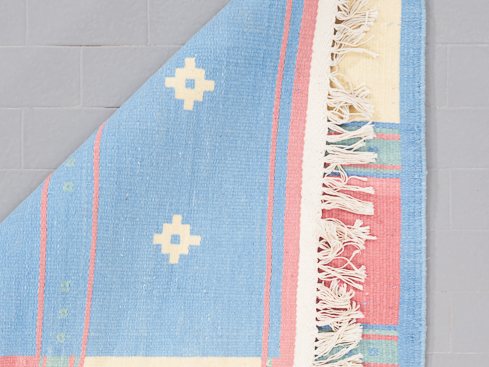
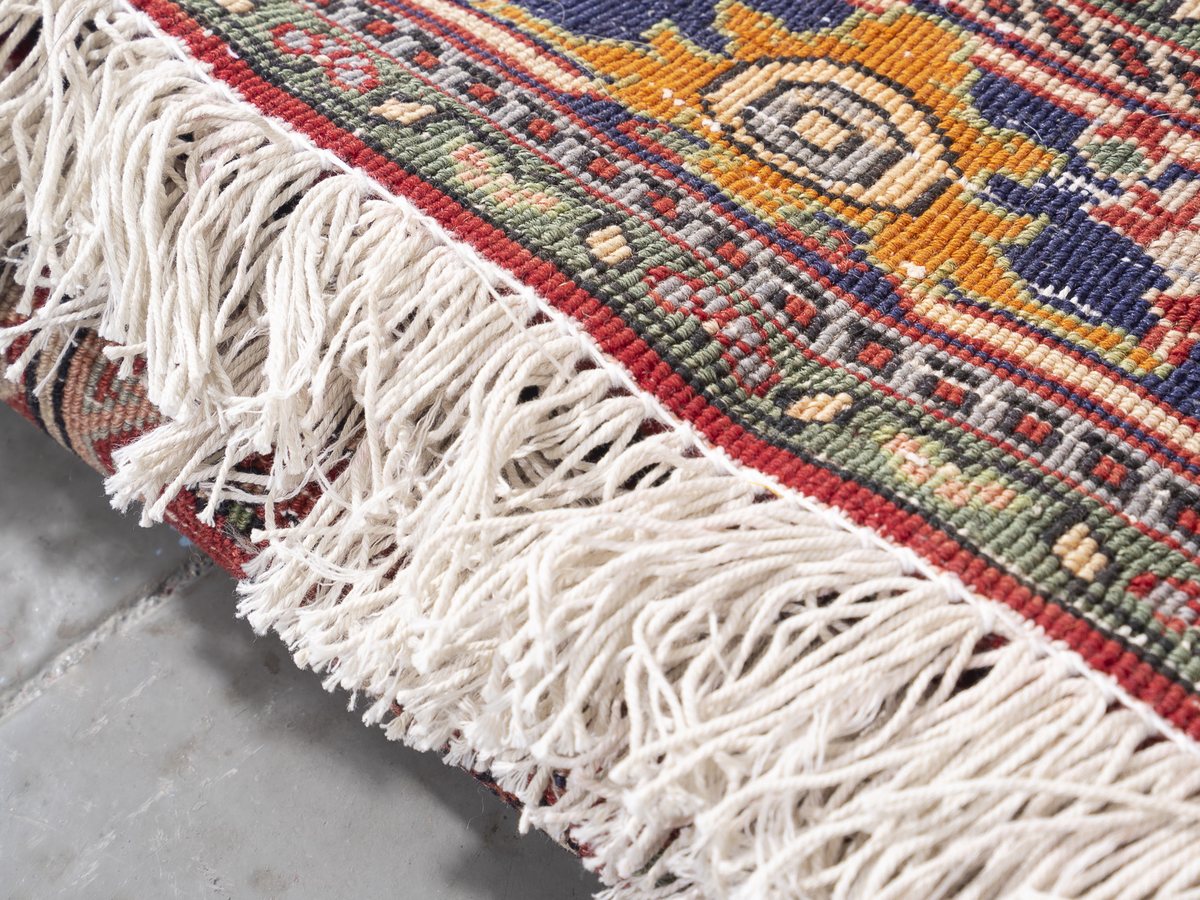
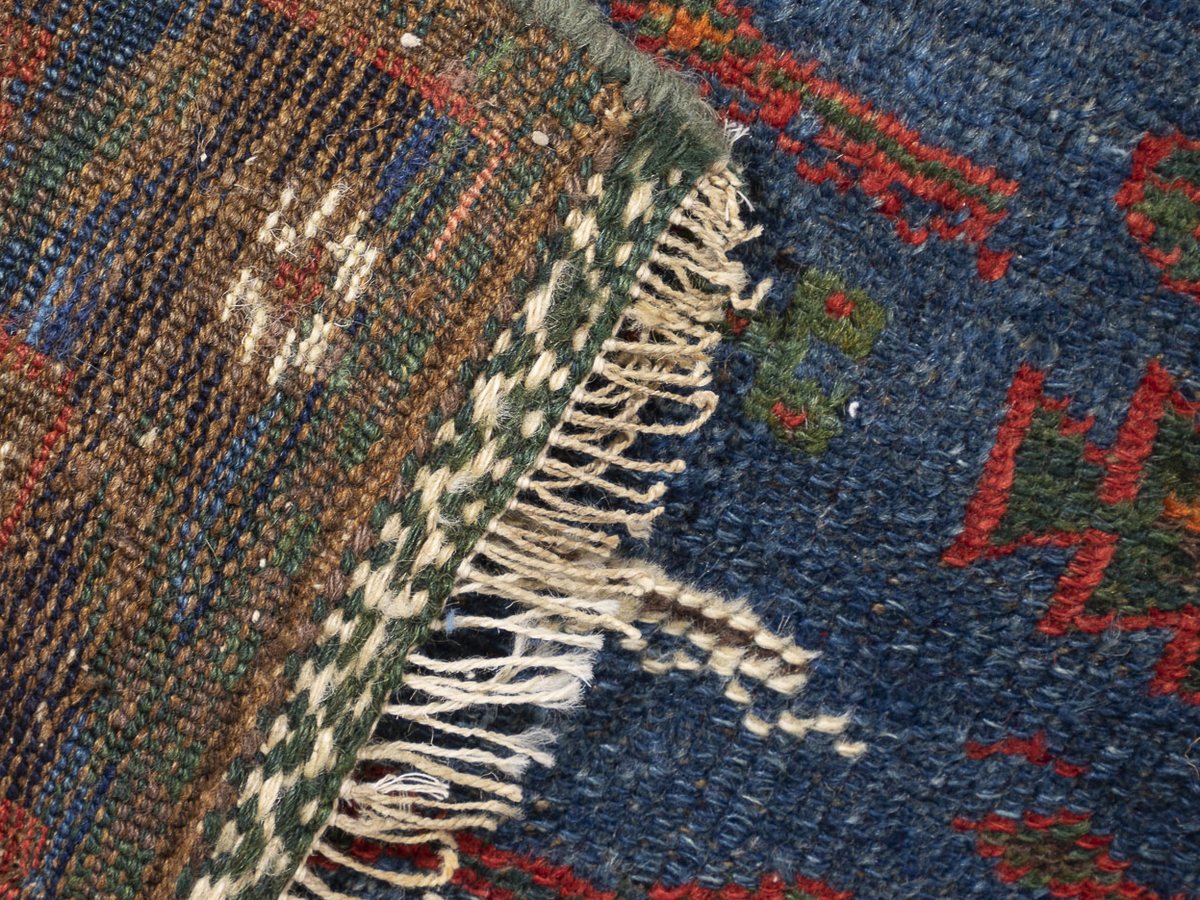
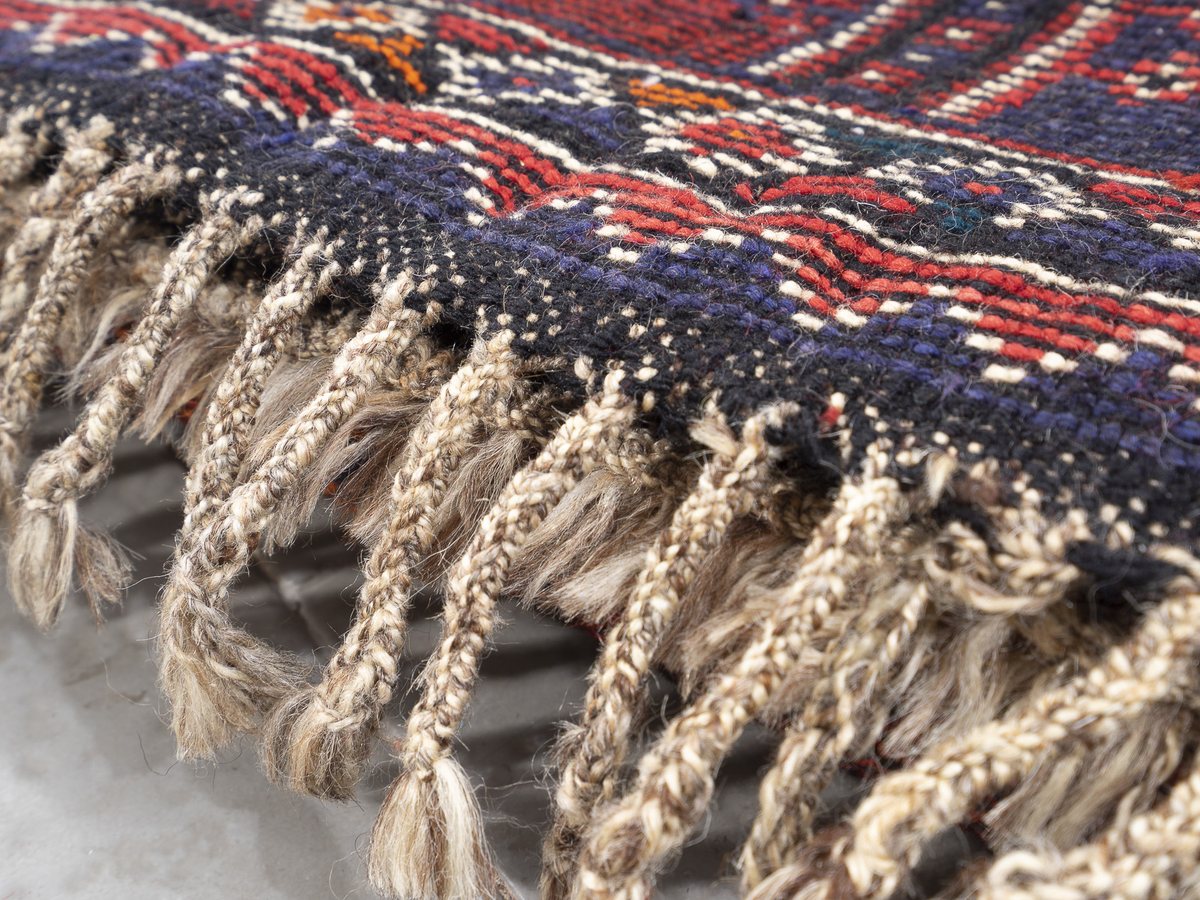
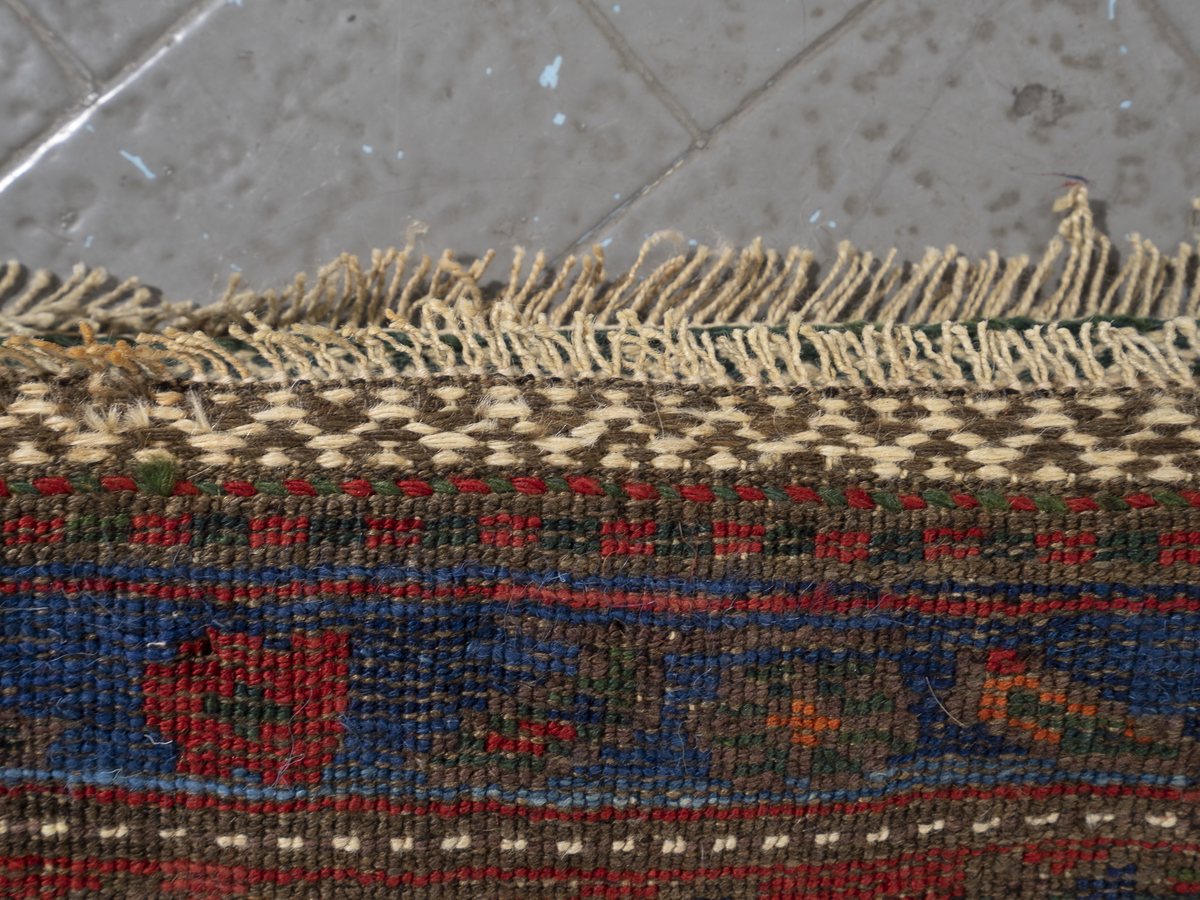
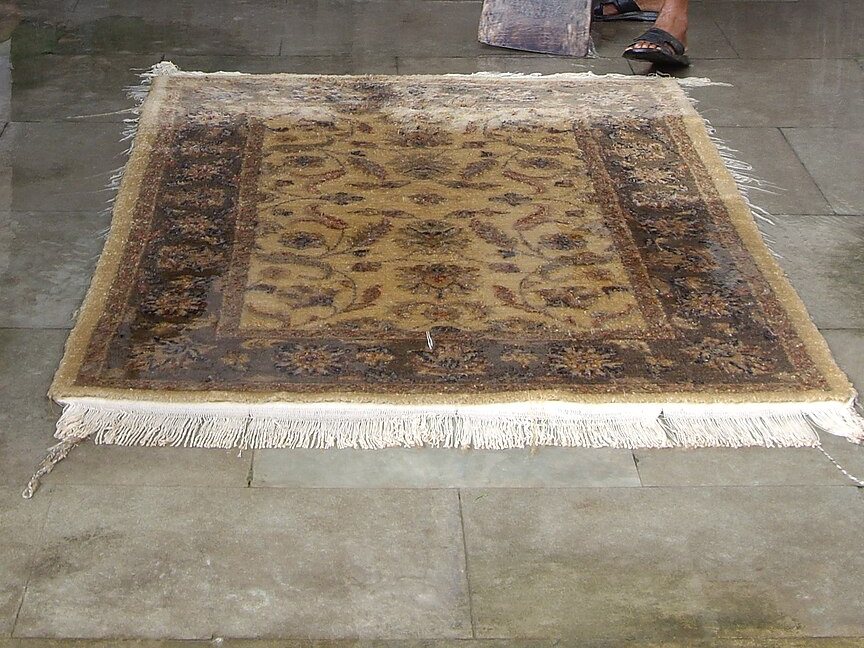
The fringe is the warp ends left free at the two short ends of a rug, in Persian risheh (ریشه). Usually it is the warps themselves, left loose or knotted, braided or netted, though fringes are sometimes added. A clean white fringe says nothing about age: every rug in the gallery has been professionally washed, and restored where needed, before export.
A kilim end, or skirt, is the band of flatweave at each end of a pile rug, between the knotted area and the fringe. Before tying the first row of knots the weaver passes several shoots of weft to make this protective strip of plain weave, and the far end is usually finished the same way. It may be left plain or woven in stripes and simple patterns.
ALSO END SKIRT · FLATWOVEN END · PLAIN-WEAVE END · GELIM END
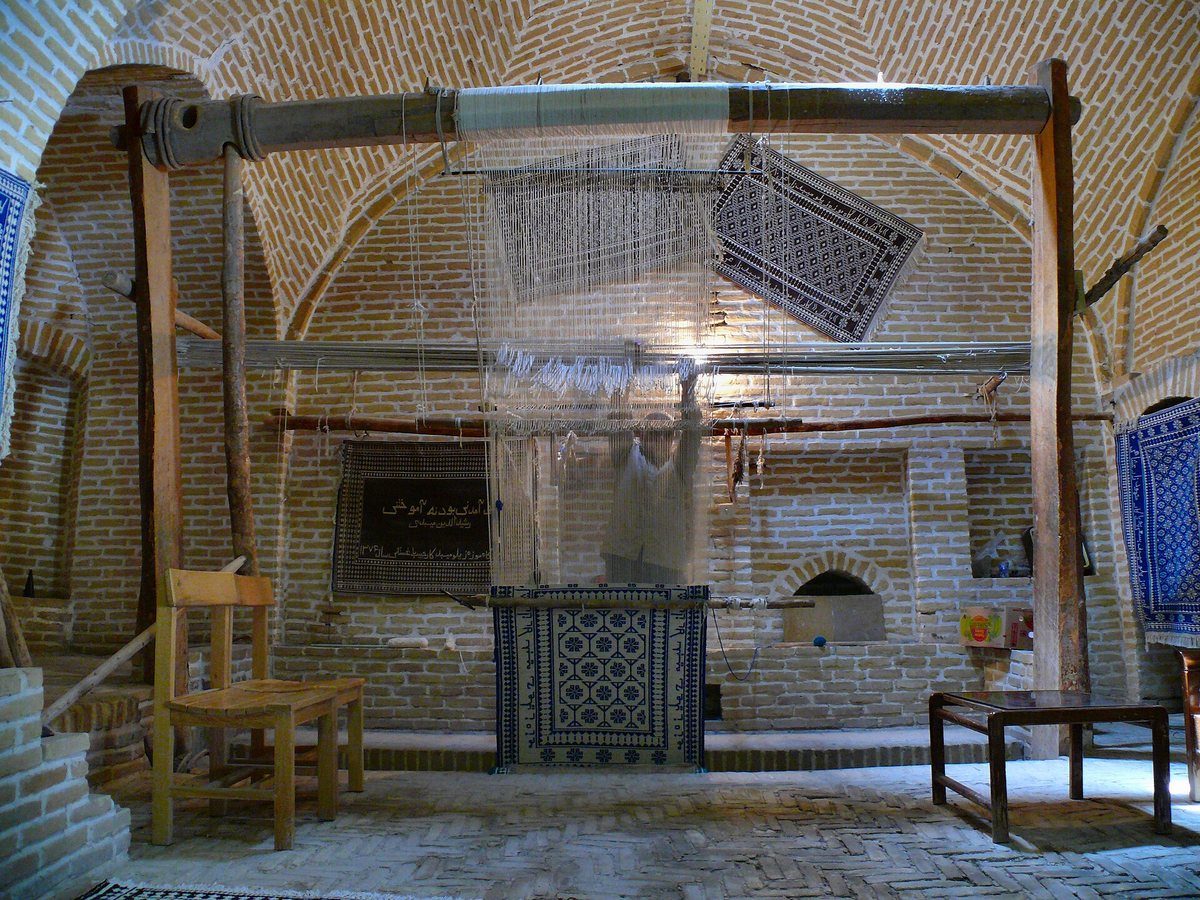
The loom (dar or dastgah) is the frame that holds the warps taut between two beams during weaving. Nomads mostly weave on horizontal looms pegged to the ground, easily dismantled for migration; town and village weavers usually work at vertical looms. With fixed beams a rug can be no longer than the loom; with rotating beams the woven part is rolled on, so it can be longer.
ALSO DAR · DASTGAH · CARPET LOOM · HORIZONTAL LOOM · GROUND LOOM · VERTICAL LOOM
A cartoon (naqsheh) is a rug's design drawn and coloured on squared paper, each square standing for one knot, for the weaver to copy. It is cut into strips set on the loom, or read out by a caller, and lets a merchant order the same design from many looms. Since the late nineteenth century it has been the commonest way to pass a complex design to weavers.
A vagireh is a knotted sampler showing a section of a rug's field and border, woven to a cartoon and then used as the model for full-size rugs. It shows how the chosen colours and drawing will look once knotted, and it outlasts a paper cartoon. Vagirehs are recorded in late nineteenth and early twentieth century production; one view holds that Western exporters introduced them, though they may be older.
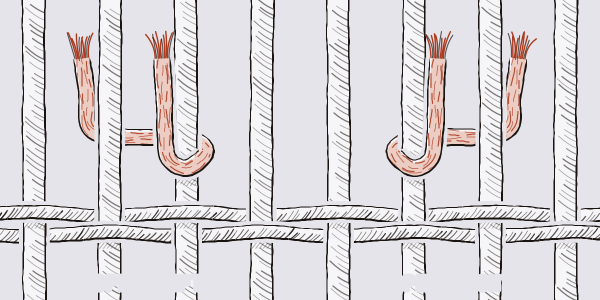
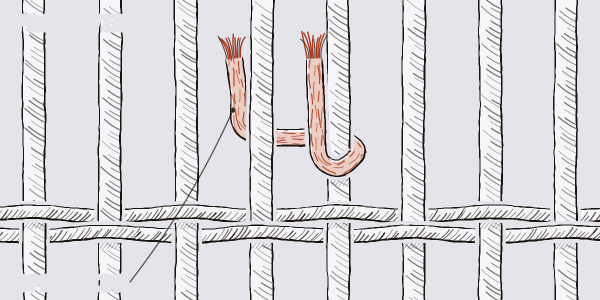
The symmetric knot wraps around both warps of a pair, and its two yarn ends rise together between them. Older books call it the Turkish or Ghiordes (Gördes) knot, after the Anatolian town, and the Iranian trade calls the technique torkibaf. The name says nothing about who wove the rug: it is widely used in Iran, including in Senneh rugs and in the camel-ground rugs of Hamadan and Sarab.
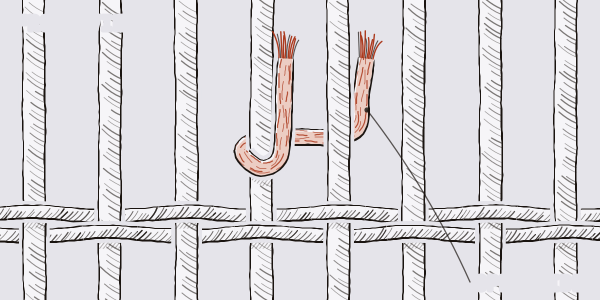
The asymmetric knot wraps one warp of a pair and passes under the other, so a yarn end rises on each side of one warp; it can open to the left or the right. Western books long called it the Persian or Senneh knot, but both knot types are used throughout Iran, and Senneh (Sanandaj) rugs are mostly tied with the symmetric knot. The Iranian trade calls this technique farsibaf.
Open left describes an asymmetric knot whose open side, the side not fully wrapped round a warp, faces left. Iranica notes that asymmetric knots in Persian carpets are more commonly open to the left, and that the old Salor Turkmen rugs are knotted open left. Left and right swap when a rug is viewed from the back, so records should name the side read.
ALSO OPEN TO THE LEFT · ASYMMETRIC OPEN LEFT · ASYMMETRICAL KNOT OPEN TO THE LEFT · PERSIAN KNOT OPEN LEFT · LEFT-OPEN KNOT
Open right describes an asymmetric knot whose open side, the side not fully wrapped round a warp, faces right: the mirror image of open left. In Persian carpets it is the less common direction. Iranica gives it as the general rule in Tekke Turkmen rugs, unlike the open-left Salor, and records Yomut weavers using all three knot forms (symmetric, open left, open right), sometimes in one carpet.
ALSO OPEN TO THE RIGHT · ASYMMETRIC OPEN RIGHT · ASYMMETRICAL KNOT OPEN TO THE RIGHT · PERSIAN KNOT OPEN RIGHT · RIGHT-OPEN KNOT
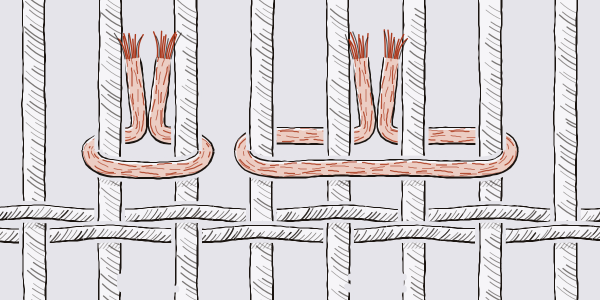
A jufti (joftī, "paired") knot is tied over more than two warps instead of the usual pair. It is a production shortcut: it saves time and yarn but lowers the knot count, which coarsens the drawing. A government conference in Tehran in 1949 named it among the industry's chief faults, judging jufti carpets inferior in both looks and durability.
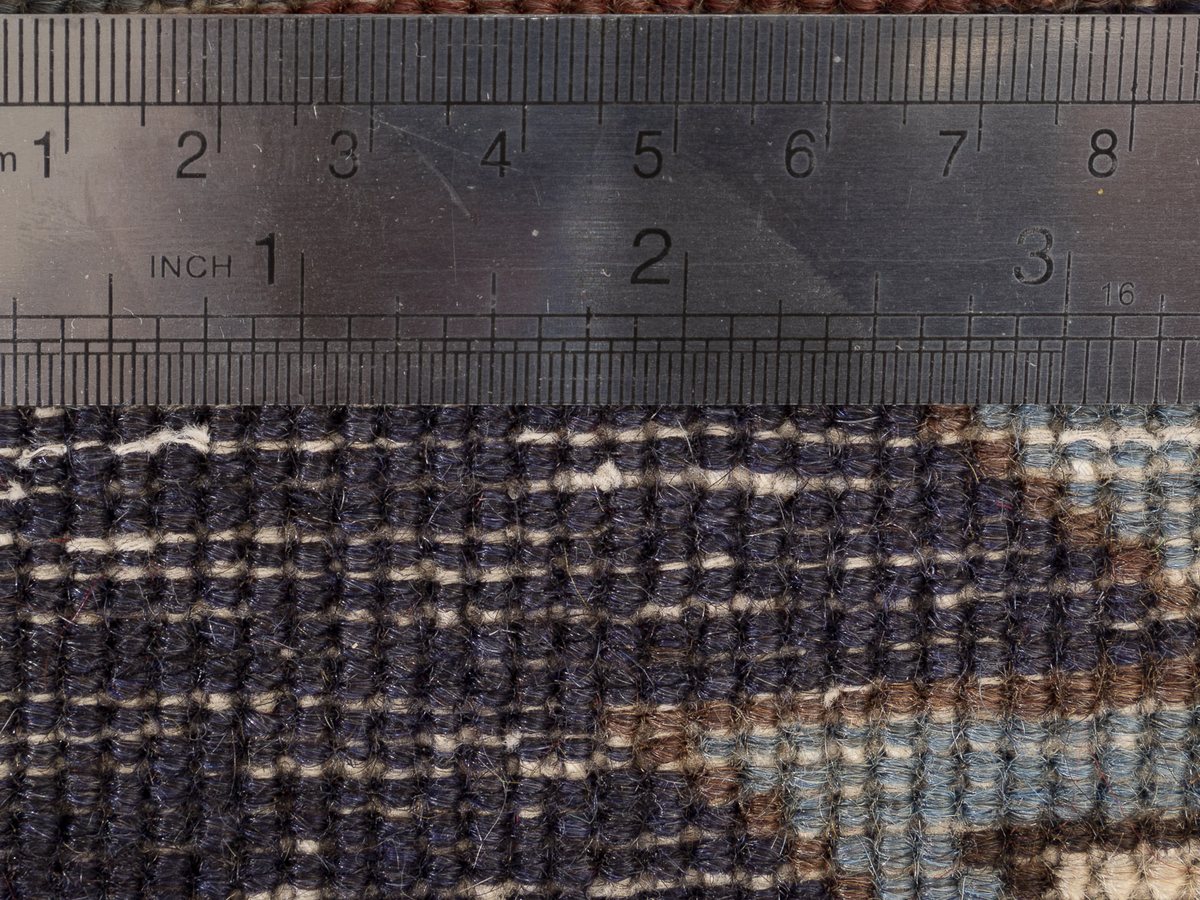
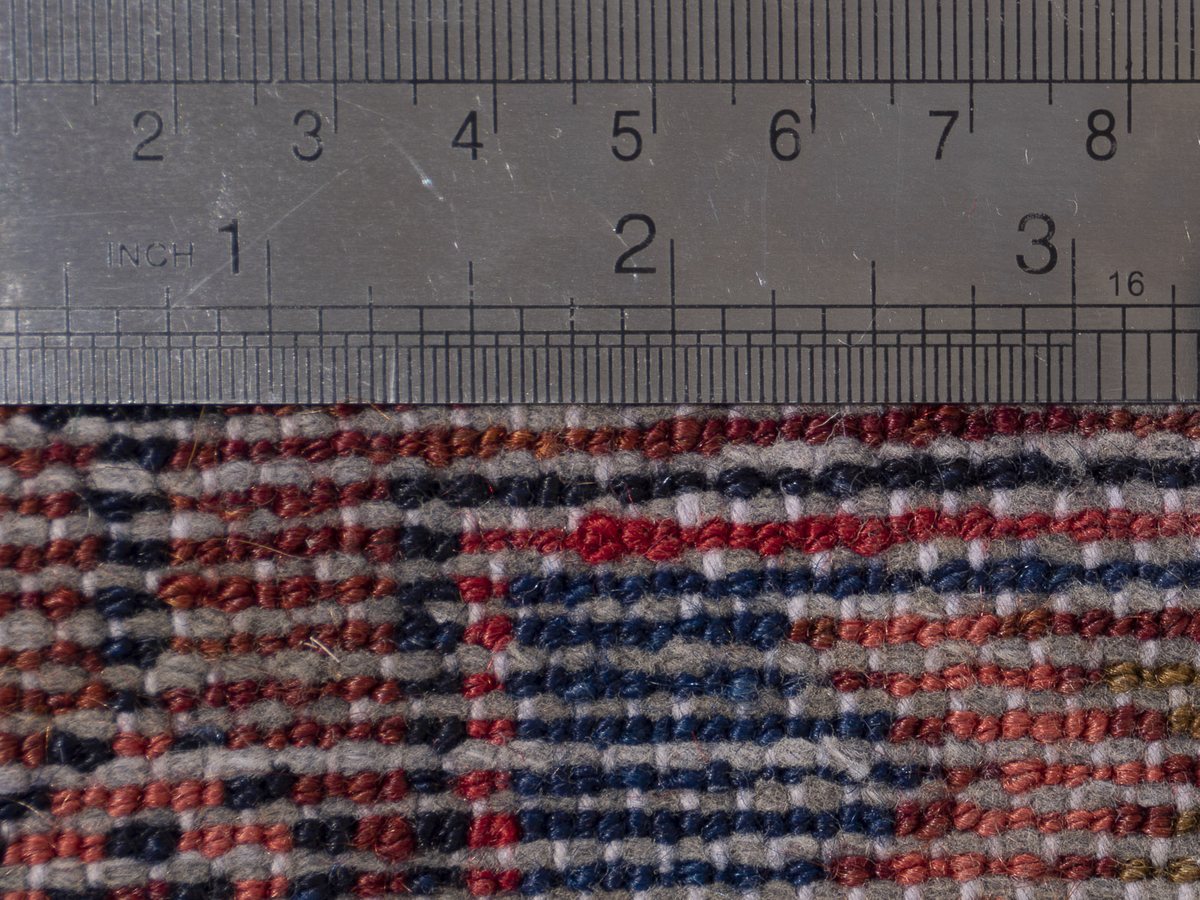
Raj (رج, literally "row") is the Iranian trade measure of fineness: the number of knots in 7 cm, counted across the width of a rug. On a coarse weave, count the warps: each knot sits on a pair, so warps per centimetre divided by two is knots per centimetre, and seven times that is the raj.
Knot density is the number of knots in a unit of area: knots per square inch (KPSI) in English-language trade, per square decimetre or metre in Europe. It is the knots across multiplied by the rows down. To convert raj, divide by 7 and multiply by 2.54 for knots per inch across; if rows match, KPSI is about raj squared times 0.13, so 40 raj is about 210 KPSI. One KPSI is 1,550 knots per square metre.
ALSO KNOTS PER SQUARE INCH · KNOTS PER SQUARE METRE · KNOTS PER SQUARE DECIMETRE · KNOT COUNT
La (لا, 'ply') is the grade given to Nain rugs: 4 La, 6 La or 9 La, the number of strands twisted into each warp thread. Fewer strands make a finer warp, so 4 La is the finest grade and 9 La the coarsest.
Wool (pashm) in rug descriptions means sheep's wool, the usual pile fibre of Persian rugs; in tribal weaving it normally forms the warps and wefts as well. Persian wool is generally coarse, which suits carpet weaving, and it varies by region: Fars wool is soft and lustrous and takes dye very well, while Kerman wool is shorter and springier, with a sheen.
ALSO SHEEP'S WOOL · SHEEP WOOL · PASHM · WOOLLEN · WOOL PILE · LOCAL WOOL
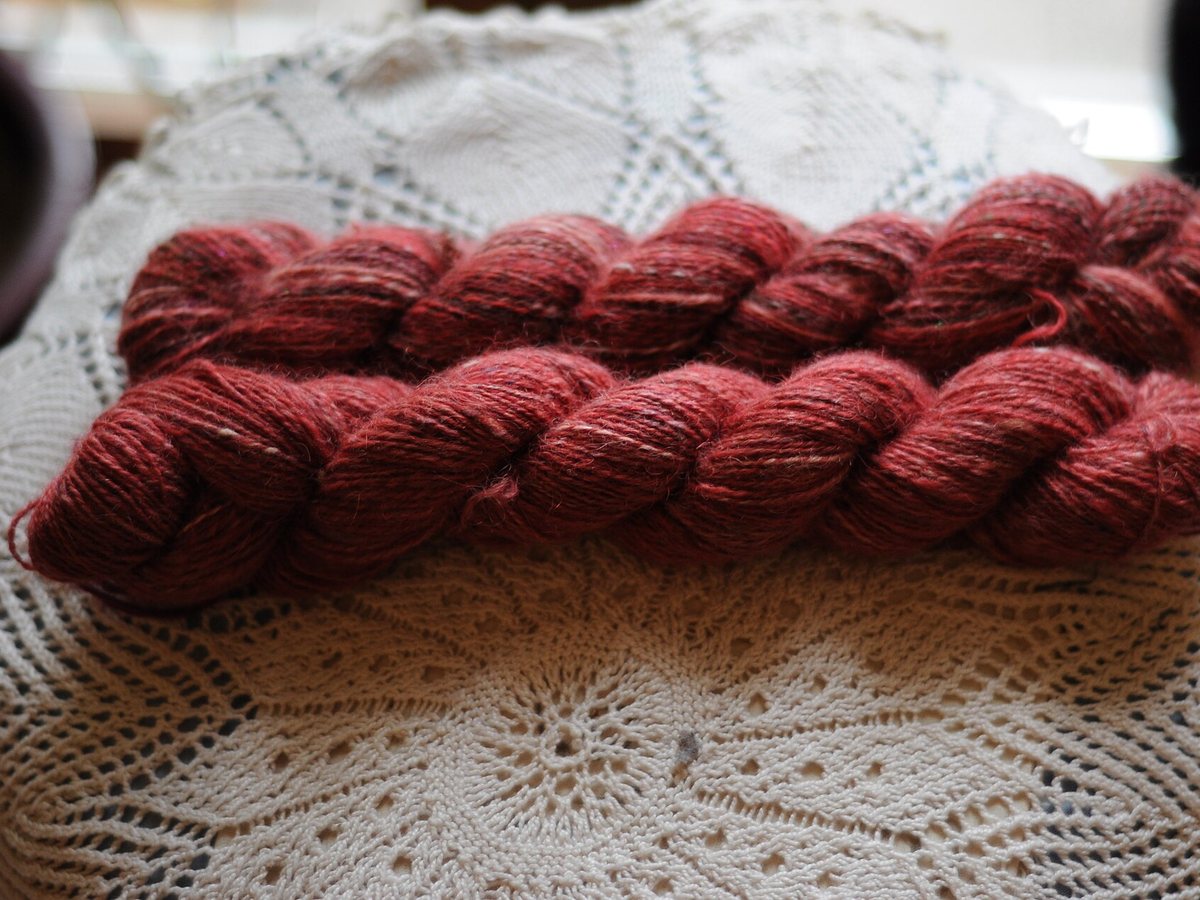
Handspun wool is spun by hand, in Iran most often on a drop spindle, giving a yarn slightly uneven in thickness and twist along its length. Those variations take dye unevenly and add to abrash. Handspun versus machine-spun yarn is one of the signs that survives washing and helps in dating, but it is judged up close and in the hand.
Machine-spun wool is carded and spun in a mill, so the yarn is even in thickness and twist and generally takes dye more evenly. Machine-spun yarns were reaching Persian weaving by the late 19th century, and in the 20th century the state Iran Carpet Company ran its own factories for washing and combing, carding and spinning wool. It is normal in later production and is not a fault, but it is one of the yarn signs read in dating.
Kork (کرک) is fine, soft, lustrous wool used for the pile of better rugs. In Persian dictionaries the word means the soft down that grows beneath goat hair, combed out and spun for shawls; in the carpet trade it means fine lamb's wool, usually from an early shearing. Trade sources disagree on which part of the animal it comes from: the neck, the underarms or the belly.
Lamb's wool is the first clip shorn from a young sheep, finer and softer than adult fleece. Iranica records weavers around Maku blending spring-shorn wool with lamb's wool to make yarn for fine carpets. In rug titles it signals a soft, fine wool pile; kork is the trade's name for the finest grade.
Dabbaghi, or tannery wool (pashm-e dabbaghi), is wool taken from the skins of slaughtered sheep instead of being shorn from live animals. Iranian tanneries loosen it with sodium sulphide and lime, which leaves the fibre swollen and brittle. A 2012 Iranian study found its yarn weaker and less colourfast than shorn wool and advised against it in hand-knotted carpets; textile references rank skin wool below clip wool.
Manchester wool is a trade name for imported yarn from English mills that dealers say was used in some fine Kashan rugs, the "Manchester Kashans", of the late nineteenth and early twentieth centuries. They describe it as merino or worsted, long-staple and very evenly spun, giving a soft, lustrous pile. Iranica notes that merino wool from Australia was introduced into Persian weaving but did not last.
ALSO MANCHESTER KASHAN · MANCHESTER WOOL KASHAN · MANCHESTER MERINO
Lustre is the natural sheen of wool. It depends mainly on the fleece: Iranica singles out the lustrous wools of Kerman, Fars and Ardabil, and the fine wool Heriz weavers once bought from the Shahsavan. Lustre is not silk. Kork wool is lustrous, and a rug with a strong sheen may contain no silk at all. A chemical wash can also add sheen.
Handle is how a rug feels and moves in the hand: soft or harsh, supple and folding or stiff and board-like. Textile dictionaries define it as the quality perceived by touching, squeezing or rubbing a fabric. In a rug it comes from the fibre and the build, including weft tension and warp depression. Aged wool has a handle that washing does not create, so it counts as age evidence, but only in person.
Camel hair (پشم شتر) is the soft tan to brown fibre plucked from camels and used undyed. Iranica records it in cheaper rugs of Chahar Mahal and Baluchistan, for browns in Khorasan and Baluch kilims, in flour sofrehs, and extensively in Shahsavan rugs from Sarab. "Camel" in a title may also name only the colour: some dealers hold that camel-coloured Serab grounds are sheep's wool dyed with walnut husk.
ALSO CAMEL WOOL · CAMEL'S HAIR · CAMEL COLOUR · CAMEL GROUND · CAMEL FIELD
Goat hair (موی بز) is used in Persian weaving mainly in the foundation and edges. Iranica records it mixed with coarse sheep's wool in the warps of tribal rugs woven for home use, in Baluch flatweaves, and in the selvedges of coarser Baluch rugs. It is clipped, washed and combed, then spun alone or with sheep's wool.
Cotton (پنبه) is the usual foundation fibre of Persian workshop rugs and of many village and some tribal rugs. Iranica notes that undyed cotton is used in the warps of finer carpets because it is less elastic than wool and holds its shape better, and that handspun cotton was still used in cheaper commercial rugs into the 1950s. Ziloos are flatweaves made entirely of cotton.
ALSO COTTON FOUNDATION · COTTON WARP · COTTON WEFTS · PANBEH
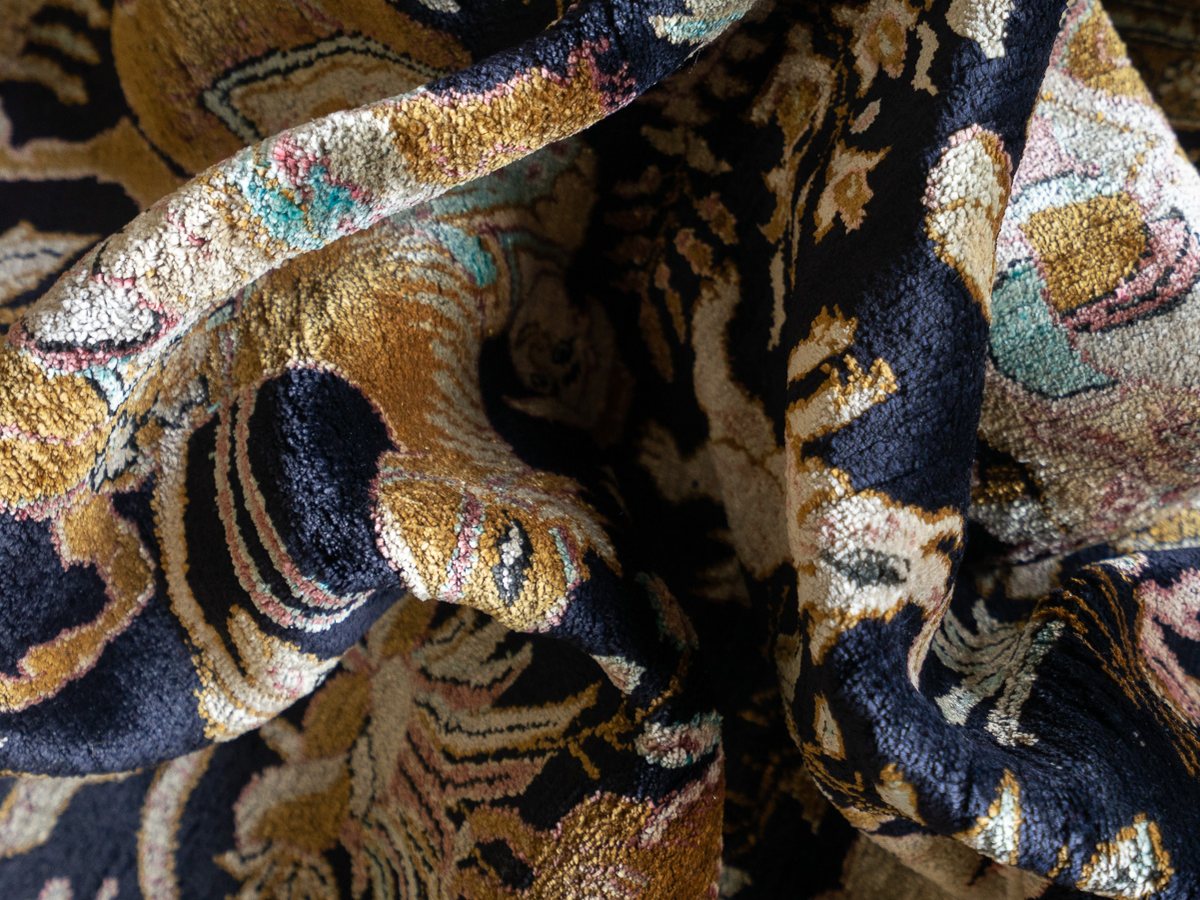
Silk (ابریشم) appears in Persian rugs as the pile of the finest pieces, the warps of very fine wool rugs, and small highlights in wool pile. Kashan, Nain and Qom have woven rugs entirely of silk. In tribal weaving it is rare and a mark of luxury. A strong sheen alone does not prove silk: fine wool is lustrous too.
Viscose is a type of rayon, a manufactured fibre made from regenerated cellulose. It can have a silk-like lustre and is sometimes called artificial silk or art silk. Those names do not mean that the fibre is silk. Check the stated material rather than judging it by sheen alone.
Mercerised cotton is cotton treated with an alkaline solution and then washed. The treatment increases its lustre, strength and ability to take dye. It remains cotton, even when its sheen resembles silk. The American spelling is mercerized cotton.
"Wool on cotton" is one of Dyad's Materiality labels. The first fibre named is the pile, or in a flatweave the face yarn; the second is the foundation. A wool on cotton rug therefore has wool knots on cotton warps and, usually, cotton wefts. It is the standard build of Persian workshop rugs and of many village rugs.
ALSO WOOL ON COTTON CONSTRUCTION · WOOL PILE ON COTTON FOUNDATION
"Wool on wool" is a Dyad Materiality label for a piece that is wool throughout: wool pile, or wool face yarn in a flatweave, on wool warps and wefts. Nomadic weavers normally use wool from their own flocks for every part of a rug, so the label is typical of tribal rugs, kilims and gabbehs. A wool foundation is more elastic than cotton.
"Kork wool on cotton" is a Materiality label in our listings: a pile of kork, fine down wool, on a cotton foundation. Modern Kerman carpets are built this way: Iranica notes that most are woven with locally produced kork, and Britannica that their foundation is now all cotton. See kork for what the word covers.
ALSO KORK ON COTTON · KURK WOOL ON COTTON · KORK PILE ON COTTON FOUNDATION
"Wool on goat's hair" is a Materiality label in our listings: wool pile or face yarn on warps of goat hair. "Wool on wool and goat's hair" means the warps are a mixture of wool and goat hair. Iranica records goat hair mixed with coarse wool in the warps of tribal weavings made for home use.
ALSO WOOL ON GOAT HAIR · WOOL ON WOOL AND GOAT'S HAIR
"Silk & Lamb's wool on cotton" is a Materiality label in our listings: wool pile with parts of the design in silk, on a cotton foundation. Iranian trade terms say where the silk goes: silk outlines (gerdeh abrisham), partly silk motifs on a kork field (gol abrishami) or a silk field with kork motifs (kaf abrisham). A Persian press account places white silk outlining mainly in Nain, Ardestan and Isfahan.
ALSO SILK & LAMB'S WOOL ON COTTON · SILK AND LAMB'S WOOL ON COTTON · LAMB'S WOOL AND SILK · PART SILK · SILK HIGHLIGHTS · SILK OUTLINES
"Wool on silk" is a Materiality label in our listings: wool pile on silk warps. Iranica records a separate grade of reeled silk used for the warps of very fine wool carpets. Isfahan carpets are knotted on cotton or silk foundations depending on quality, and dealers describe the finer grades of Nain as wool on a silk warp.
ALSO WOOL PILE ON SILK FOUNDATION · WOOL ON A SILK FOUNDATION · WOOL ON SILK WARP · SILK WARP · SILK-WARP RUG
"Silk on cotton" means silk pile on a cotton foundation. Cotton is the usual warp of Persian workshop rugs because it is less elastic than wool and holds its shape well. An Iranian trade account keeps the name tamam abrisham, "all silk", for silk rugs whose warps are silk as well.
ALSO SILK PILE ON COTTON FOUNDATION · SILK ON A COTTON FOUNDATION
"Silk on silk" is a Materiality label in our listings: silk pile on a silk foundation, which the Iranian trade calls tamam abrisham, "all silk". Iranica names Kashan, Nain and Qom in particular as central Iranian towns where carpets were woven entirely of silk, and Britannica notes that Kashan carpets are knotted on silk or cotton foundations according to the pile fibre.
ALSO ALL SILK · PURE SILK · TAMAM ABRISHAM · SILK PILE ON SILK FOUNDATION · SILK RUG
"Cotton on cotton" is a Materiality label in our listings for a piece made of cotton throughout, face and foundation. Ziloos, the flatwoven floor coverings of the Yazd region, are usually all cotton, and our listings also give the label to a few cotton kilims and sofrehs. Cotton is less elastic than wool and holds its shape better.
Undyed wool is fleece used in its own colour: ivory, greys, camel, browns and near-black. The Persian word is khodrang (خودرنگ), 'its own colour', which some of our titles render as 'self dye'. Iranica notes that traditional gabbehs take colours from undyed cream, light brown and black wool as well as from natural dyes. Undyed browns never corrode, because no iron mordant is involved.
A natural dye is colour taken from plants, insects or minerals rather than made synthetically. "Vegetable dye" is the usual trade term, though some natural reds come from insects. Persian dyers fixed them with mordants, chiefly alum. Iranica reports vegetable dyes in common use in Iran until the 1940s; synthetic dyes appeared in Persian carpets from the 1870s and later took over commercial production.
A mordant is a metal salt that binds a dye to the fibre and fixes the colour. Persian dyers used mainly alum (zāj); iron salts darken colours and are used for dyed browns and blacks. The same dye gives different shades with different mordants, and tannin-rich additions darken them further. Iron weakens wool over time, which is why iron-mordanted browns corrode.
ALSO MORDANTED · ALUM · ZAJ · IRON MORDANT · IRON-MORDANTED · FERROUS SULPHATE
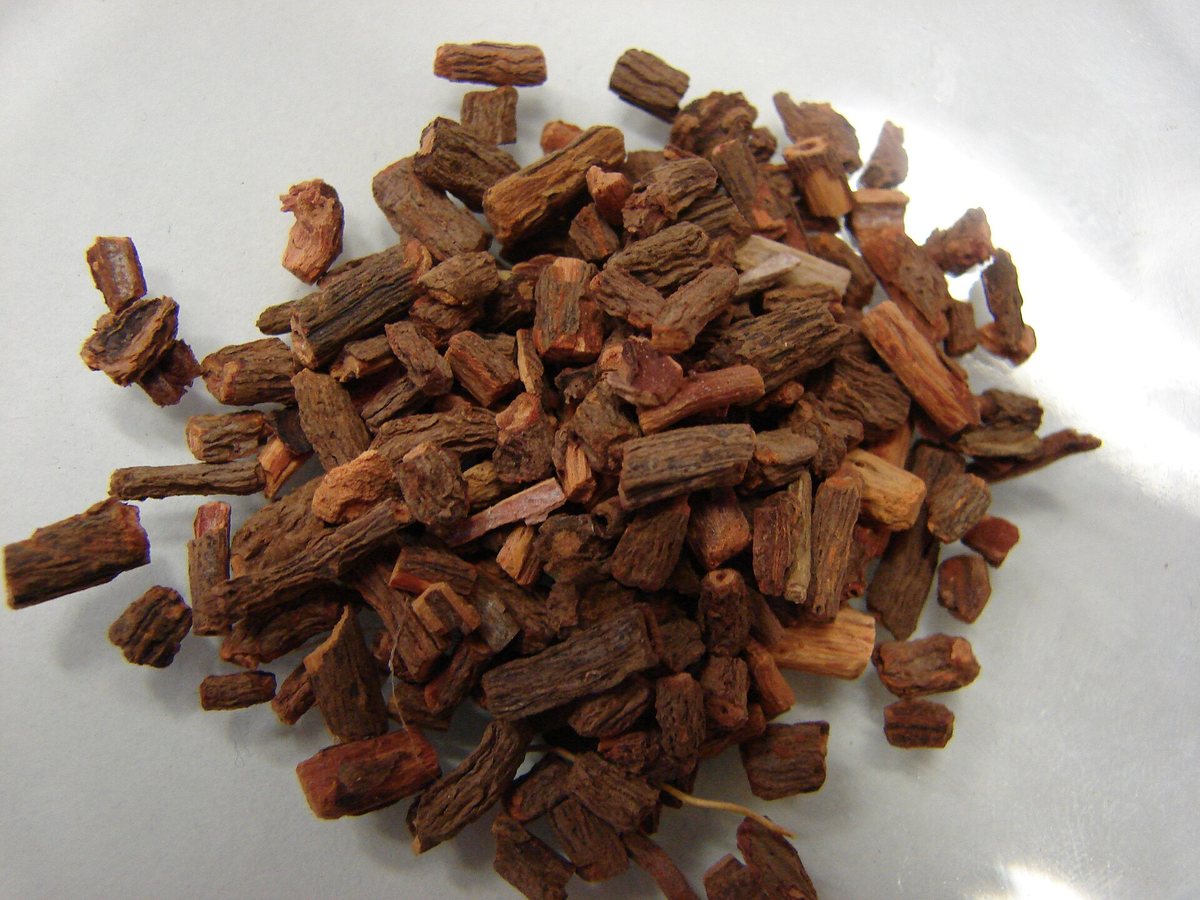
Madder (روناس, runas) is the red dye from the root of Rubia tinctorum, historically the commonest red in Persian carpets. One root gives a wide range of reds depending on the mordant, the wool, the age of the plant and additions such as dried yogurt or sour grape juice. Iran grew and exported madder for centuries; by the mid 20th century synthetic reds had largely replaced it in commercial production.
ALSO RUNAS · RONAS · ROONAS · MADDER RED · RUBIA TINCTORUM
Cochineal is a red dye made from the dried bodies of female scale insects. True cochineal (Dactylopius coccus) is American: the English were shipping it to Baku by the late 16th century and into Persia in the early 17th. Older local insect reds, kermes and Armenian red (Porphyrophora hamelii), were produced in north-west Iran and Armenia. The sources often confuse the three.
ALSO KERMES · ARMENIAN RED · INSECT RED · INSECT REDS · QERMEZ · DACTYLOPIUS COCCUS
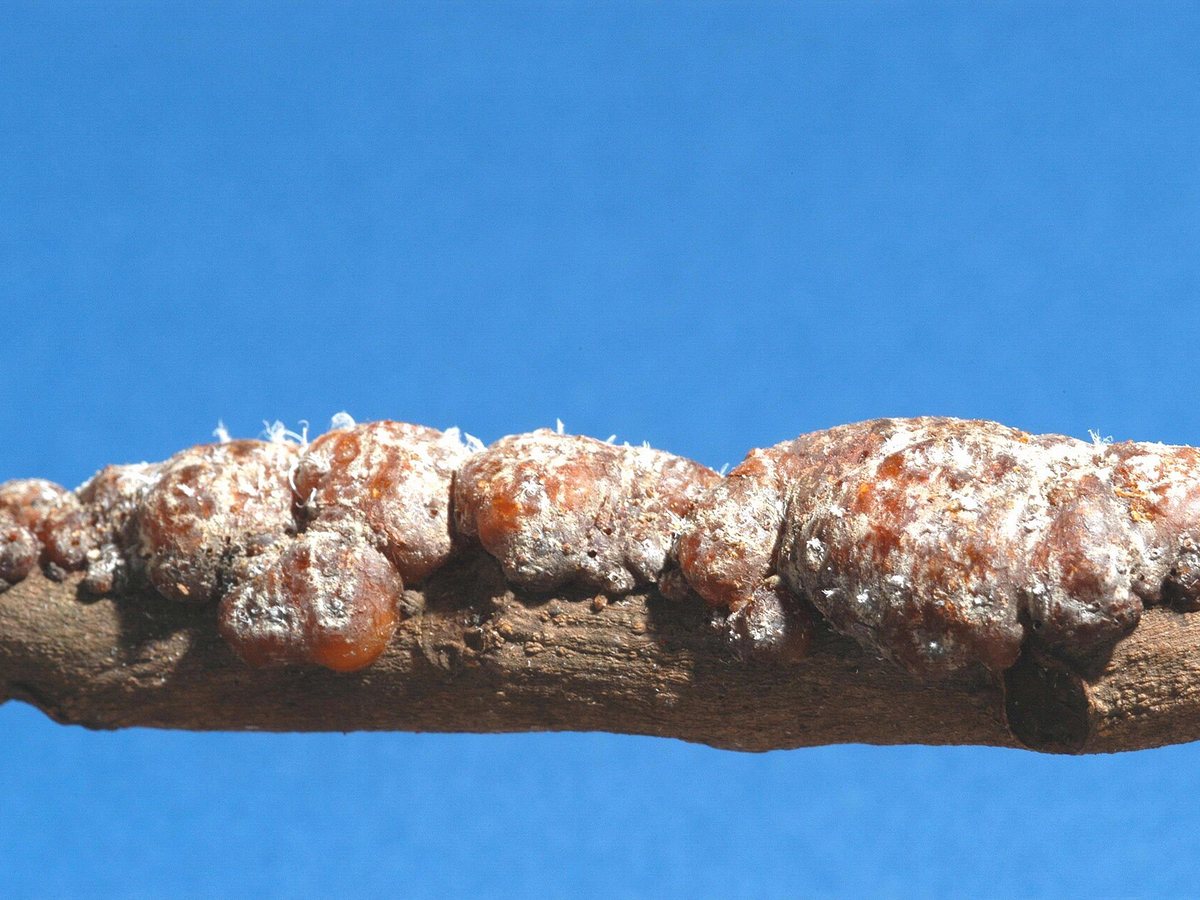
Lac (لاک) is a red dye from female lac insects (Kerria, formerly Coccus lacca) of India. Iran imported it from India by the early 17th century, and dye analysis finds it as the red of classical Safavid carpets: the V&A's report on a 16th-century fragment gives red as lac and orange as madder.
ALSO LAC DYE · LAC RED · LAC-TINGED · KERRIA · COCCUS LACCA · STICK LAC
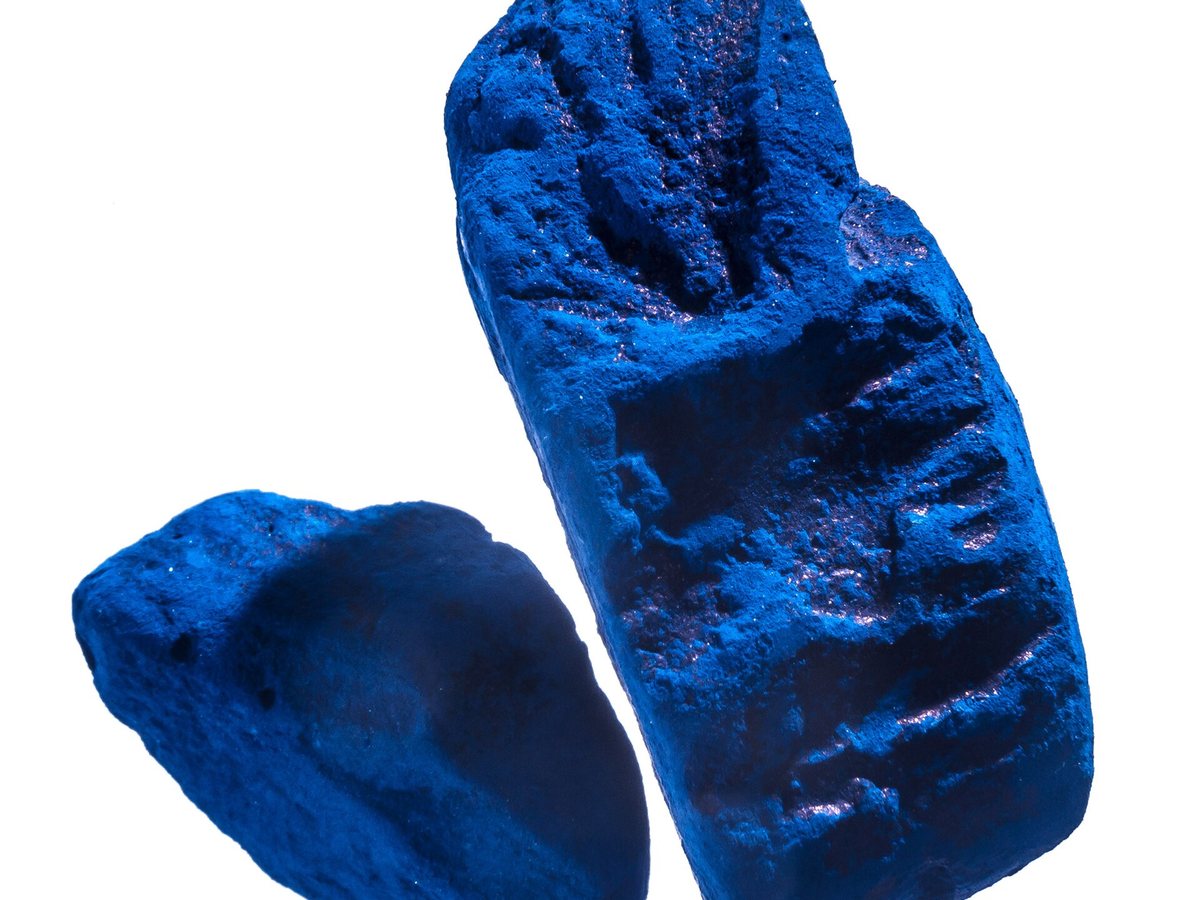
Indigo (نیل, nil) is the blue dye from the fermented leaves of indigo plants, chiefly Indigofera tinctoria. Dipping again gives a deeper blue, and indigo under a yellow gives green. Most indigo for Persian rugs was imported from India. Iranica associates a very dark, double-dyed blue with Bijar and Karadagh and a medium blue with Heriz. Synthetic indigo entered industrial production in 1897. Blue colour alone does not establish whether the dye is natural or synthetic.
ALSO NIL · INDIGO BLUE · INDIGOFERA · INDIGOFERA TINCTORIA · INDIGO-DYED
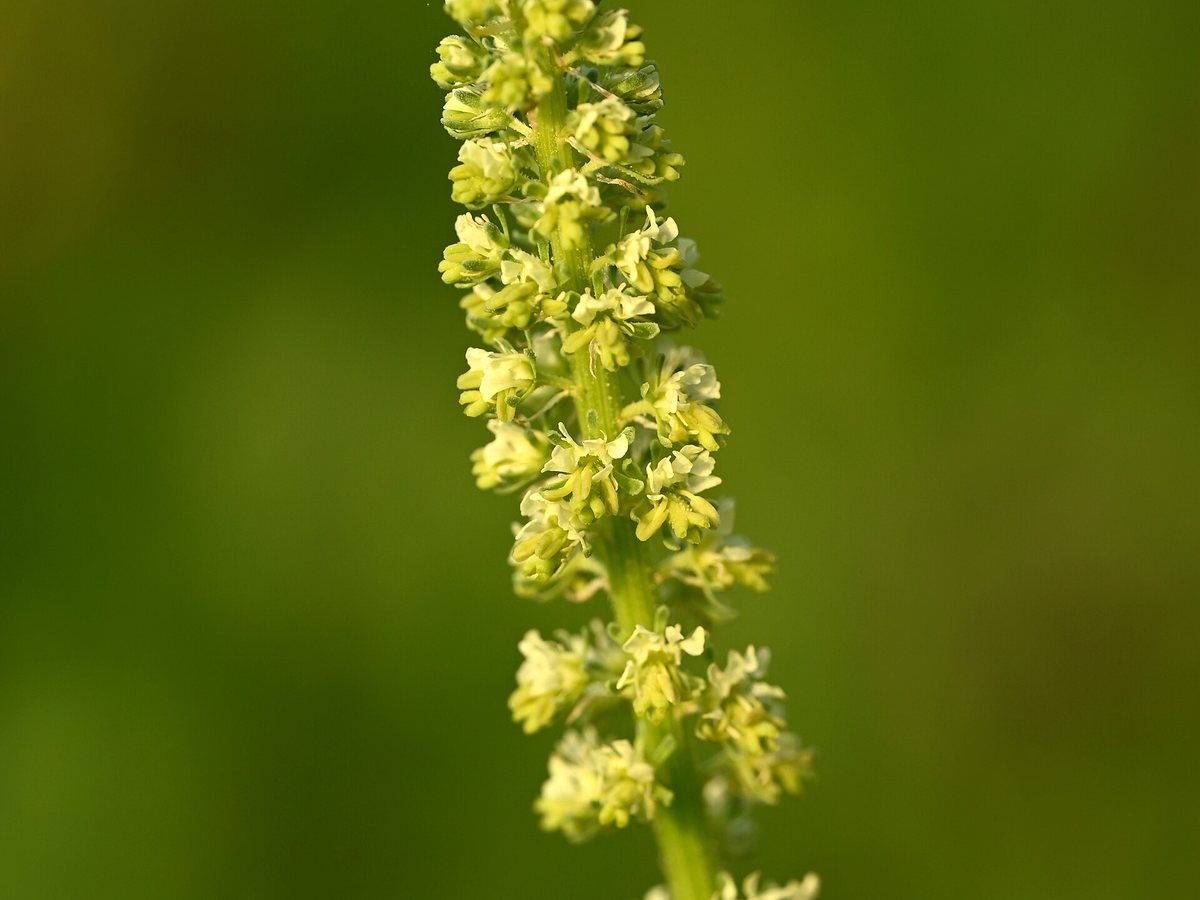
Weld is the yellow dye plant Reseda luteola. Dye analysis of the "Salting" group of carpets proposed weld for their yellows, and the V&A records a luteolin yellow in a 16th-century Persian carpet fragment. Iranica and Edwards equate weld with Persian isparak, but present-day Isfahan dye masters name isparak as a larkspur and say they do not use weld.
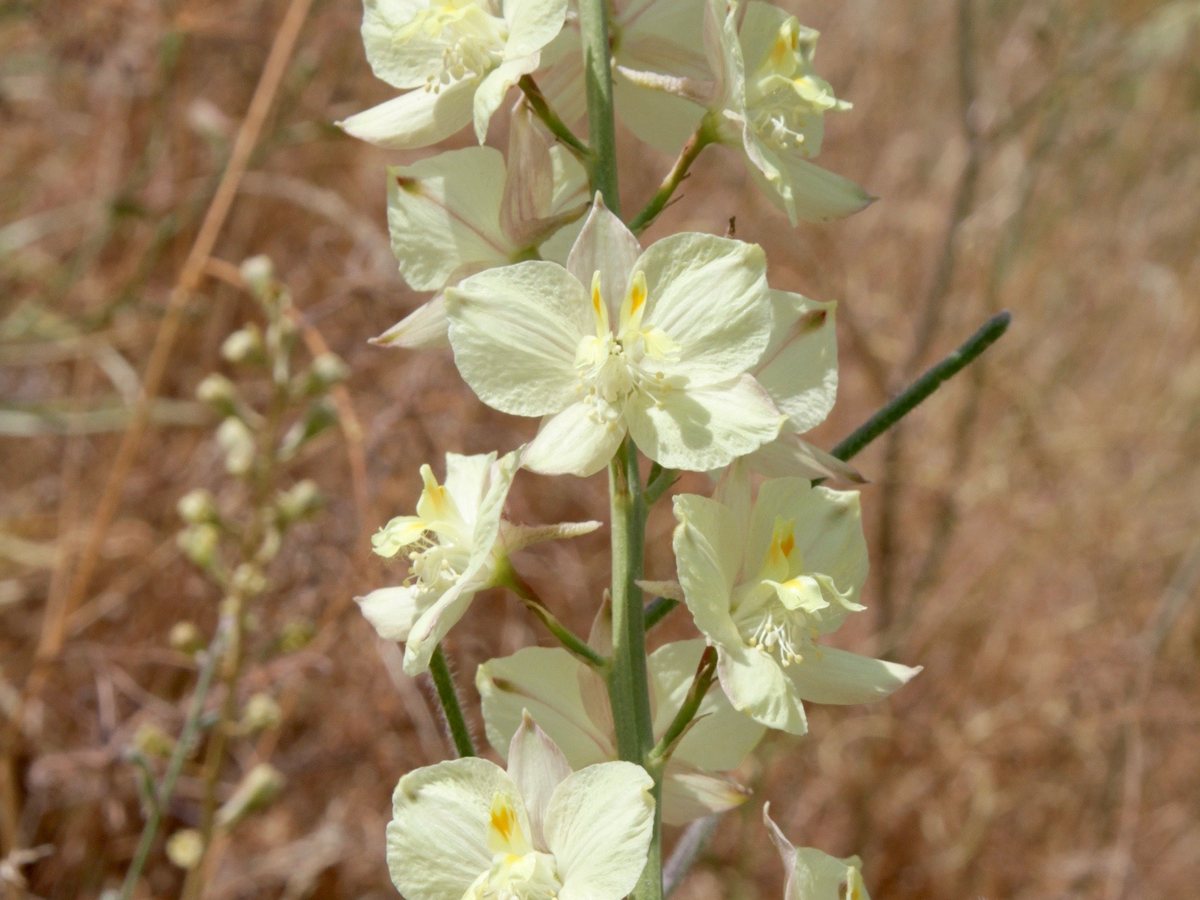
Isparak (اسپرک) is a principal yellow dye of Persian rugs, from the flowers of a yellow larkspur. Dye masters in Isfahan province identify it as Delphinium semibarbatum and use it as their main source of strong yellow; wool dyed with indigo and then with isparak turns green. Older sources, including Iranica and Edwards, call isparak weld (Reseda luteola), a different plant.
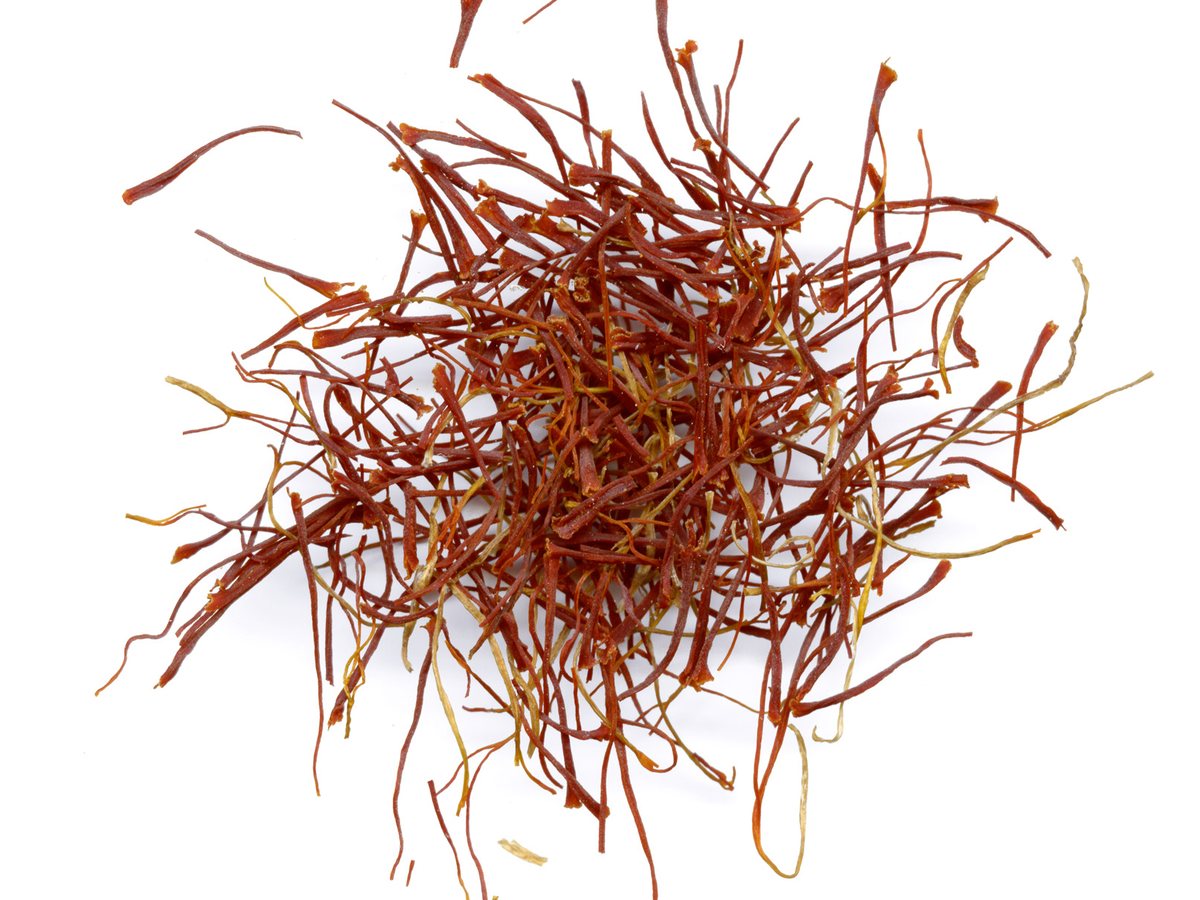
In rug descriptions saffron is a colour name: a warm golden yellow to yellow-orange. As a dye it is doubtful. Saffron (Crocus sativus) is named as a dyestuff in early Persian texts, and Iranica lists it among historical yellows, but notes that it was very costly and that it is not clear it continued to be used as a dye.
Pomegranate rind (پوست انار), the dried peel of Punica granatum, is a yellow dye source in Iran. Isfahan dye masters today use it as a secondary dye with isparak, to shade yellows towards darker yellows, oranges and browns. "Pomegranate red" in a rug description is a colour name only: the dye from the rind is not red.
ALSO POMEGRANATE PEEL · PUNICA GRANATUM · POMEGRANATE RED
Natural greens in Persian rugs are usually compound colours: wool dyed blue with indigo and then dyed again in a yellow such as isparak. Iranica also records green from willow leaves mixed with indigo. Because the yellow can fade faster than the blue, old greens often drift towards blue.
ALSO OVER-DYED GREENS · COMPOUND GREEN · GREEN DYE
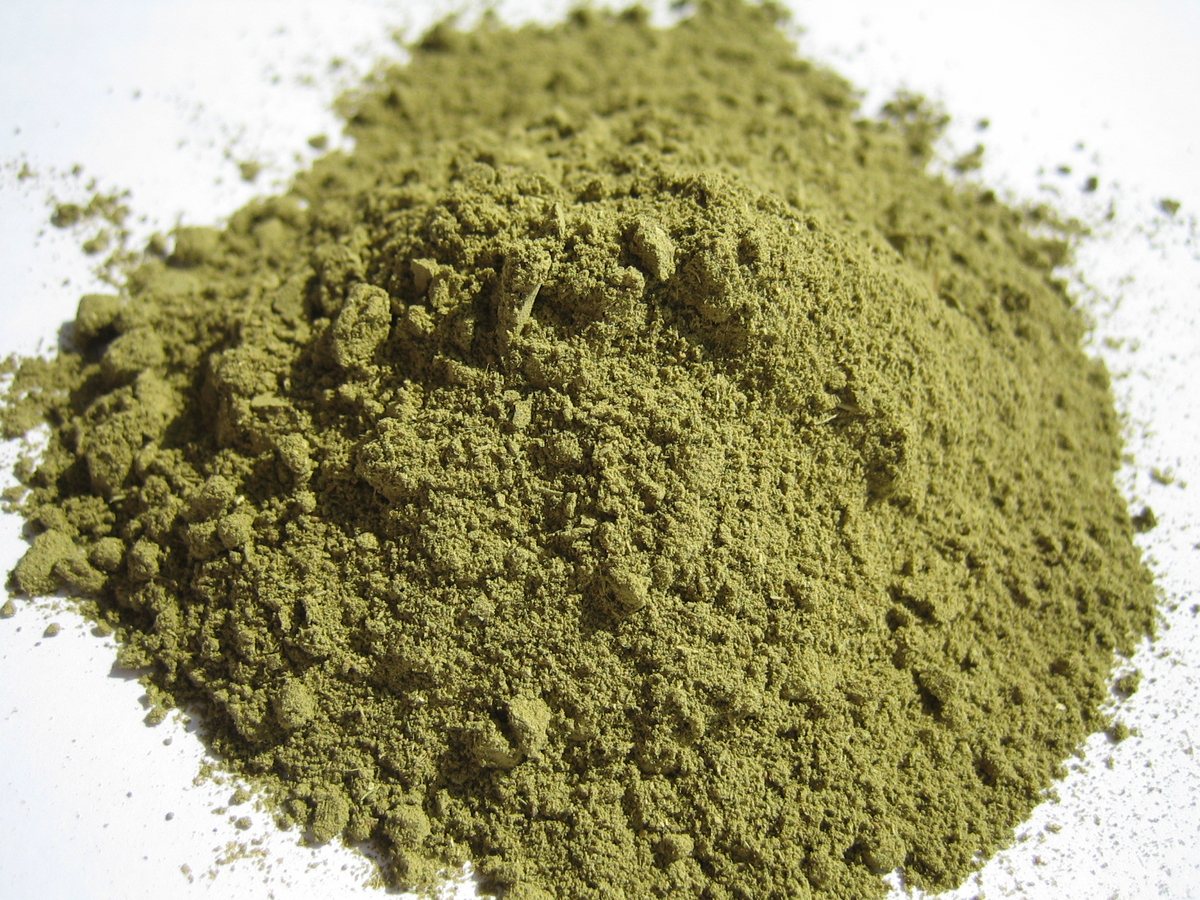
Henna (حنا) is a russet-orange dye from the powdered leaves of Lawsonia inermis, best known in Iran as a cosmetic for hair and hands. For rug wool, Iranica records it combined with indigo to give a luminous black.
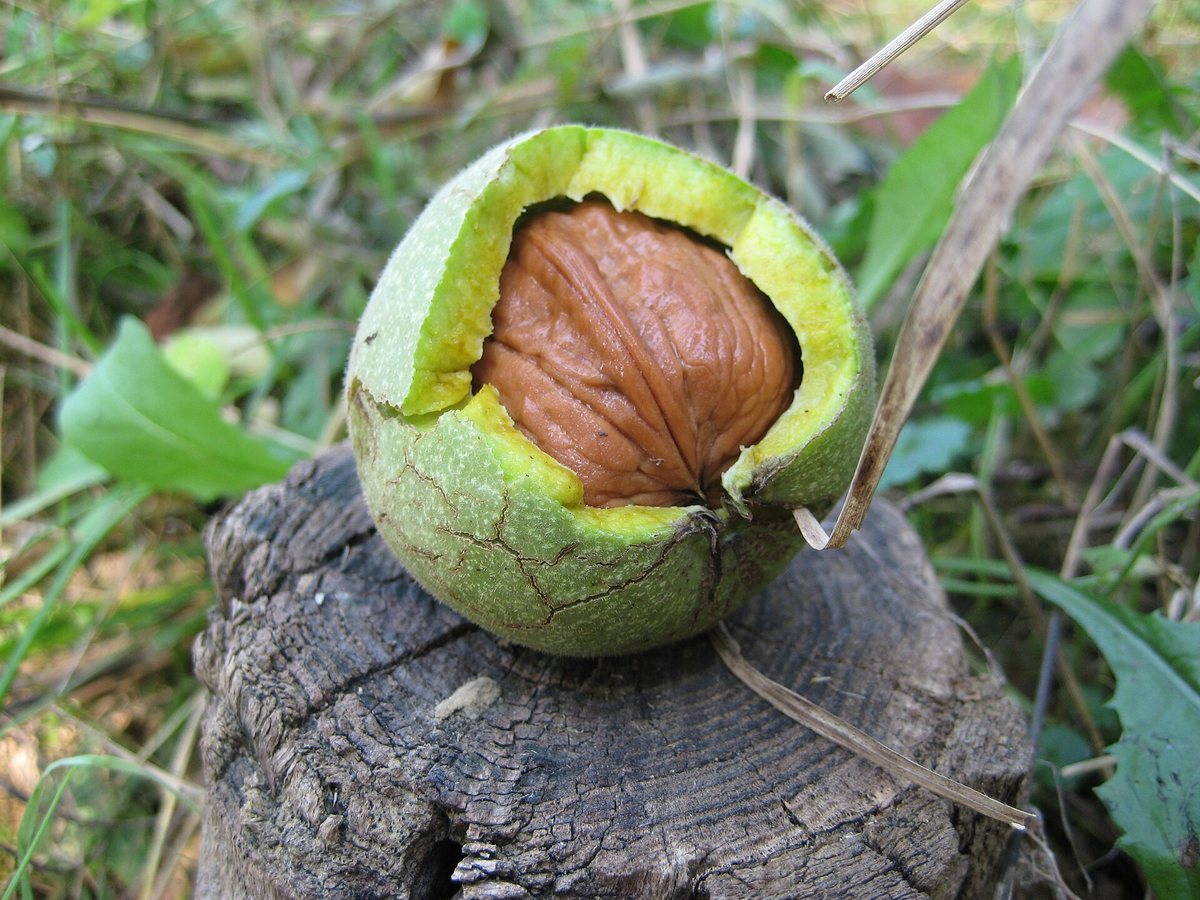
Walnut husk (پوست گردو) is the green outer hull of the walnut, Juglans regia. Iranica lists it, with oak bark, as the Persian source of browns, beiges and tans; Serab weavers are said to have dyed Shahsavan wool with it for their camel tones. Dark browns fixed with an iron mordant are the colours that corrode with age.
ALSO WALNUT HULL · WALNUT HULLS · WALNUT SHELL · WALNUT BROWN · WALNUT BROWNS · JUGLANS REGIA
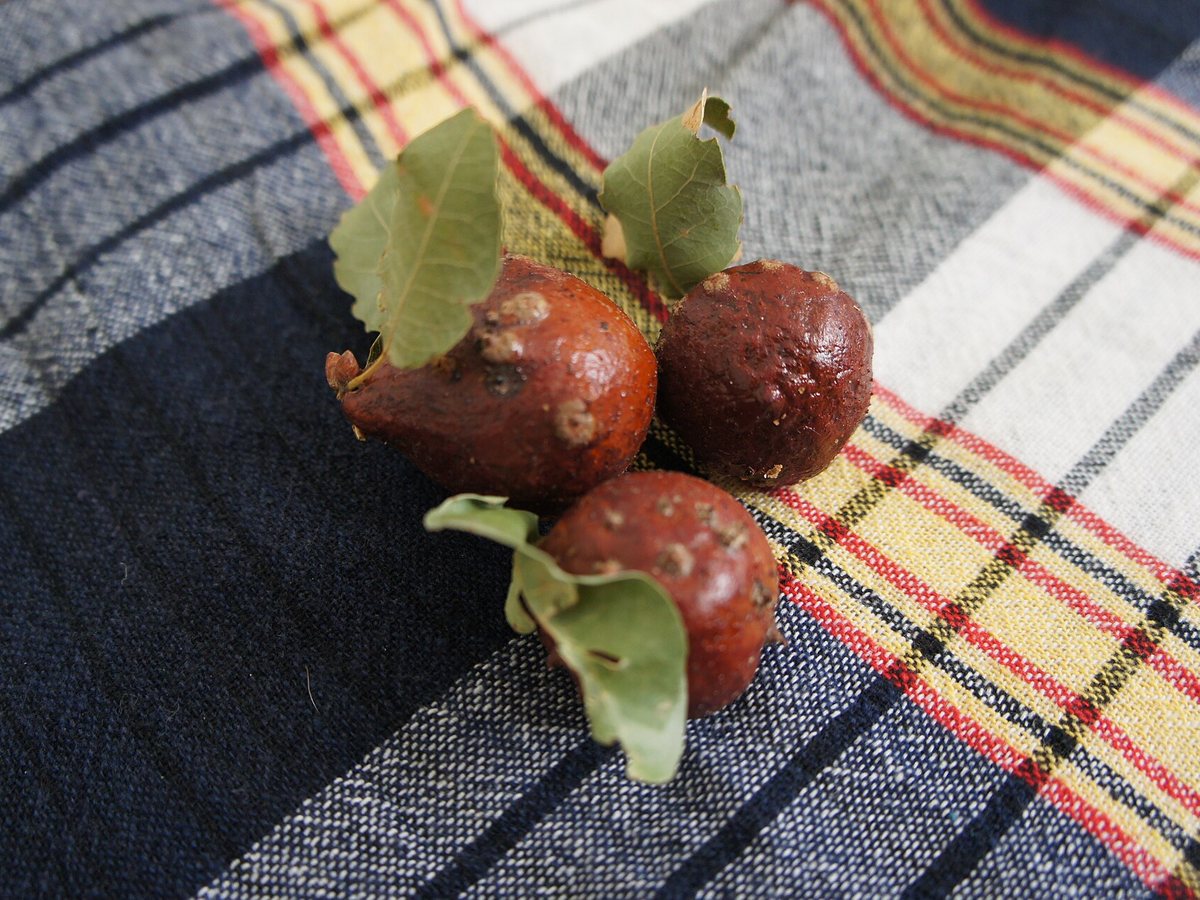
Oak galls (مازو, mazu) are hard growths on oak buds and leaves caused by gall wasps. They are very rich in tannin, and tannin with iron gives black, the chemistry of iron-gall ink. Iranica records oak galls as a source of black for rug wool in parts of Iran. Blacks and browns made with tannin and iron weaken wool, and they are the colours that corrode.
Aniline dyes are the first synthetic dyes, developed in Europe from the 1850s from coal-tar chemistry; the rug trade uses the word for early synthetics in general. They were noted in Persian carpets by the 1870s. Many were fugitive: some faded in light, others ran when washed, so a sun-faded front over a brighter back is a classic sign. The Persian government tried to ban their import, and to confiscate rugs made with them, without success.
ALSO EARLY SYNTHETIC DYES · COAL-TAR DYES · FUCHSINE · ANILINE FUCHSIA
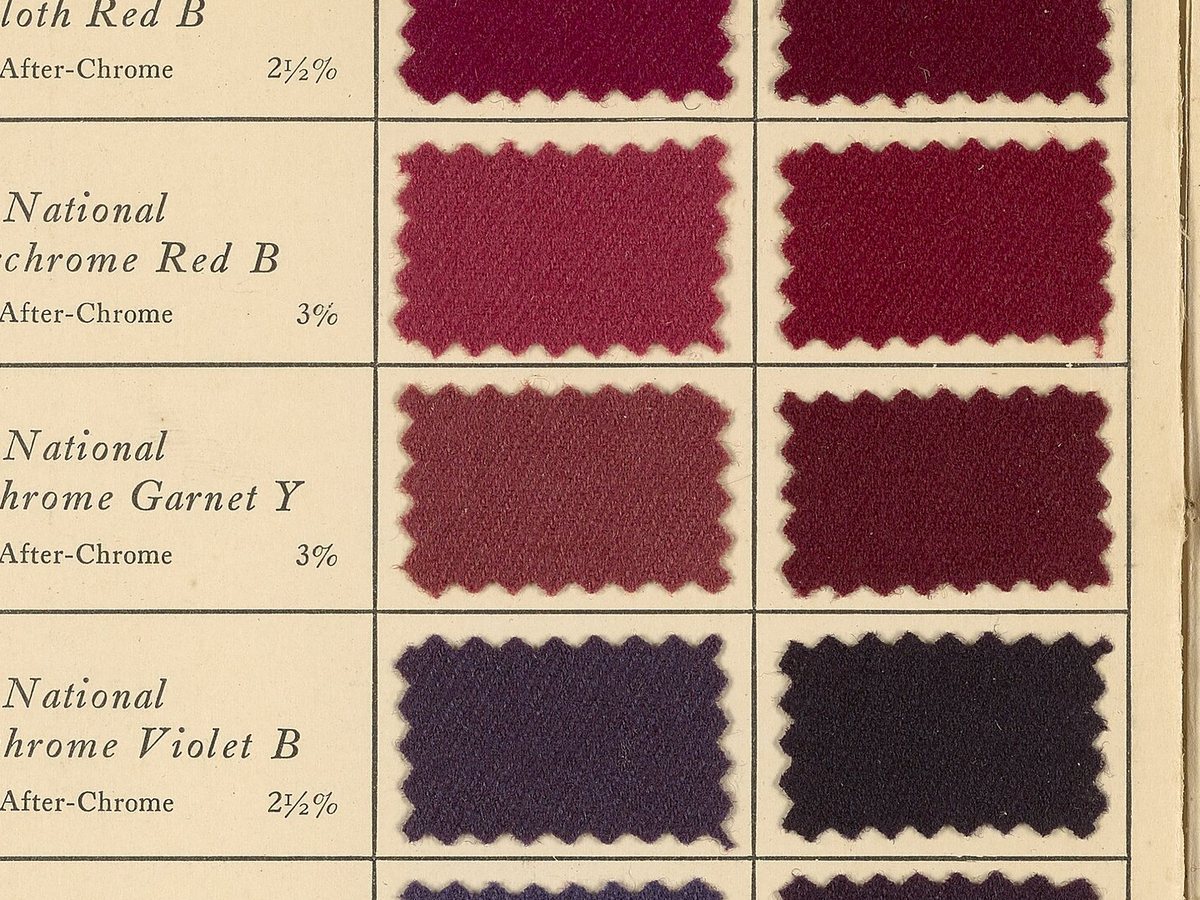
Chrome dyes are synthetic dyes fixed with a chromium compound, potassium dichromate. In the 20th century they replaced the early anilines in commercial rug dyeing: they are cheaper than natural dyes, fast to light and washing, and easy to match from batch to batch, so chrome-dyed fields tend to be uniform. By 1949 an Iranian government conference listed aniline and chrome dyes among the industry's problems.
ALSO CHROME-DYED · SYNTHETIC DYE · SYNTHETIC DYES · MODERN SYNTHETIC DYES · CHROME YELLOW · CHROME RED
Abrash (ابرش) is a change of shade in horizontal bands across the width of a rug, where the weaver moved on to wool from a different dye or wool lot. Read it on the whole rug: a shift at the same height on both long borders is abrash, while a smooth diagonal gradient is lighting. It is a sign of hand-dyed, small-batch wool, not a fault. The word means dappled, as of a horse.
Corrosion is pile worn lower in certain dyed colours than in those around it: most often dark browns and blacks fixed with iron, and in some older rugs greens made with copper salts. The metal weakens the wool, so over decades that pile wears down. Undyed natural brown or camel wool is not subject to this dye-related corrosion. Shearing before export reduces the visible trough.
ALSO OXIDATION · OXIDISED · OXIDIZED · IRON CORROSION · CORRODED BROWNS · ETCHED PILE
Nili (نیلی) is Persian for indigo-coloured: a deep blue leaning towards violet. Rug titles use it for a piece whose ground or dominant colour is dark indigo blue. It names the colour, not the dye; whether the blue is natural indigo needs separate evidence.
Firuzeh (فیروزه) is Persian for turquoise, the stone, and for its colour: a light sky blue with a touch of green. In rug titles it names the colour of a ground or of details. Colour and its evenness are clues to consider alongside other evidence, rather than proof of a particular dye.
ALSO FIROUZEH · FIROOZEH · TURQUOISE · TURQUOISE BLUE
Laki (لاکی) is Persian for lac-coloured, after lac, a red obtained from the lac insect. Dehkhoda records laki as a named shade in Kashmir shawls, set against emerald, and gives laki termeh as a bright red cloth. Our titles spell it Laaki and use it for a red ground or main colour. It names the colour, not the dye.
Lajevardi (لاجوردی) is Persian for the colour of lajevard, lapis lazuli: a deep blue. Dehkhoda glosses it as kabud, dark blue, and notes that classical poets use it for the sky. In rug descriptions it names a deep blue ground or detail. It names the colour, not the dye.
ALSO LAJVARDI · LAJVERDI · LAPIS BLUE · LAPIS LAZULI BLUE
Sormei (سرمهای) is Persian for the colour of sormeh, the kohl drawn round the eyes: a dark blue verging on black. The Amid dictionary defines it as a dark colour mixed of black and blue, and dictionaries give it for navy blue. In rug descriptions it names a navy ground or border. It names the colour, not the dye.
Shotori (شتری) is Persian for camel-coloured. Dehkhoda describes it as a colour leaning to yellow, like camel wool, or like ardeh, sesame paste. In rug descriptions it names a camel-coloured ground, which may be camel hair or sheep's wool dyed to the shade; Iranica notes that walnut hulls give beige and tan. It names the colour, not the fibre or the dye.
Nokhodi (نخودی) is Persian for chickpea-coloured. Dehkhoda defines it as a colour like the chickpea, a pale yellow. In rug descriptions it names a pale yellow ground or detail. It names the colour, not the dye.
Alvan is Persian for 'colours' (the plural of lawn, colour), and as an adjective it means multicoloured. In titles it marks a piece woven in many colours.
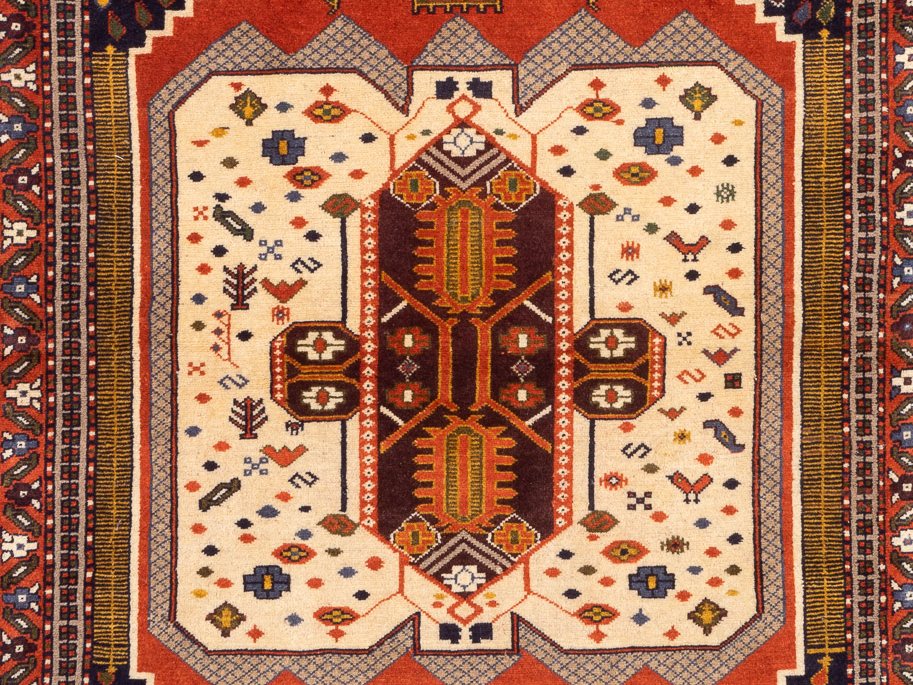
The field (matn) is the central area of a rug, enclosed by its borders. It carries the main design: a medallion, an all-over repeat, a lattice, a pictorial scene or open colour. Its background colour is called the ground, as in an ivory or a red field.
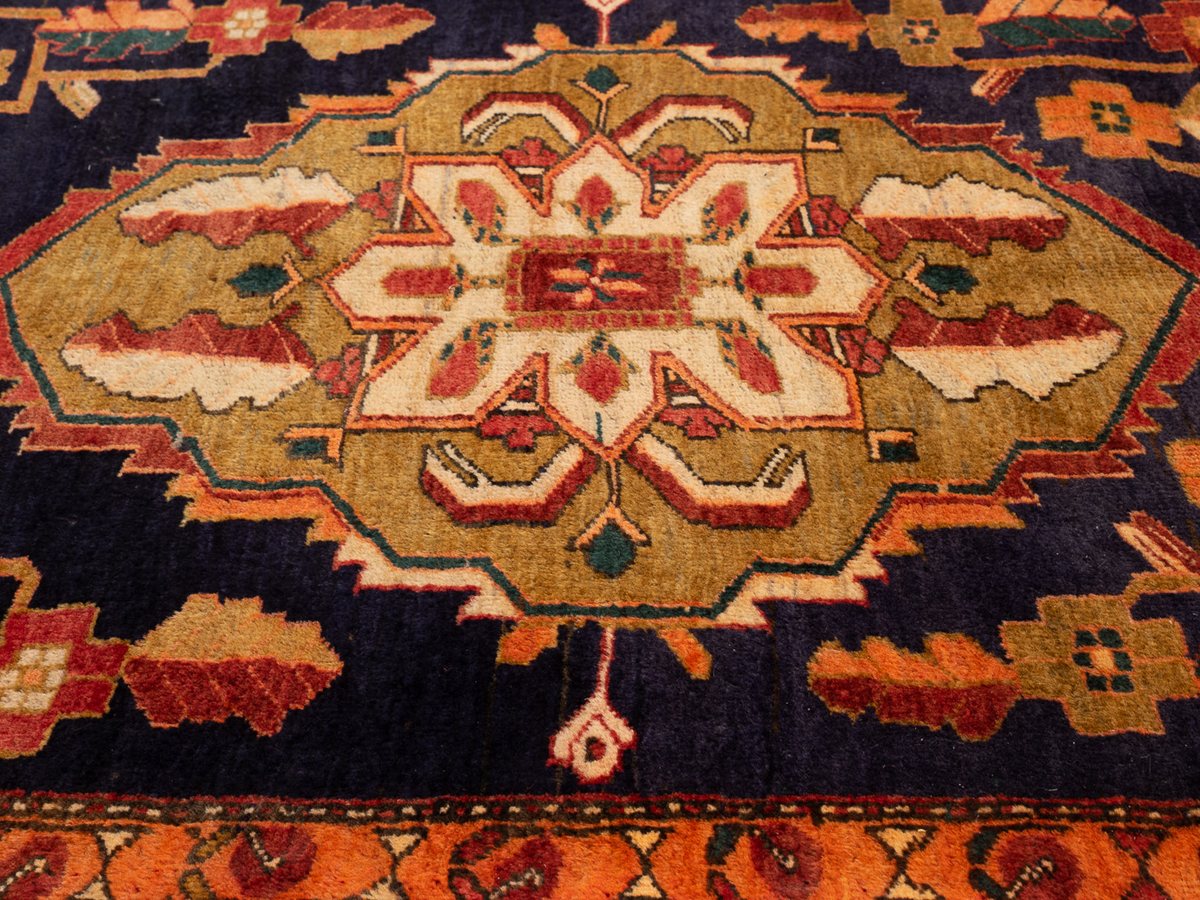
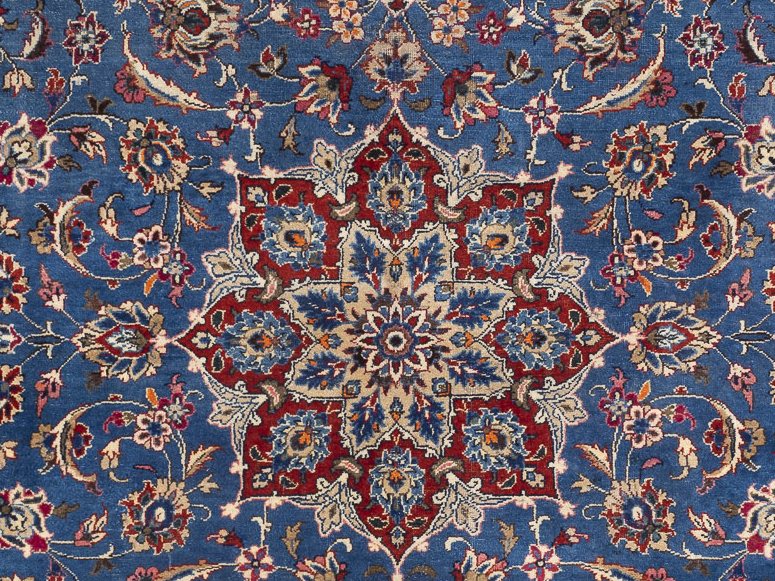
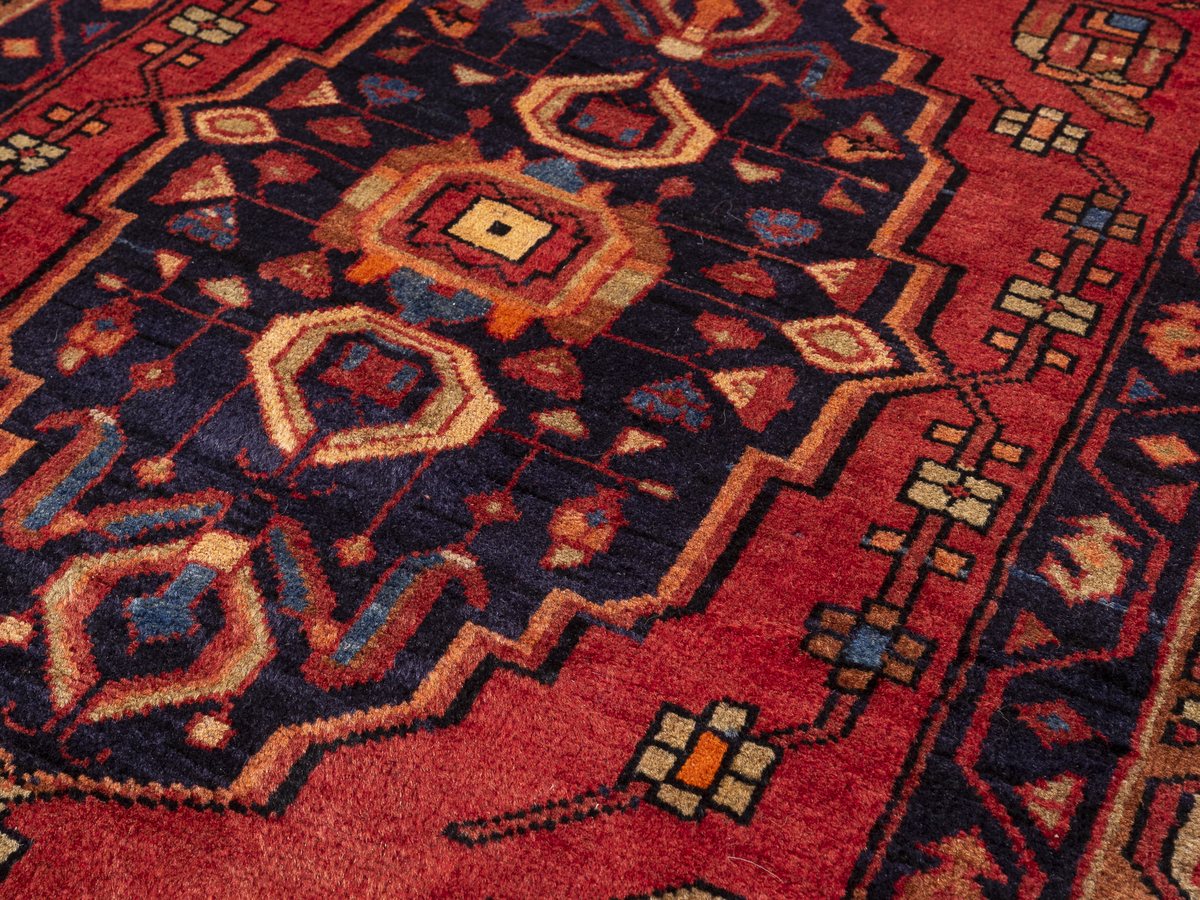
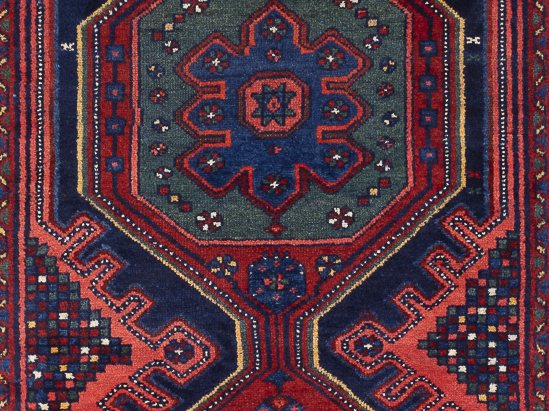
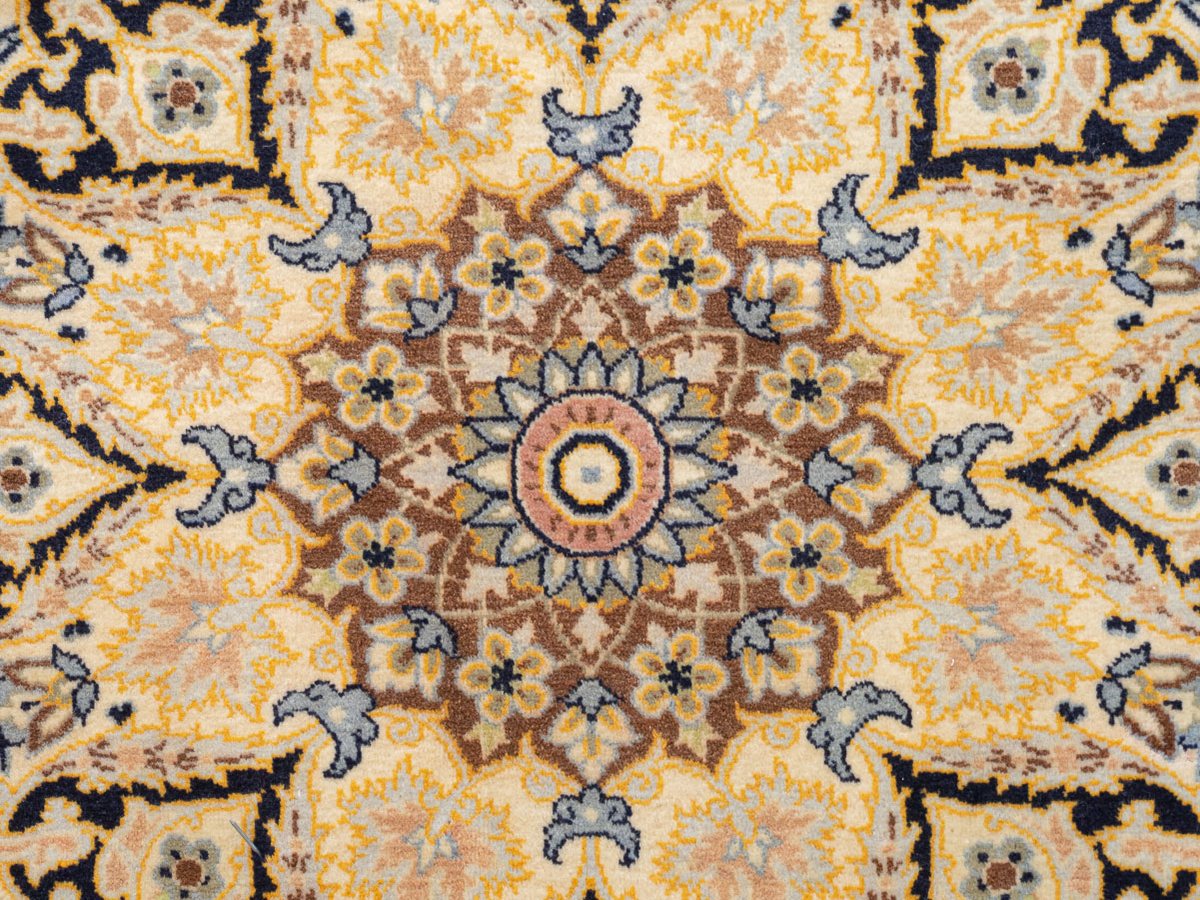
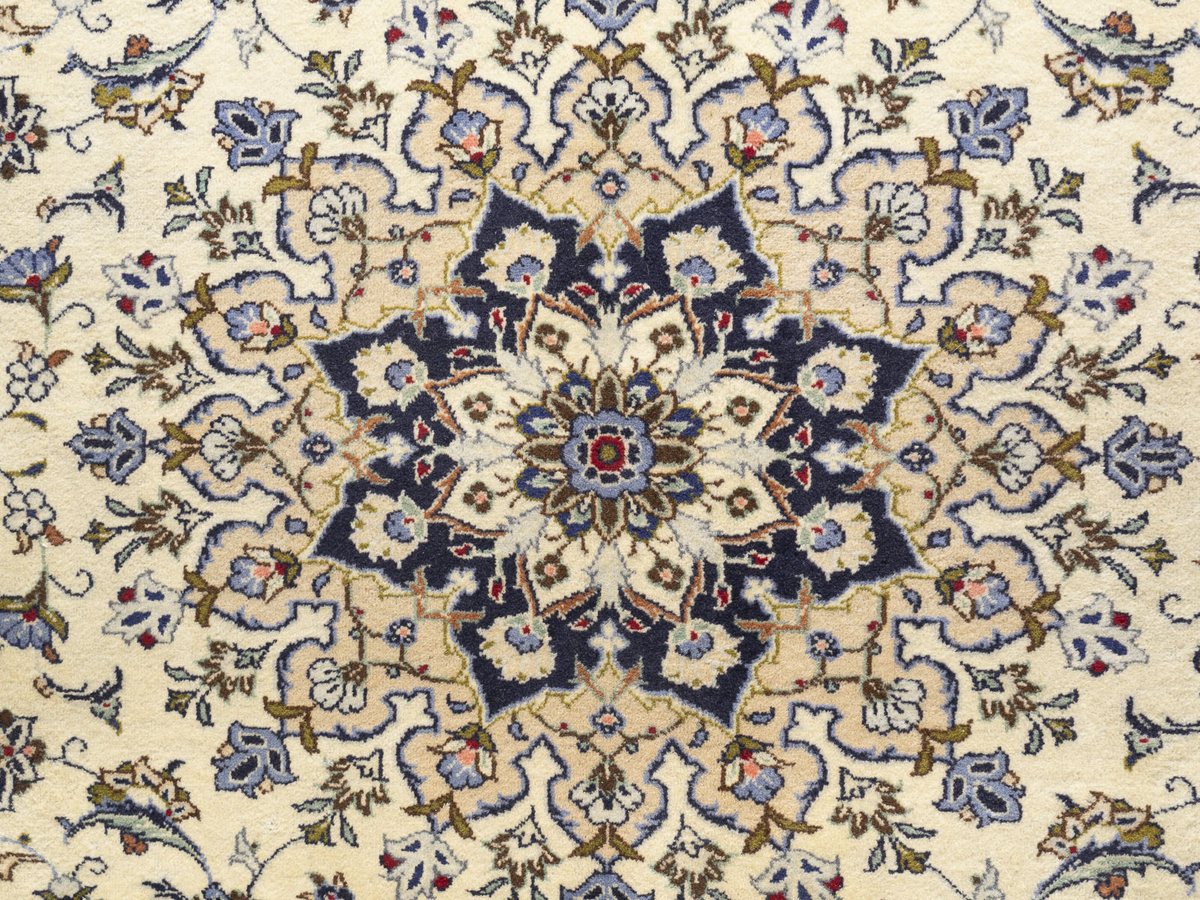
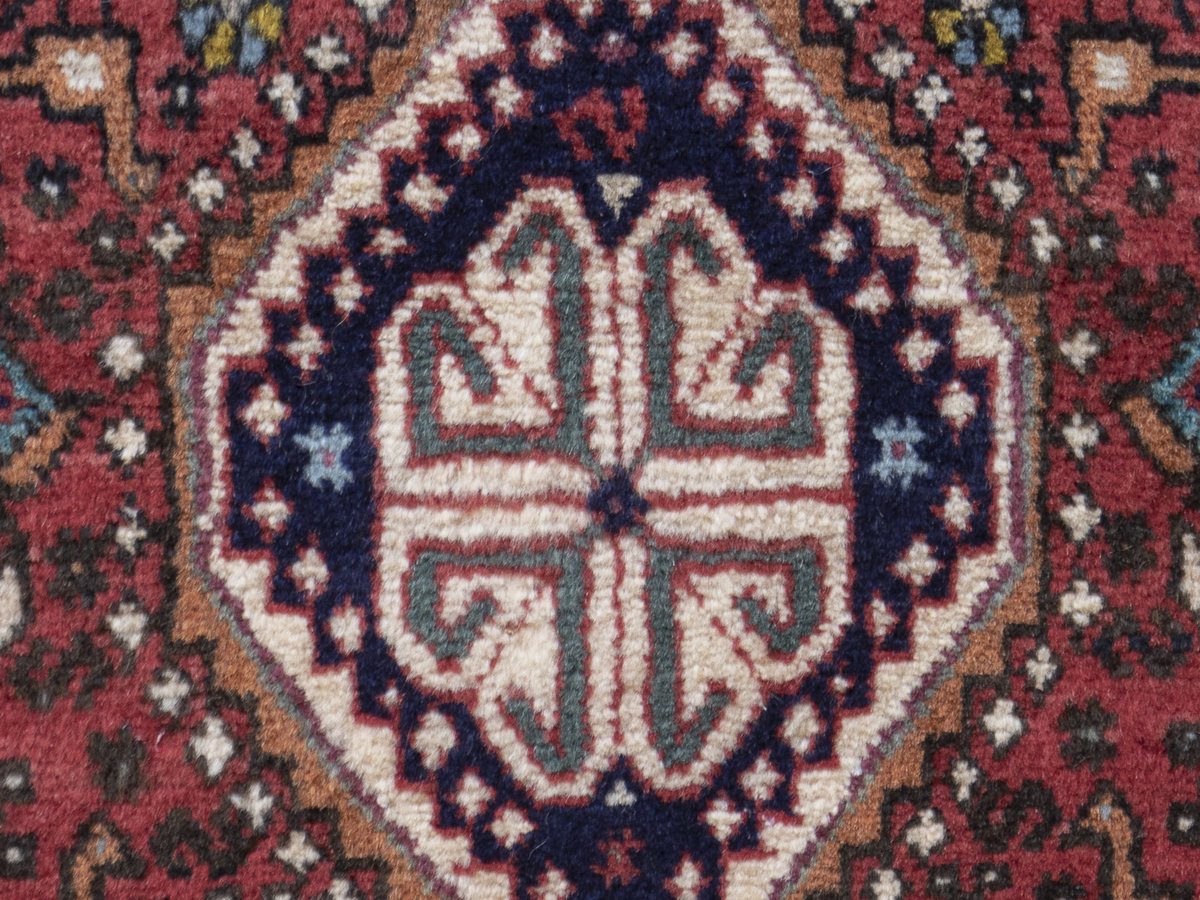
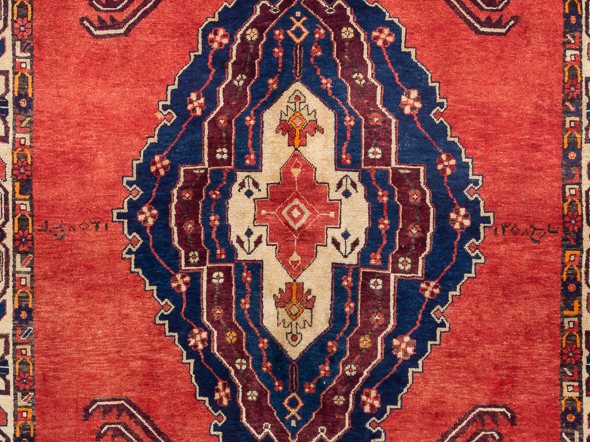
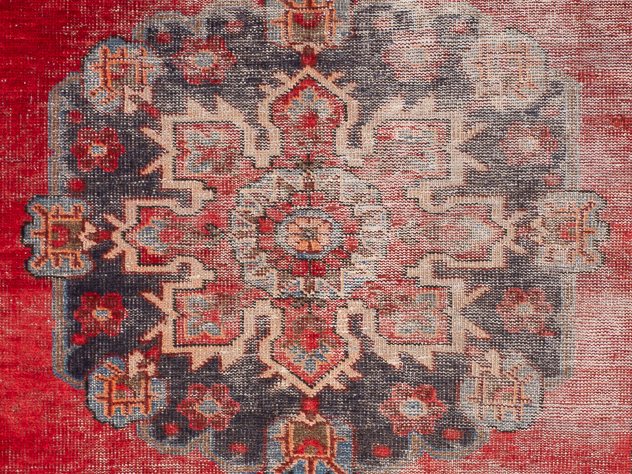
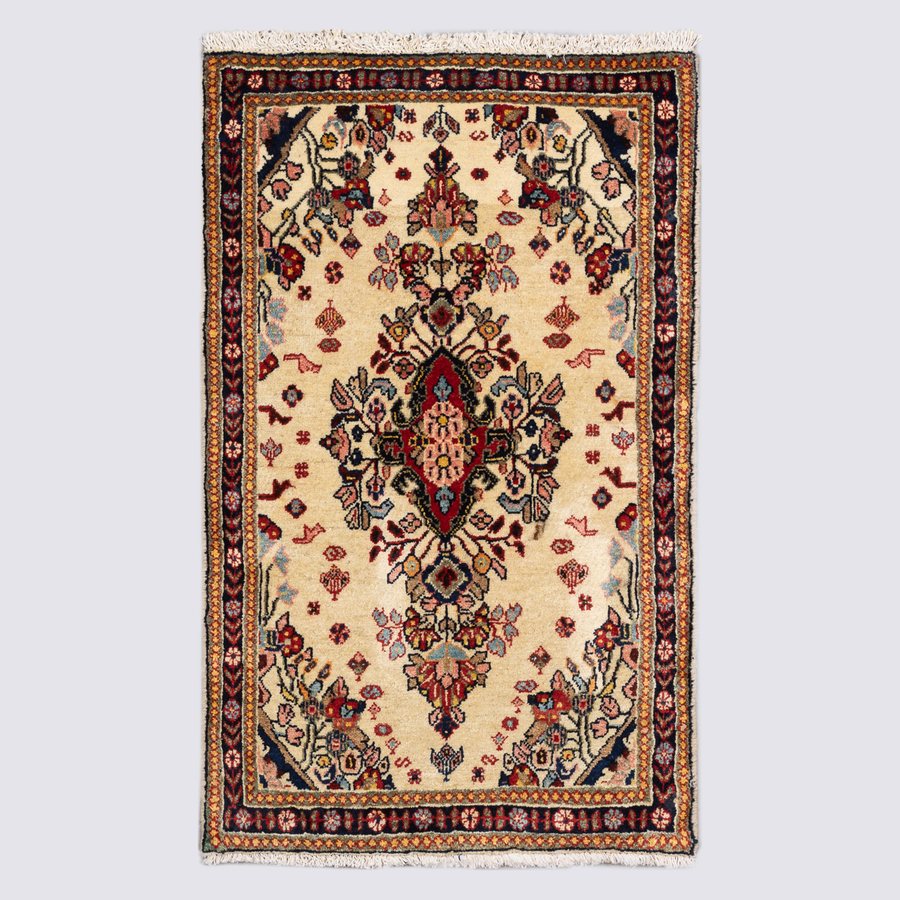
A medallion (toranj) is a large ornament at the centre of the field, most often round, oval, lozenge-shaped or shield-shaped, with lobed or stepped edges. Toranj is also the Persian name of the citron. A design built around one is a medallion design; with quarter-medallions in the corners as well, it becomes lachak toranj.
ALSO TORONJ · TORANH · OVAL TORANJ · SINGLE TORANJ · NAQSH-E TORANJ
Lachak are the corner pieces of a field: quarter-medallions or triangular spandrels in each of the four corners, usually echoing the central medallion. The Persian word also means a small triangular headscarf. Combined with a central medallion, they form the lachak toranj layout.
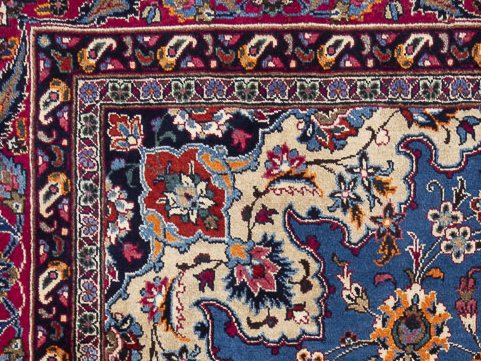
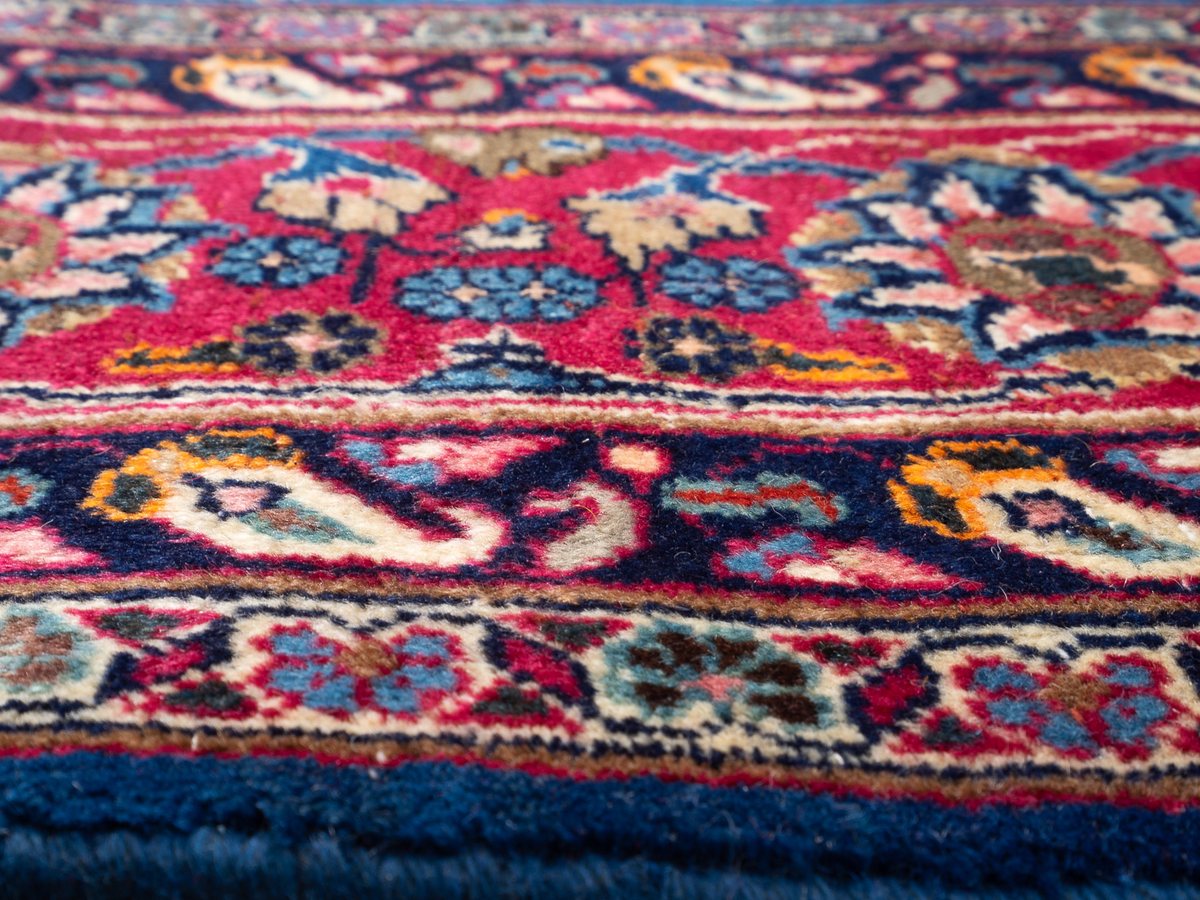
The border (hashiyeh) is the band of patterned stripes framing the field. Persian rugs usually have three or more: a wide main border with narrower minor borders on either side, separated by guards. Hashiyeh means the border; the selvedge, the finished long edge, is shirazeh in Persian.
ALSO HASHIYEH · HASHIEH · HASHIA · MAIN BORDER · MINOR BORDER · BORDER STRIPE
Guards are the narrow bands, often of plain colour, that run between the stripes of a rug's border and usually separate the wide main border from the narrower minor borders on either side.
Lachak toranj is the medallion-and-corner layout: a medallion at the centre of the field and a quarter-medallion in each corner. It is among the most common Persian formats, from the curving floral versions of town workshops to the angular medallion-and-corner carpets associated with Heriz.
ALSO LECHEK TORANJ · LACHAK TORANH · MEDALLION AND CORNER
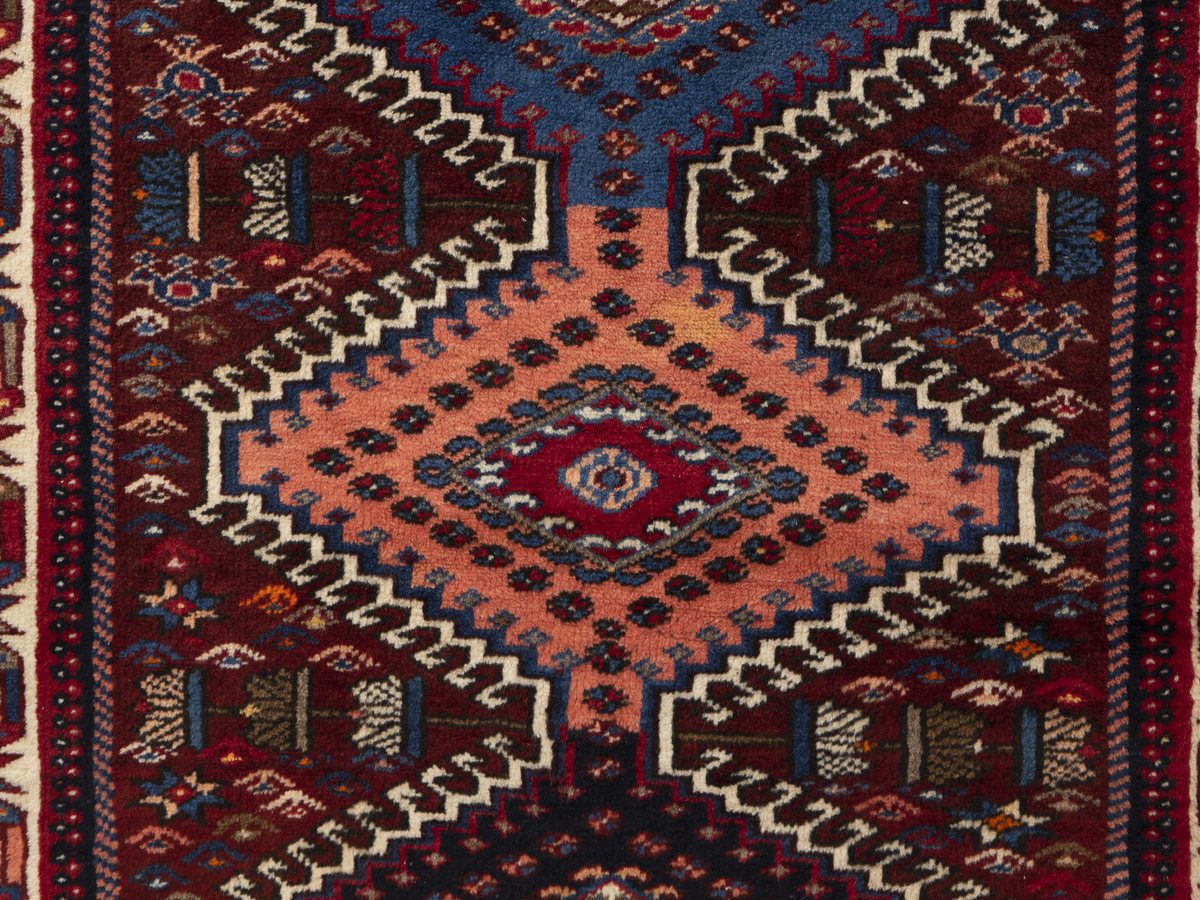
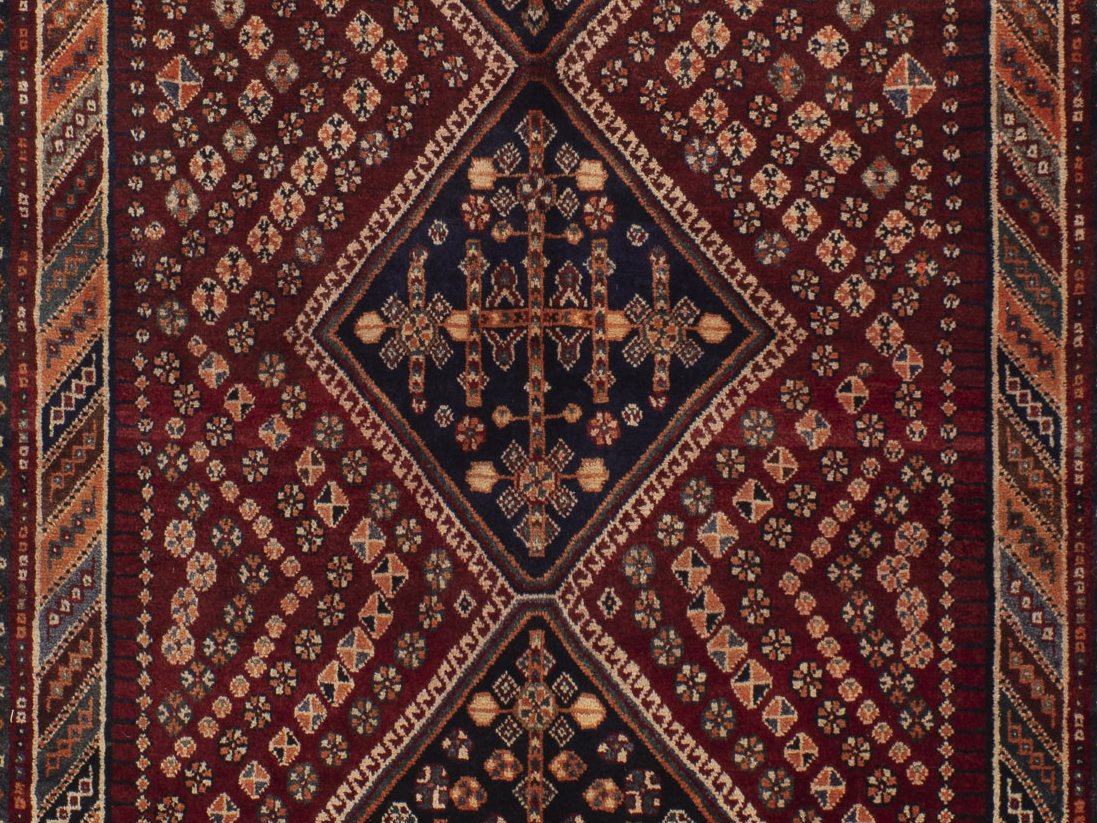
A multiple-medallion design fills the field with two or more medallions, usually set in a row down the length of the rug, either separate or linked. Titles count them, as in double, triple or five toranj.
ALSO DOUBLE TORANJ · TRIPLE TORANJ · THREE TORANJ · FOUR TORANJ · FIVE TORANJ · FIVE MEDALLION
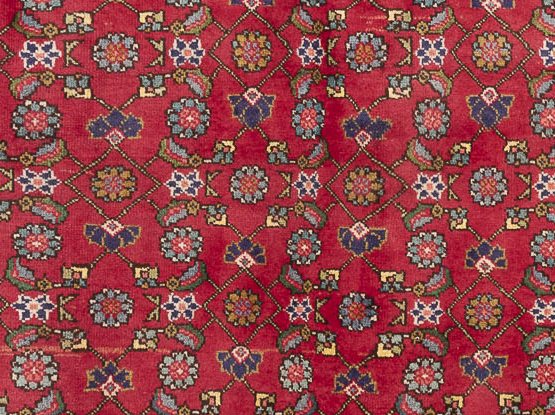
An all-over design covers the field edge to edge with a pattern instead of building it around a medallion. Most are repeats of a small unit, such as the herati or the boteh, set in rows or offset rows, and many read the same from any side.
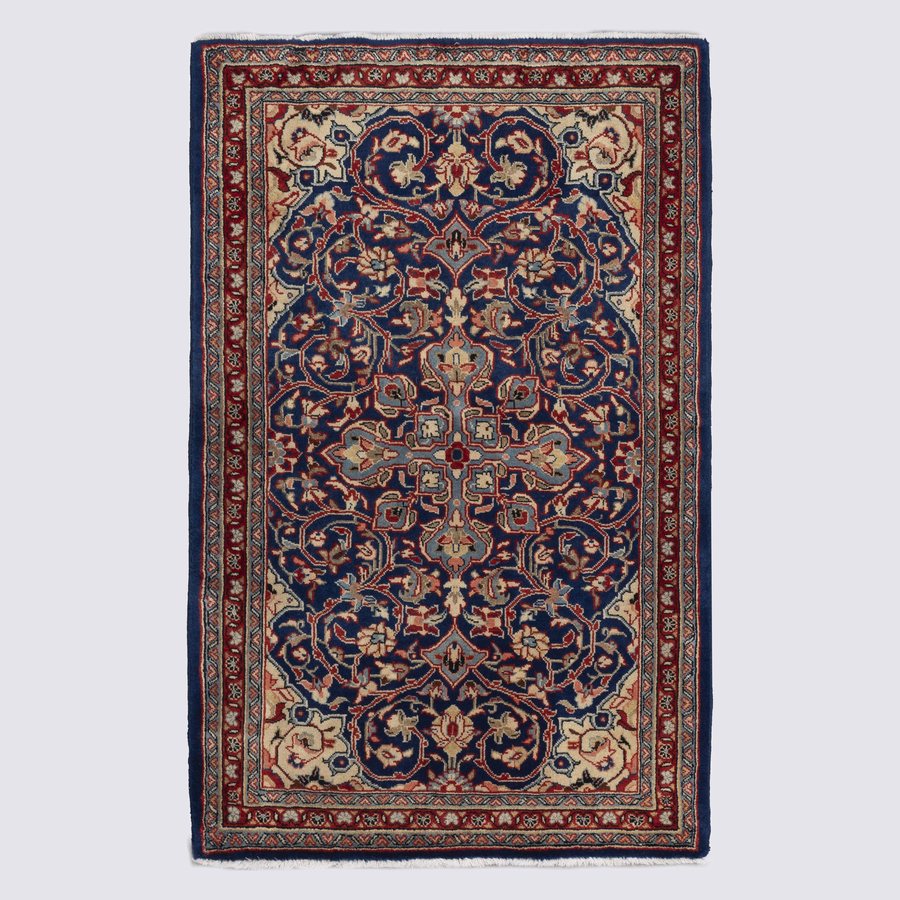
Afshan (Persian 'scattered') is an all-over design of flowers, palmettes and leaves strewn across the field on a network of scrolling stems. It usually has no dominant medallion, though some rugs set a medallion over it.
ALSO AFHSAN · AFSHAN SHAH ABBASI · AFSHOON · SCATTERED DESIGN
Millefleur (French, 'a thousand flowers') describes a field densely covered with small flowers and flowering sprays. Museums use the term for a group of eighteenth-century Kashmir rugs with an arched niche, which may have served as prayer rugs, and the V&A applies it to a Farahan rug with a prayer arch from about 1850.
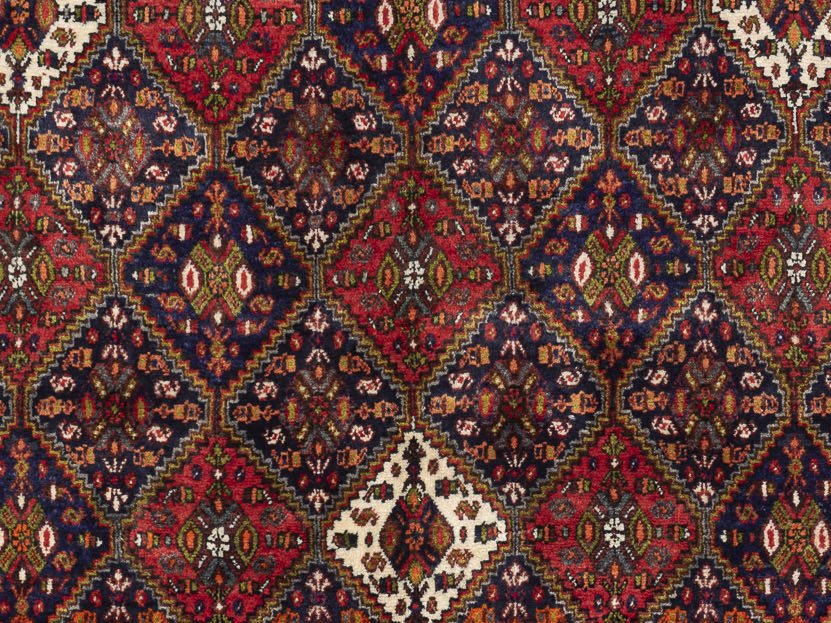
A lattice design divides the field with an all-over grid of lines or stems, often diamond-shaped, with a motif in each compartment. Two or more grids can be laid one over another so that they cross at regular intervals.
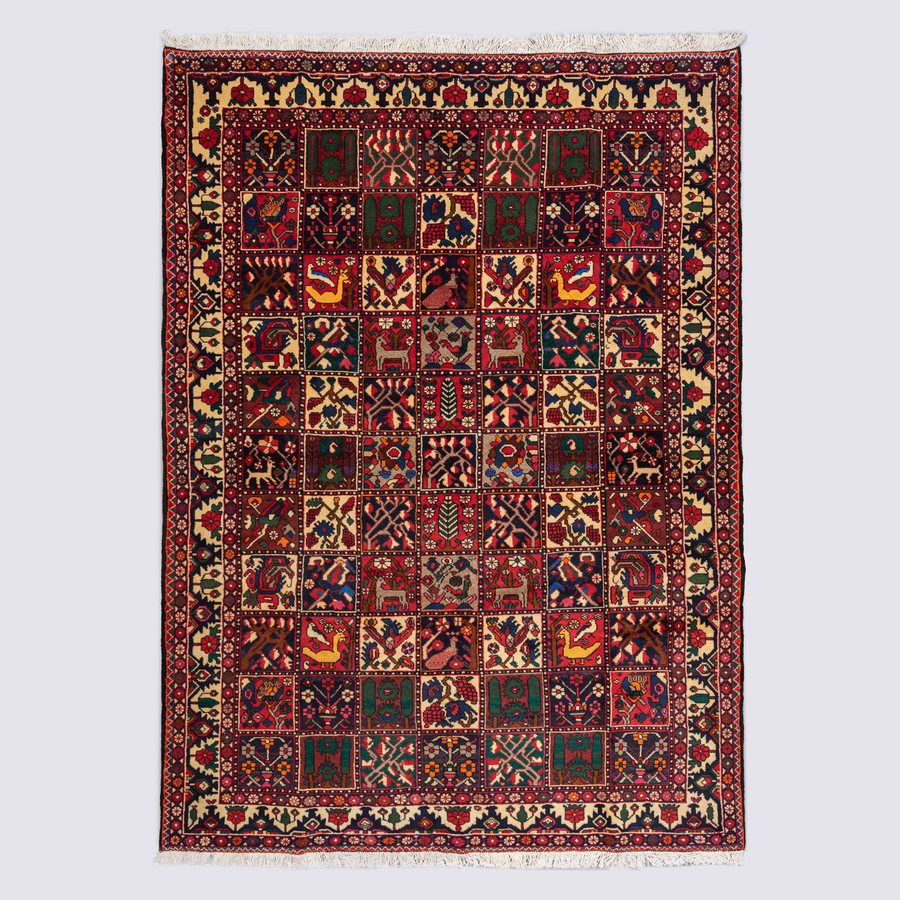
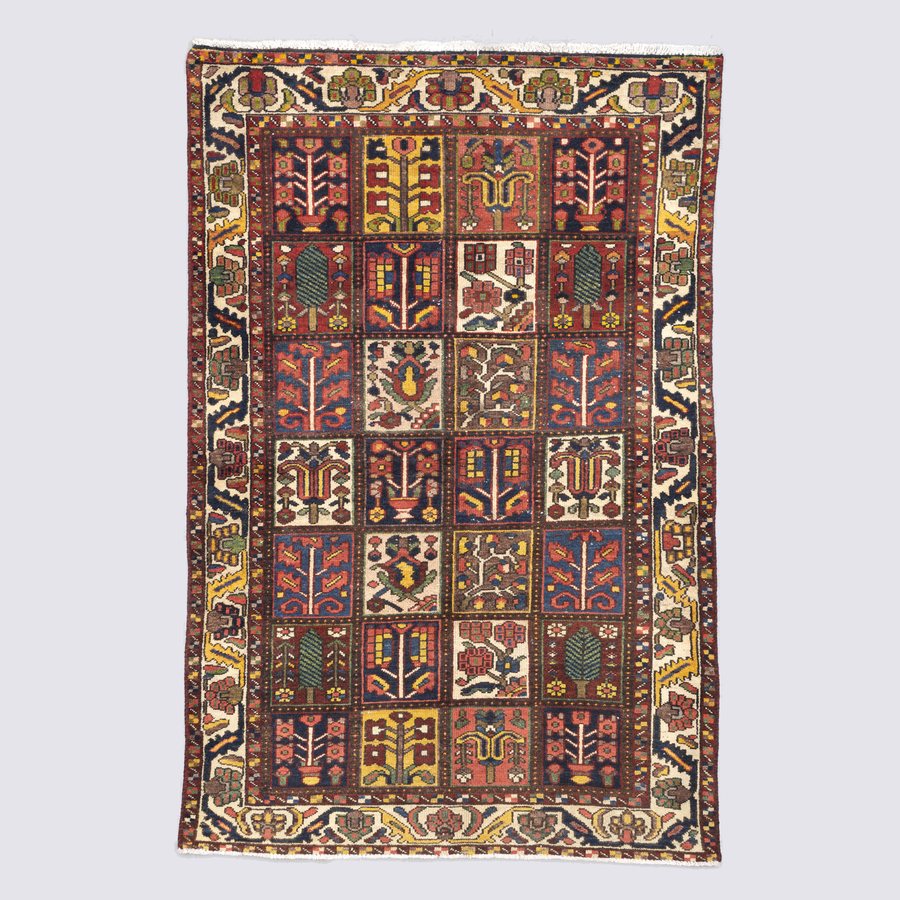
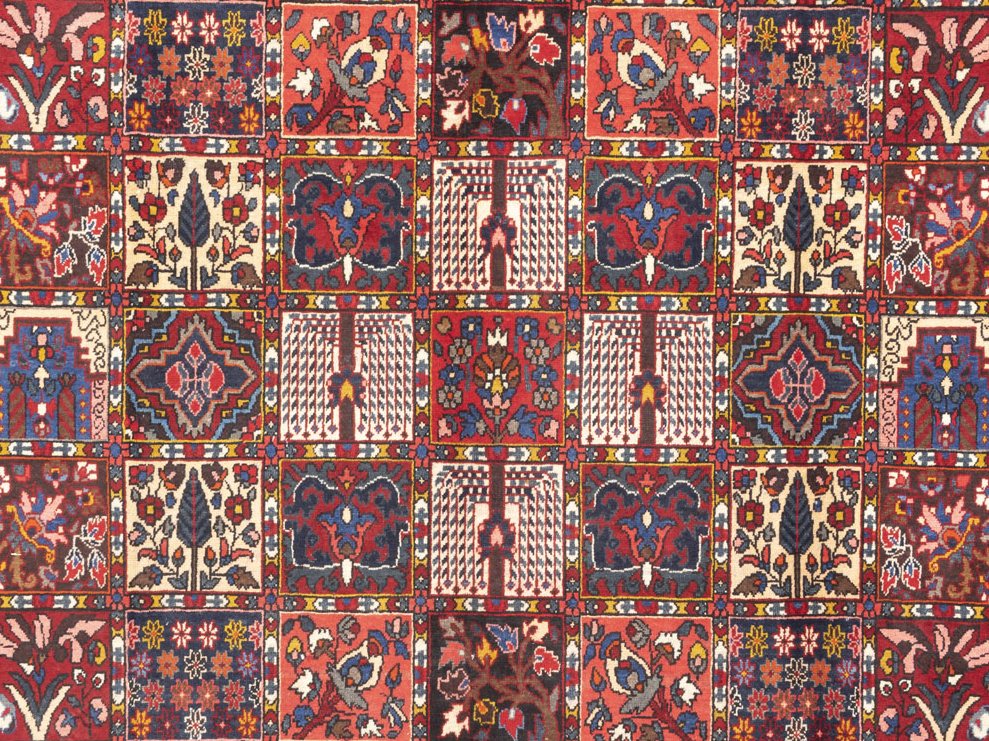
Kheshti (Persian 'brick-like', from khesht, a mud brick) is a design that divides the field into a grid of square or rectangular compartments, each holding its own motif. Iranica names the brick-patterned rugs of Chahar Mahal-e Bakhtiari as the classic example; the layout is woven in other regions too.
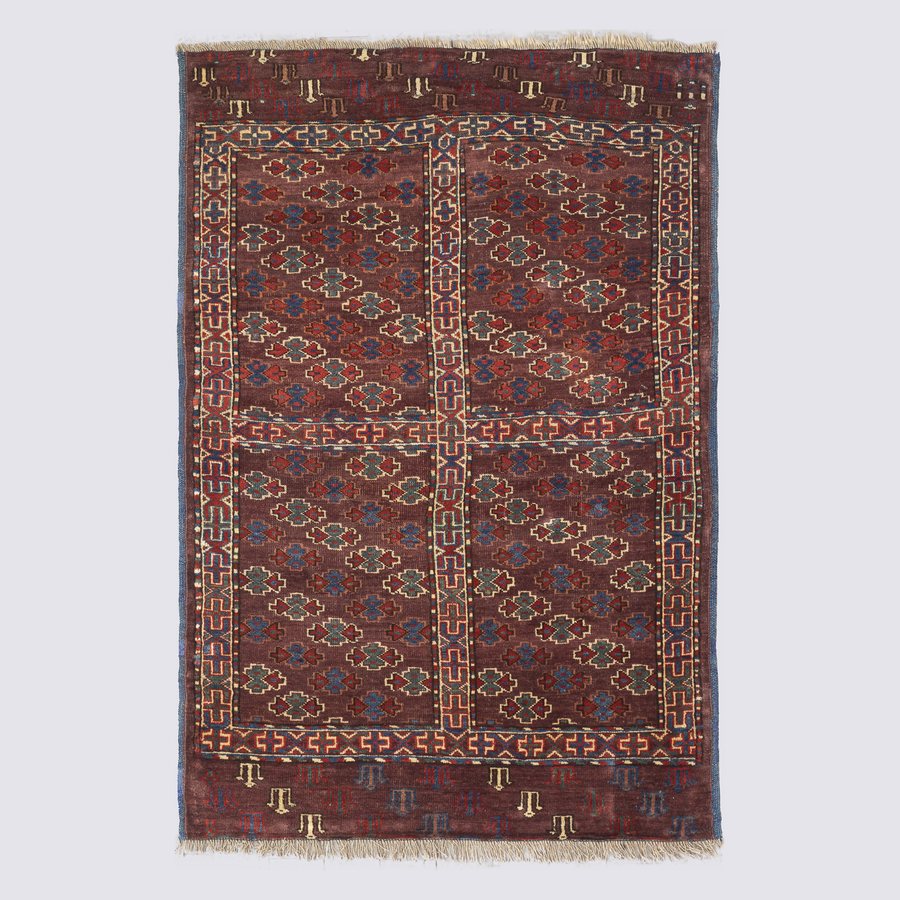
Qab is Persian for a frame or case. A qabi ('framed') design sets the field out in framed panels, much like kheshti; '4 Qabi' on our Turkmen rugs means a field divided into four framed panels.
A garden design arranges trees, flowers and other garden elements across the field. Some carpets depict a garden from above, with water channels dividing beds around a pool. Others, including the Bakhtiari kheshti example pictured here, place plants in repeated compartments. These are different ways of representing a garden.
ALSO GARDEN CARPET · PERSIAN GARDEN · ANIMAL GARDEN · LATTICE GARDEN · CHAHAR BAGH · CHAR BAGH
Howz is Persian for a pool or basin, such as the central pool of a Persian garden. In our titles, howzi ('of the pool') names a design with a pool-shaped medallion, rectangular or lozenge-shaped, at the centre of the field.
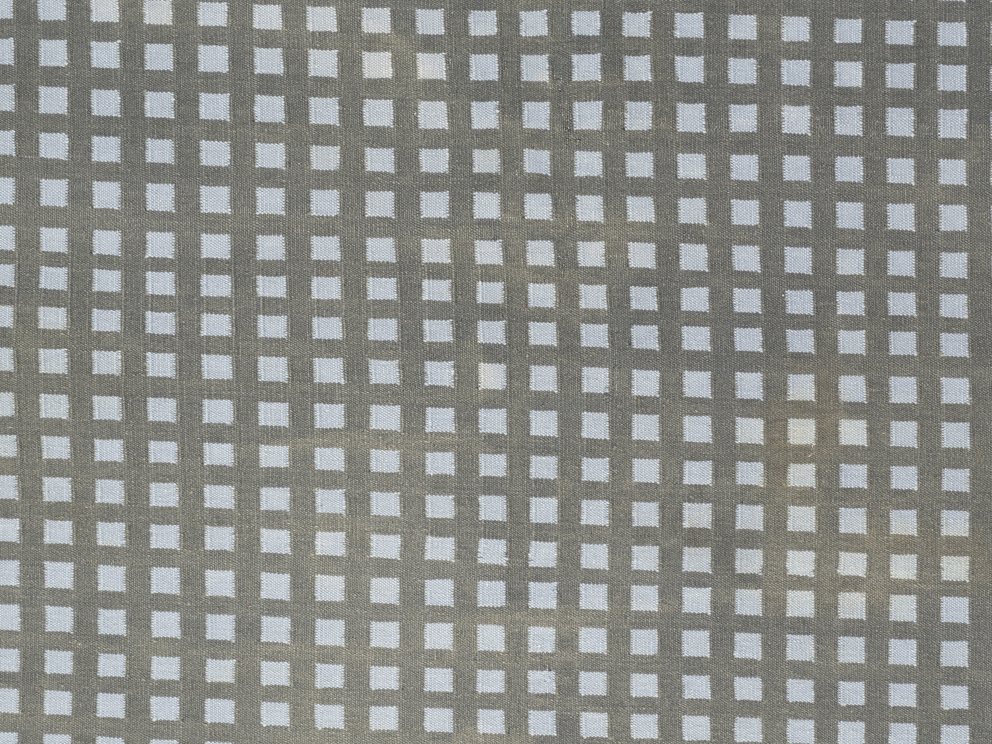
A checkered design divides the field into a grid of squares in alternating or varied colours, like a chessboard. The Persian word shatranji, from shatranj ('chess'), means chequered and is also an old name for a kind of carpet or spread.
ALSO CHEQUERED · MICRO CHECKERED · CHECKERBOARD · CHECKS
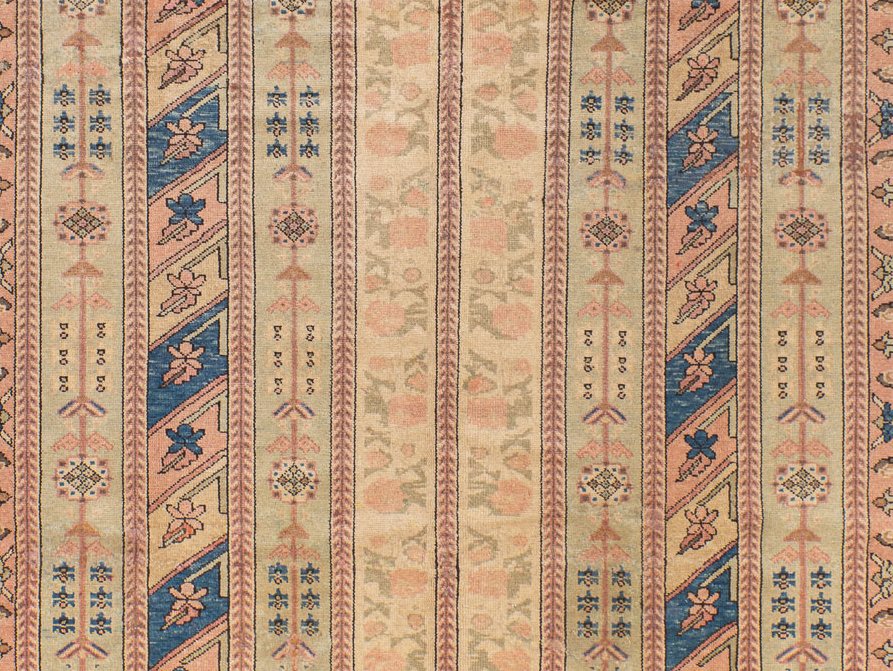
Muharramat is a striped design: the field is divided into parallel bands, usually running the length of the rug, each filled with its own colour or small repeating motif. In Persian the word also means a multicoloured striped cloth.
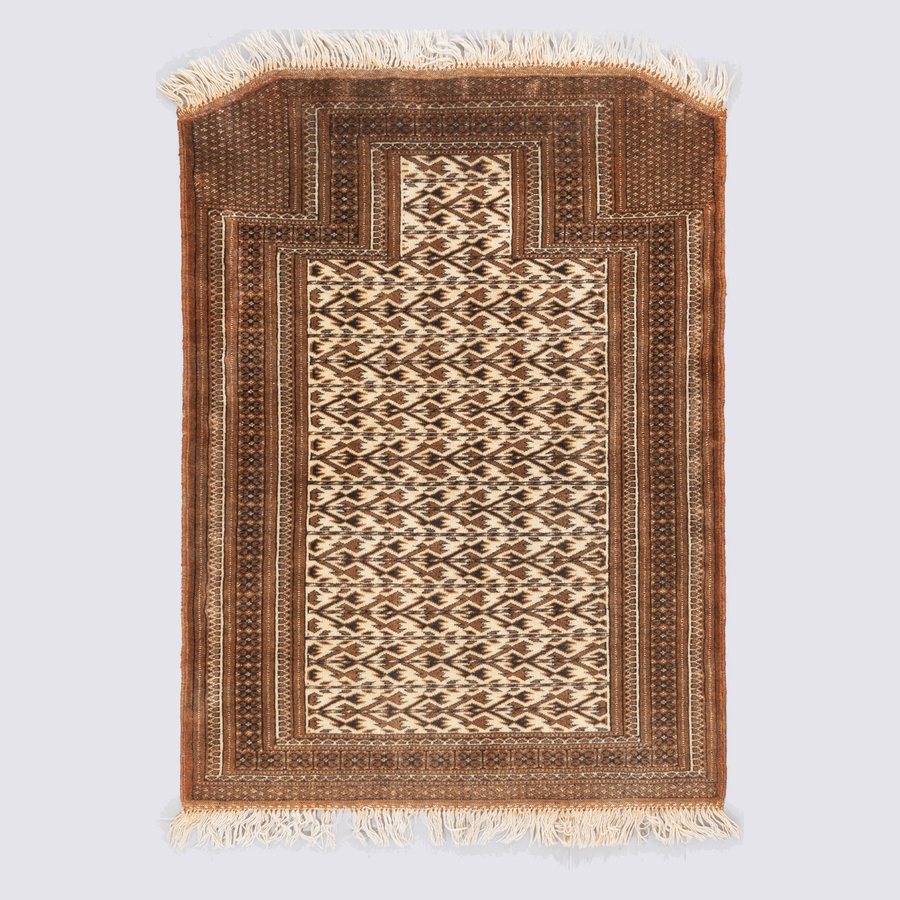
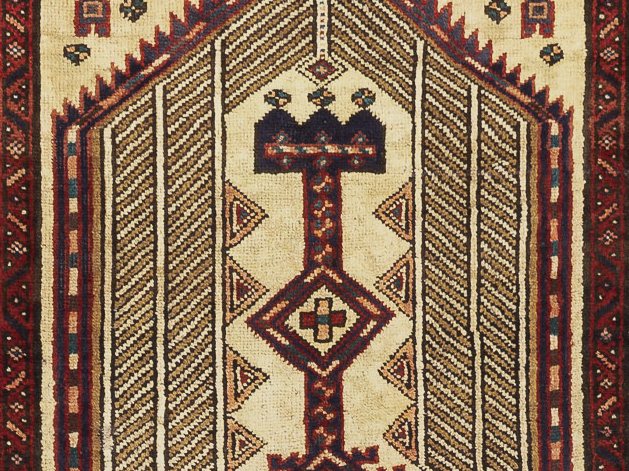
A mehrab design places an arched niche at one end of the field, after the mihrab, the niche in a mosque wall that shows the direction of Mecca. The design is directional: it reads from one end. Rugs in this format are called prayer rugs, and in use the arch is laid toward Mecca.
ALSO MIHRAB · PRAYER · PRAYER MAT · PRAYER MATT · NICHE DESIGN
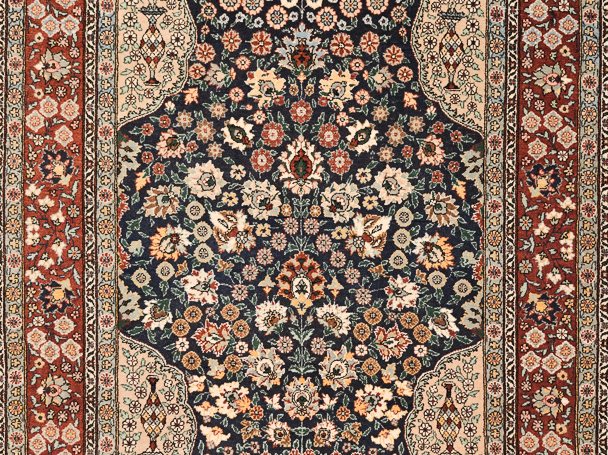
A vase design (goldani) uses vases of flowers as its main motif: one large vase at the foot of a directional field, or vases repeated across the field or set in a lattice. 'Vase carpet' means something else: a group of Safavid carpets, generally attributed to Kerman, named after the vases that appear in many, though not all, of them.
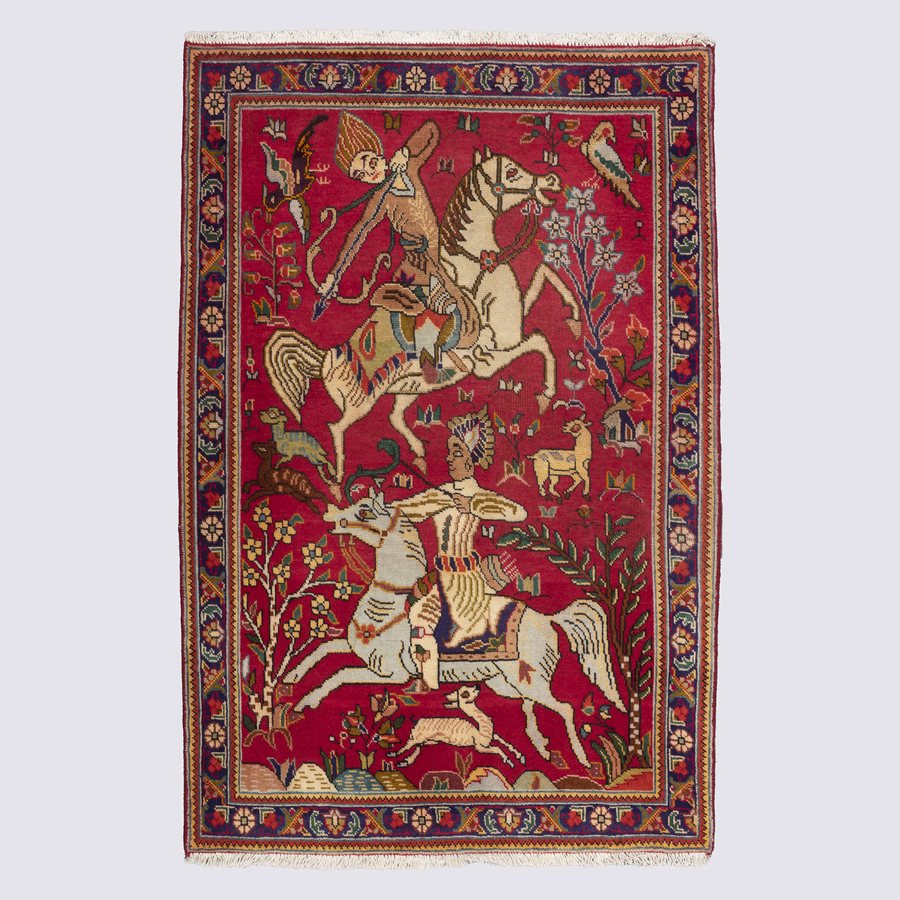
A pictorial rug shows a picture rather than a pattern: a scene, a portrait, buildings or figures from poetry and history. In 19th-century Persia favourite subjects were scenes from Ferdowsi's Shahnameh and Nezami's Khamseh and historic Persian figures, and from about the 1870s European subjects copied from prints and postcards.
ALSO FIGURAL · SCENE · HOOSHANG SHAHI · HOOSHANG SHAH · BAHRAM GUR · PERSEPOLIS
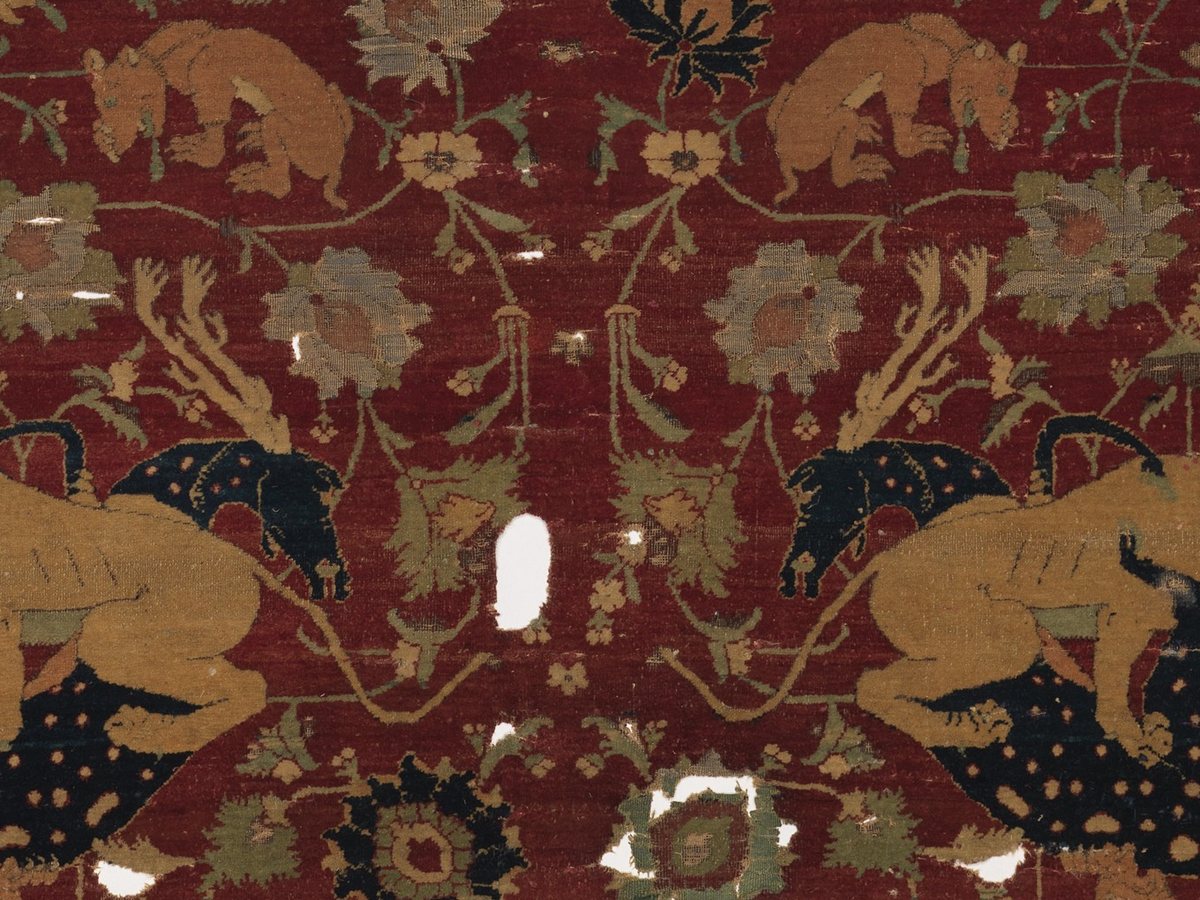
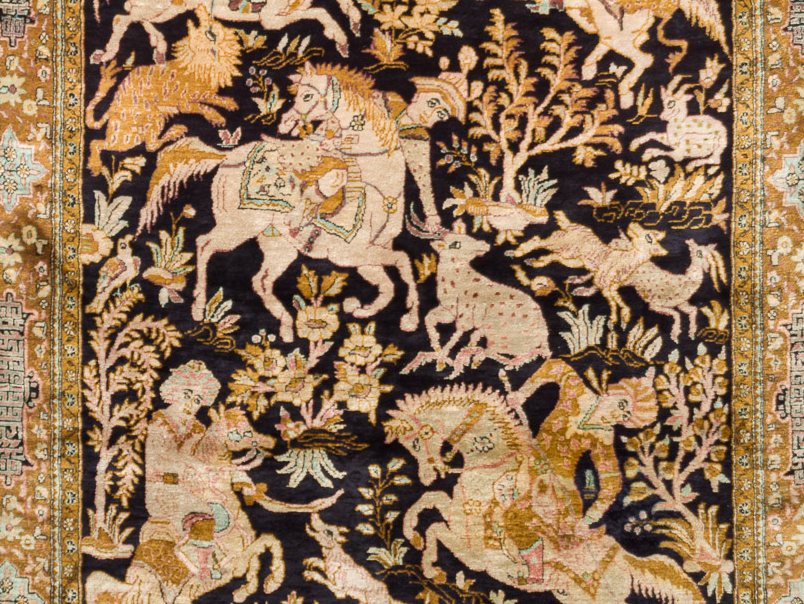
Shekargah (Persian 'hunting ground') is a design of mounted hunters pursuing animals through a landscape of trees and flowering plants. It goes back to Safavid carpets such as the Milan hunting carpet in the Poldi Pezzoli Museum, one of the few Safavid carpets with a woven date, read as either 1522 or 1542.
ALSO SHIKARGAH · HUNTING CARPET · HUNTING SCENE · HUNT
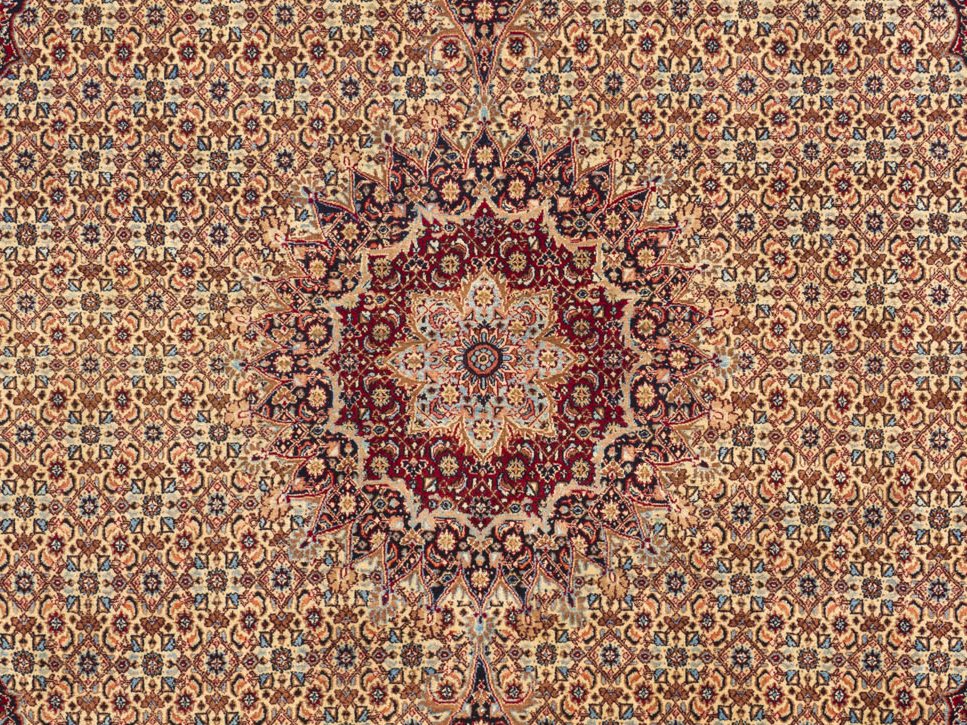
The herati is a small repeating unit: a rosette framed in a diamond, with palmettes at its corners and four curved, serrated leaves around it. In Persian it is also called mahi ('fish') or mahi dar ham, because the leaves look like small fish. It is woven across Persia, as an all-over field or behind a medallion.
ALSO MAAHI · MAHI DAR HAM · FISH PATTERN · FISH DESIGN · HERATI DESIGN · MAHI TORANJ
Mina Khani is a repeating floral pattern in which rosettes and other flowers are linked by a lattice of stems. The repeat can cover the field. Its presence describes the design and does not, by itself, identify a workshop, weaving community or date.
Mahi dorosht (Persian 'large fish') is the herati drawn at a large scale, so that fewer and bigger repeats fill the field. Its counterpart is rizeh mahi ('small fish'), the herati drawn very small, a named design of Birjand rugs.
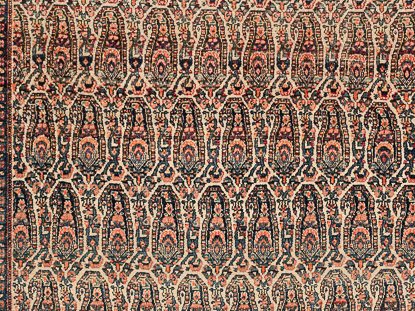
The boteh (Persian 'bush' or 'shrub') is a leaf-like motif with a rounded body and a curved, pointed tip, known in the West through the paisley shawl. It appears singly or as an all-over repeat, often in offset rows. Its origin is debated: it has been read as a cypress bent by the wind, a leaf and a flowering spray.
ALSO BOTA · BUTA · BUTAH · BOTEH JEGHEH · BOTEH JEGHE · PAISLEY
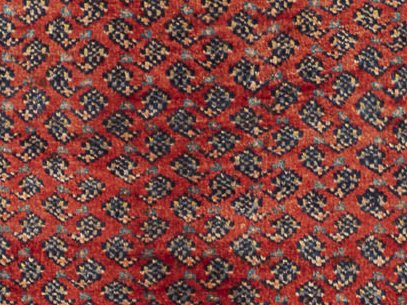
Boteh mir, or the mir design, fills the field with small botehs in diagonal rows, their tips pointing alternately in opposite directions. It is the distinctive design of Saraband rugs, from the district south-west of Arak, and Persian also calls it the Sarabandi boteh. The main border usually carries a geometric vine of similar leaf forms.
ALSO BOTE MIR · BOTEH MIRI · MIR BOTEH · MIR-I-BOTEH · SARABANDI · SARABAND
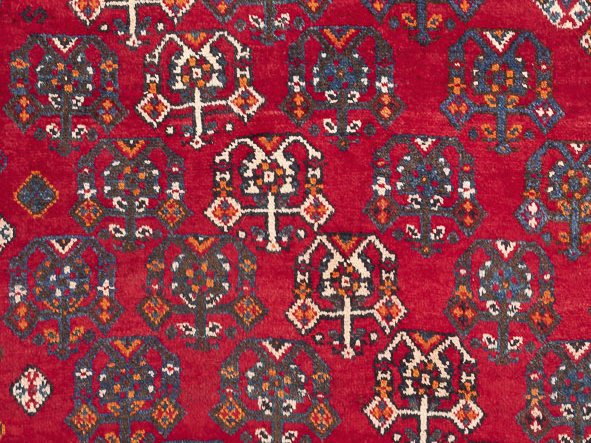
Qobadkhani, or Boteh Qobadkhani, is a bazaar name for a boteh field on some Qashqai rugs. The boteh is drawn as an upright, symmetrical flowering bush rather than a teardrop: a stem with a rounded head, short side branches ending in small lozenges and a pointed crown, repeated in offset rows.
Shah Abbasi ('of Shah Abbas') describes designs built from palmettes, blossoms and cloud bands of the kind associated with Safavid carpets. The palmette itself is a fan-shaped flower, somewhat like a lotus seen in section. Today the style is closely tied to town workshops such as Isfahan, Nain, Kerman and Tabriz.
Eslimi is the arabesque: a stylised scrolling stem with split, forked leaves, used to tie a design together in the field and in borders. In borders it runs as a continuous scroll or in paired, mirrored sections.
A rosette is a round flower seen from directly above, its petals radiating from the centre. It is a common small motif in both fields and borders, and the flower at the heart of each herati unit.
A sickle leaf is a long, curved leaf with a serrated inner edge. Four of them surround the rosette and its diamond in each herati unit, and their resemblance to small fish gave the herati its Persian name, mahi.
Harshang, from the Persian kharchang ('crab'), is a pattern of interlacing scrolling stems with large stylised palmettes, the 'crabs', where the stems meet and leaves, the 'claws', at their ends. Iranica describes it as a border pattern.
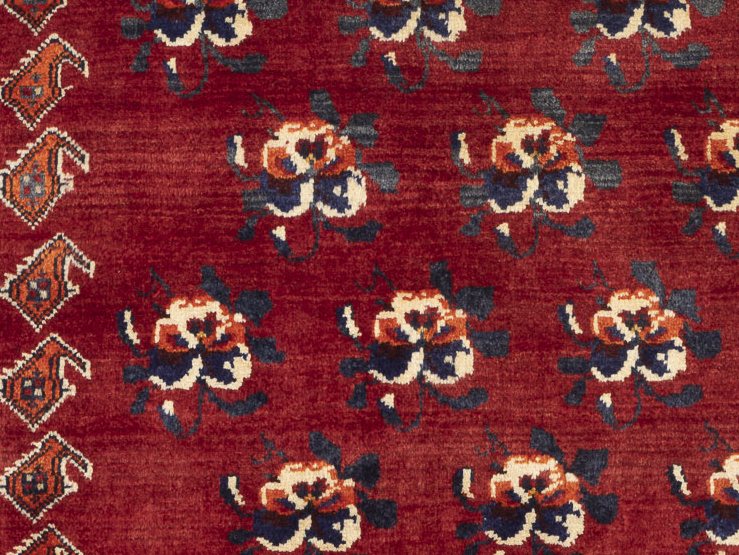
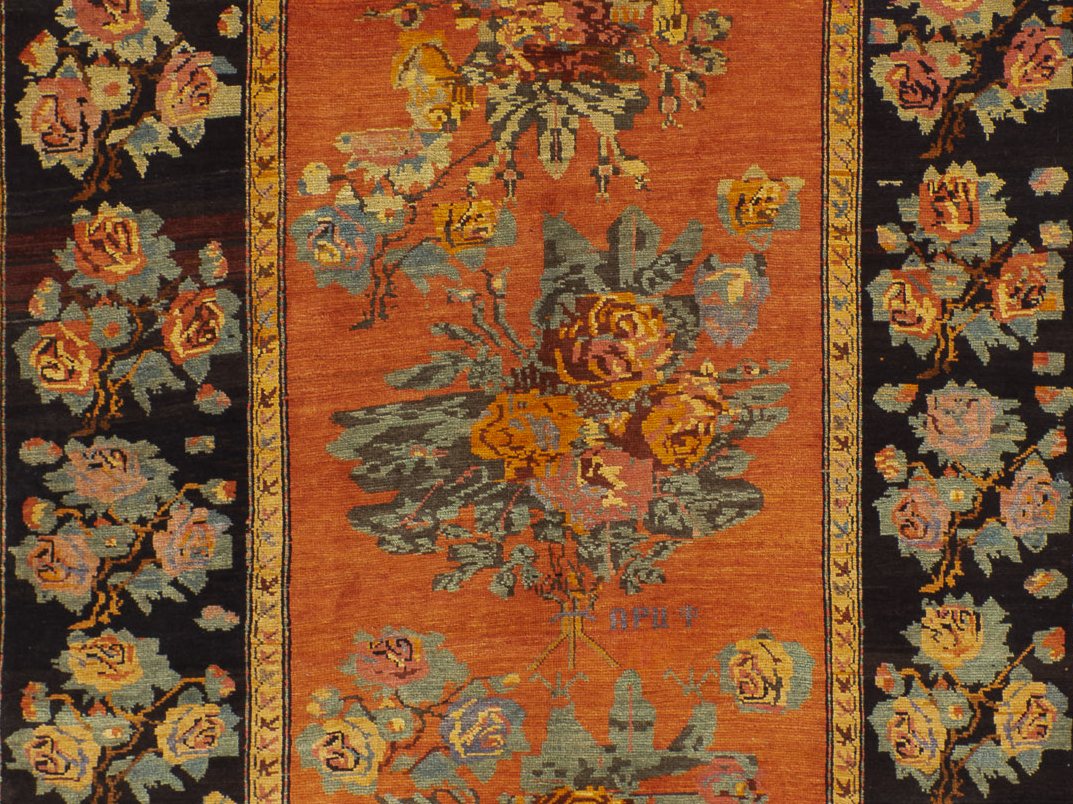
Gol farang (Persian 'European flower') is a design of naturalistic roses, rose sprays or bouquets drawn in a European manner, either scattered across the field or set in rows. How and when the style entered Persian weaving is debated.
ALSO GOL-E FARANG · GOL FARANGI · GUL FARANGI · GOL FARANGH · EUROPEAN FLOWER · FOREIGN FLOWER
Khusheh (خوشه) is Persian for a cluster, of grapes, wheat or flowers. In our titles khooshei ('clustered') names a design of flower clusters, as on a fine Qom rug.
The cypress (sarv) is drawn as a tall, narrow evergreen, singly or in rows. A silk carpet dated 1662 already shows a directional field of cypresses and flowering plants. In Persian poetry the cypress is an image of a graceful, upright figure, and some scholars see the boteh as a cypress with its top bent by the wind.
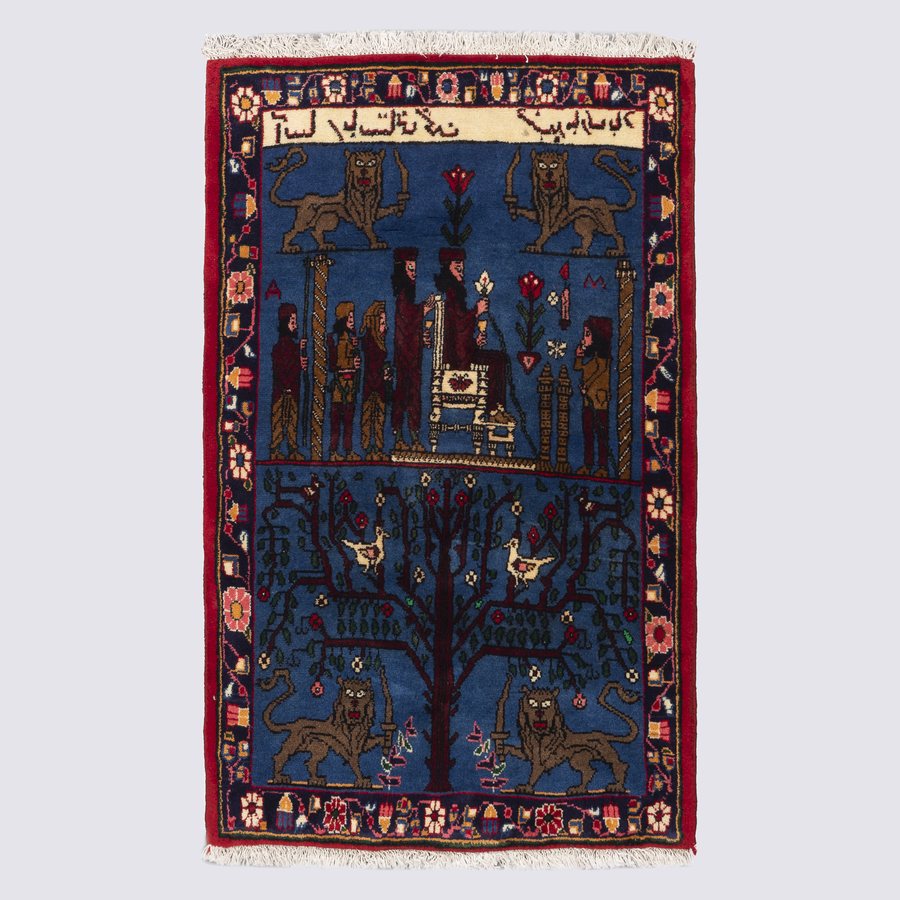
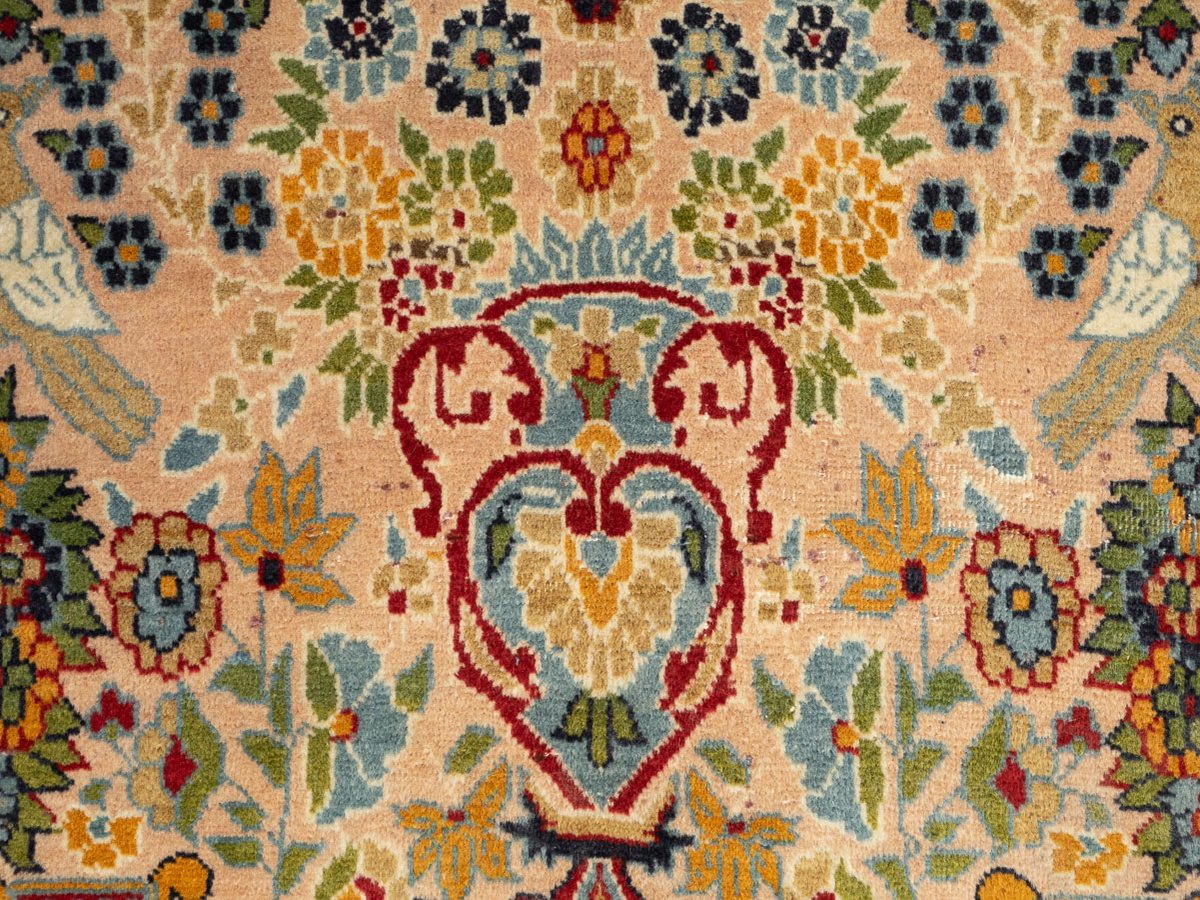
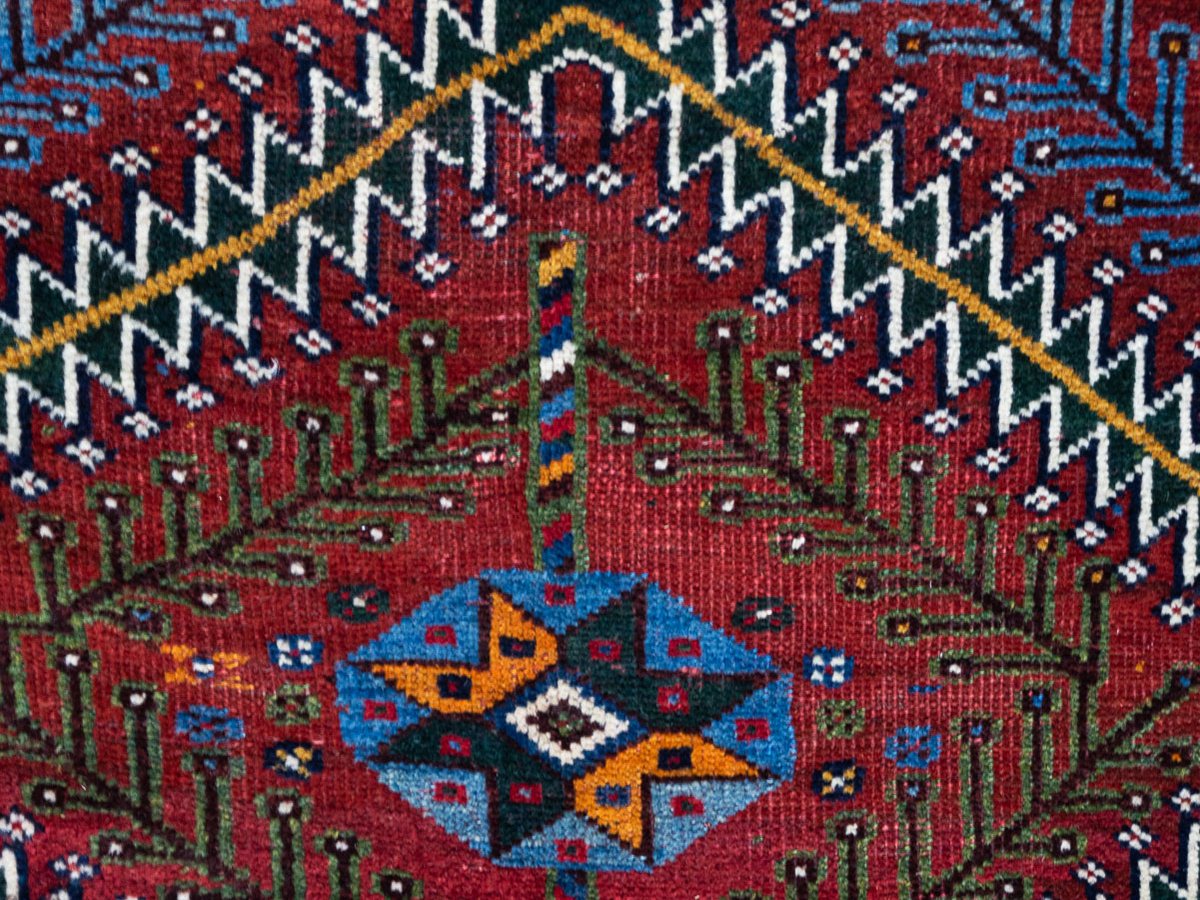
Derakht-e zendegi ('tree of life') is the name given to designs dominated by a single large tree, or a pair, usually growing from the foot of the field with flowering branches and often with birds or animals among them. The design reads from one end.
ALSO DOUBLE TREE OF LIFE · TREE DESIGN · DERAKHTI · BIRD-AND-TREE
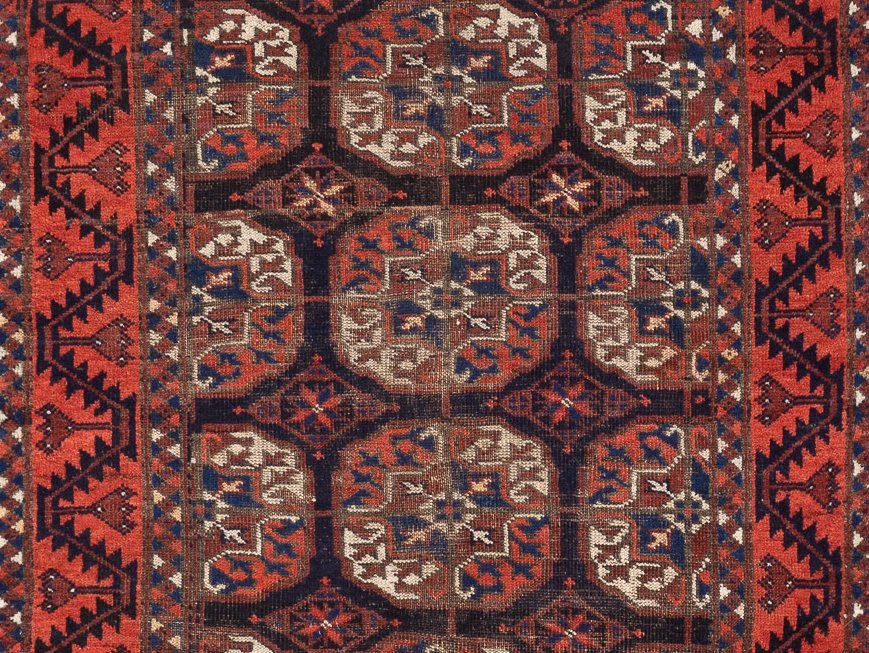
A gul (Turkmen göl, from Persian gol, 'flower') is the medallion-like motif repeated in rows across the field of Turkmen rugs. Tribes are associated with particular guls, but guls passed between tribes and changed over time, so attribution now rests on structure, materials and colour more than on the gul.
ALSO GOL · GÖL · GOOL · TURKMEN GUL · TORKAMAN GUL
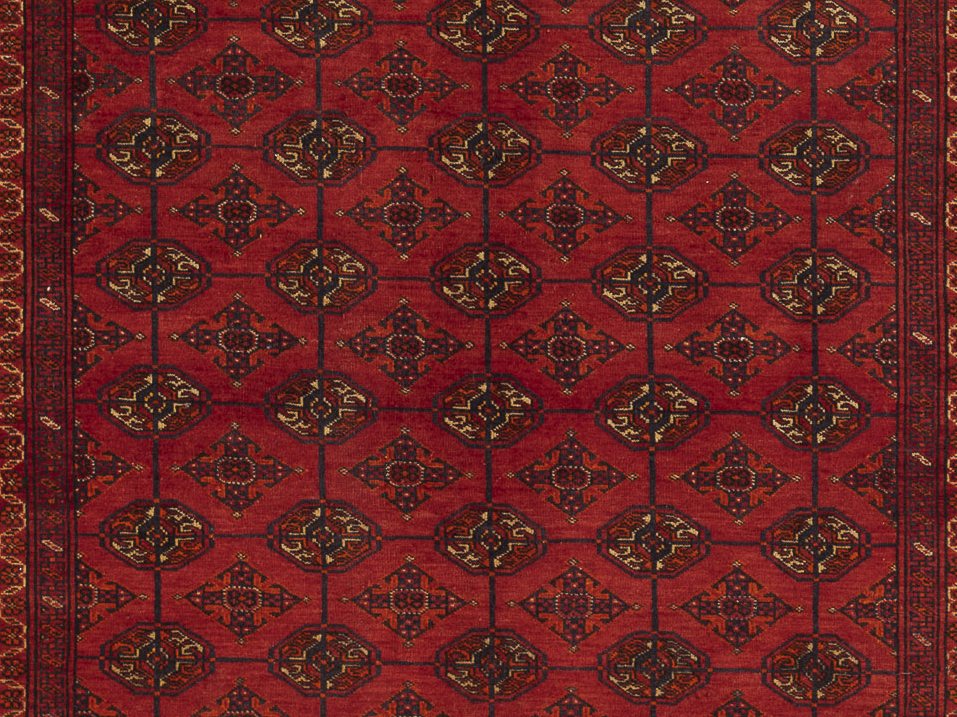
Mari Gul is the bazaar name for the Tekke gul: the octagonal motif repeated in rows across Tekke Turkmen rugs, known in retail as the 'elephant's foot'. The gul has been widely copied, and in the Iranian bazaar the name covers it whichever Turkmen group wove the rug, Yomut included. 'Bokhara' is a trade misnomer for the same rugs.
ALSO MARI GOL · MARI GOOL · TEKKE GUL · ELEPHANT'S FOOT · ELEPHANT FOOT · ELEPHANT FEET
The kepse gul is one of the main guls of Yomut Turkmen rugs, repeated in offset rows across the field. Like other guls it was shared and varied, so it points toward a Yomut attribution without proving one.
Lowzi is Persian for a lozenge, a diamond shape with four equal sides. A lowzi design is built on lozenges, used as stacked medallions, as an all-over repeat or as the cells of a lattice.
Chalipa is Persian for a cross; Dehkhoda's dictionary defines the word simply as 'a cross'. Persian carpet scholarship uses it for cross-shaped motifs: a 2021 study of Armenian-pattern carpets from Kharaqan, in Qazvin province, names the chalipa among their leading motifs and lists a cross medallion (toranj-e chalipa) among their common designs.
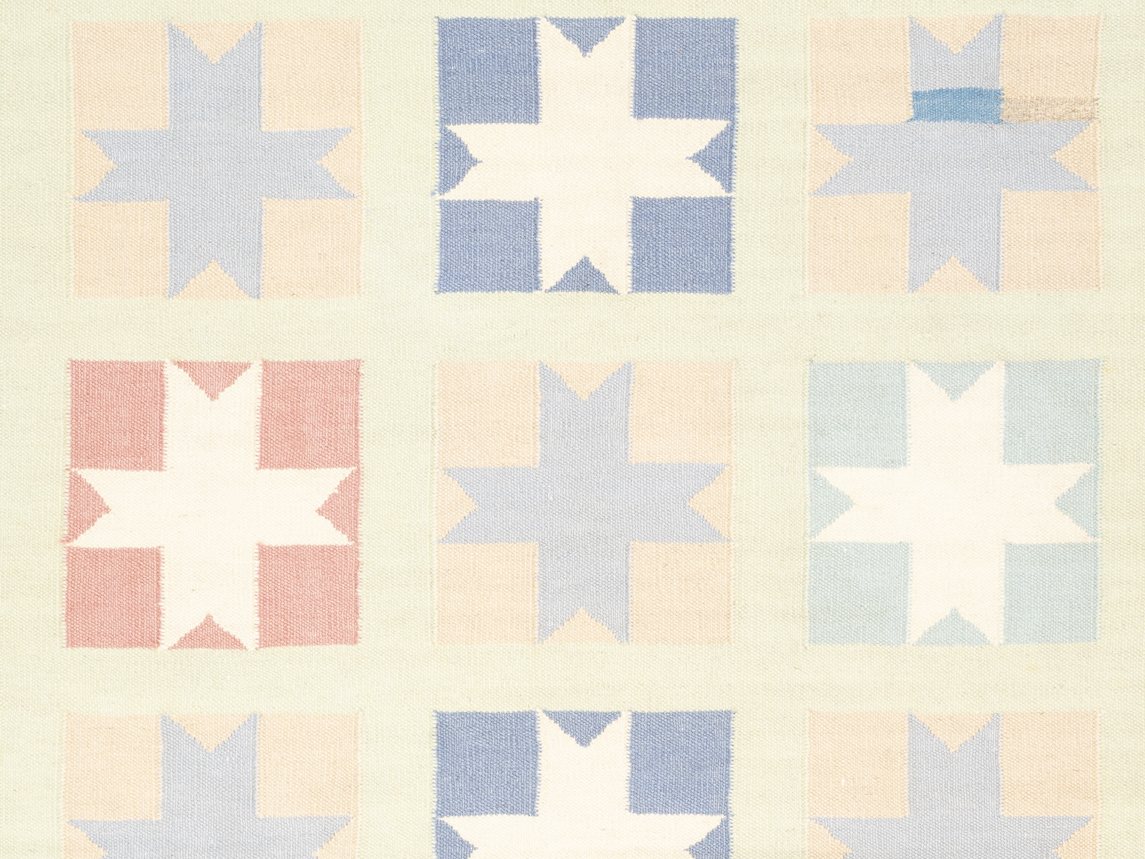
Stars are small star-shaped motifs, often eight-pointed, worked as scattered fillers between larger motifs or set in rows and bands, in pile rugs and flatweaves alike. In Afshar kilims, small soumak-style stars in the field and along the sides are, in our experience, a mark of an original piece rather than a later copy.
ALSO STAR MOTIF · STARS AND STRIPES · SUMAC STYLE STARS · SETAREH
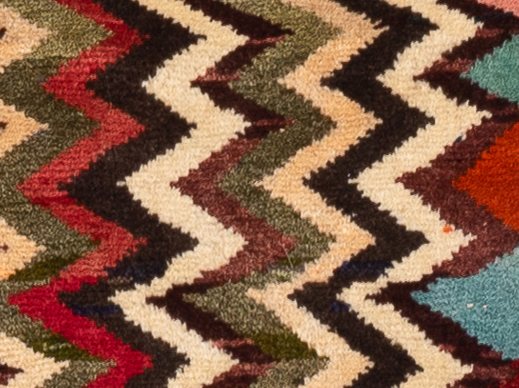
Mowj is Persian for 'wave'. In titles, mowj or mowji marks a design of wavy or zigzag bands. The same root gives the border pattern Iranica calls shakheh-ye mawwaj ('wavy branch'), a run of repeated S-shaped stems ending in small leaves or flowers.
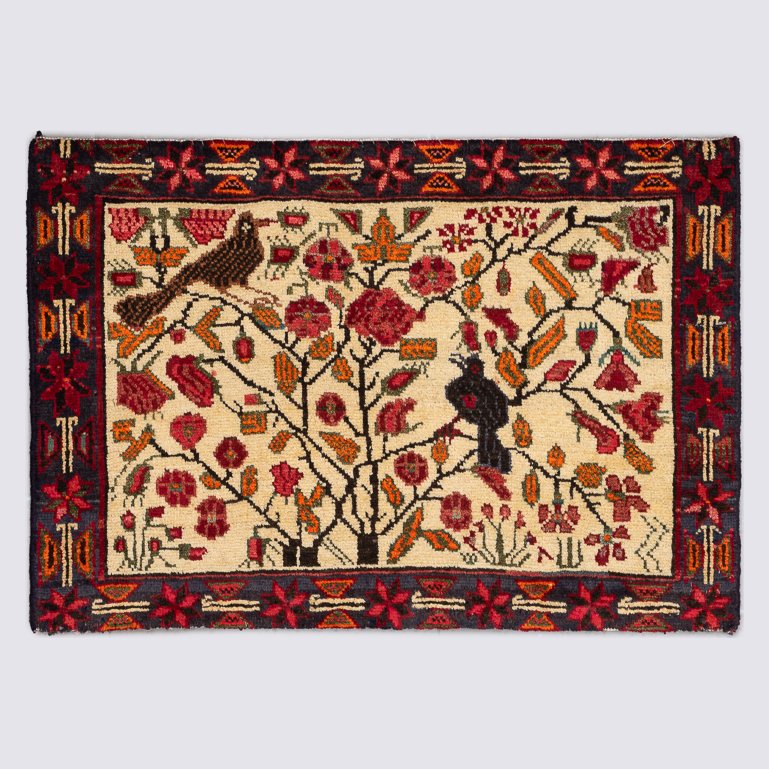
Morghi (from morgh, 'bird') is a design or motif of birds. A Persian field study of tribal rugs from South Khorasan lists it among their common motifs, beside the peacock (tavusi), and birds appear widely in Persian carpets, from pairs in a flowering tree to small birds scattered among the motifs of a tribal field.
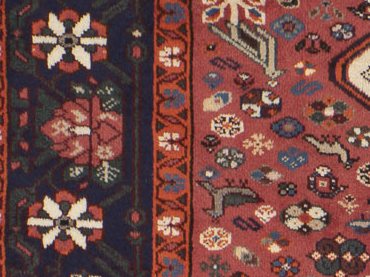
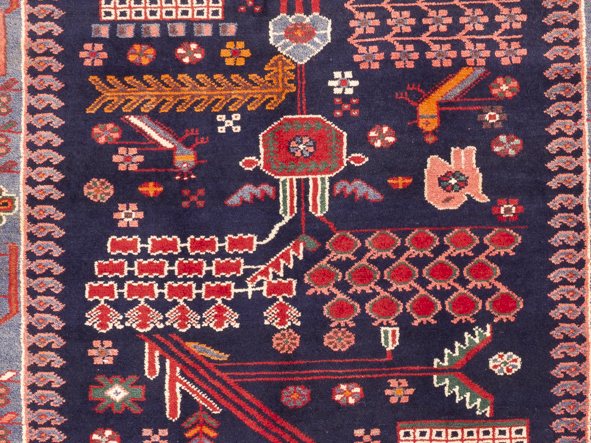
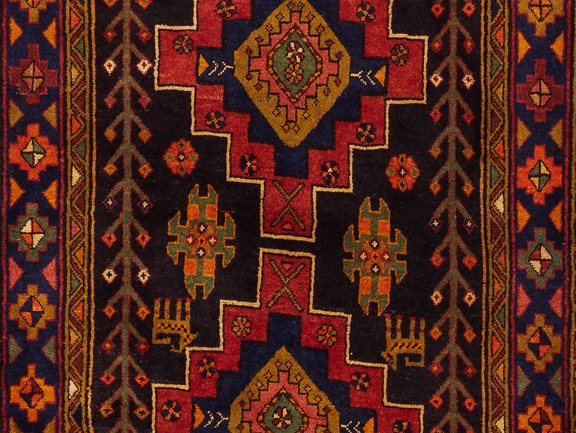
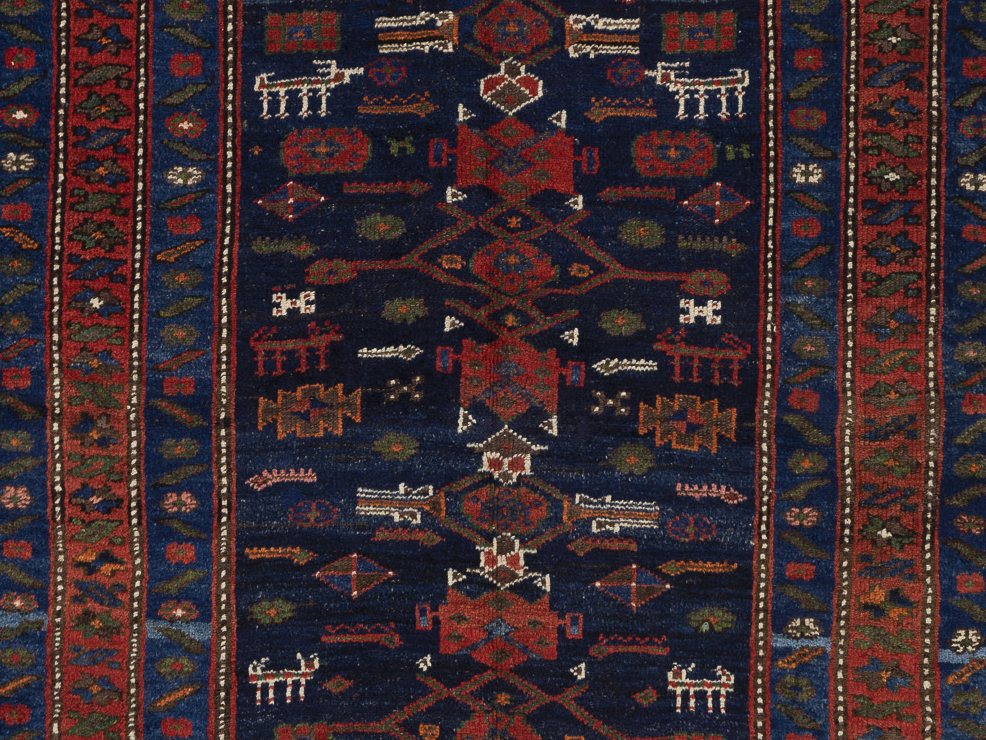
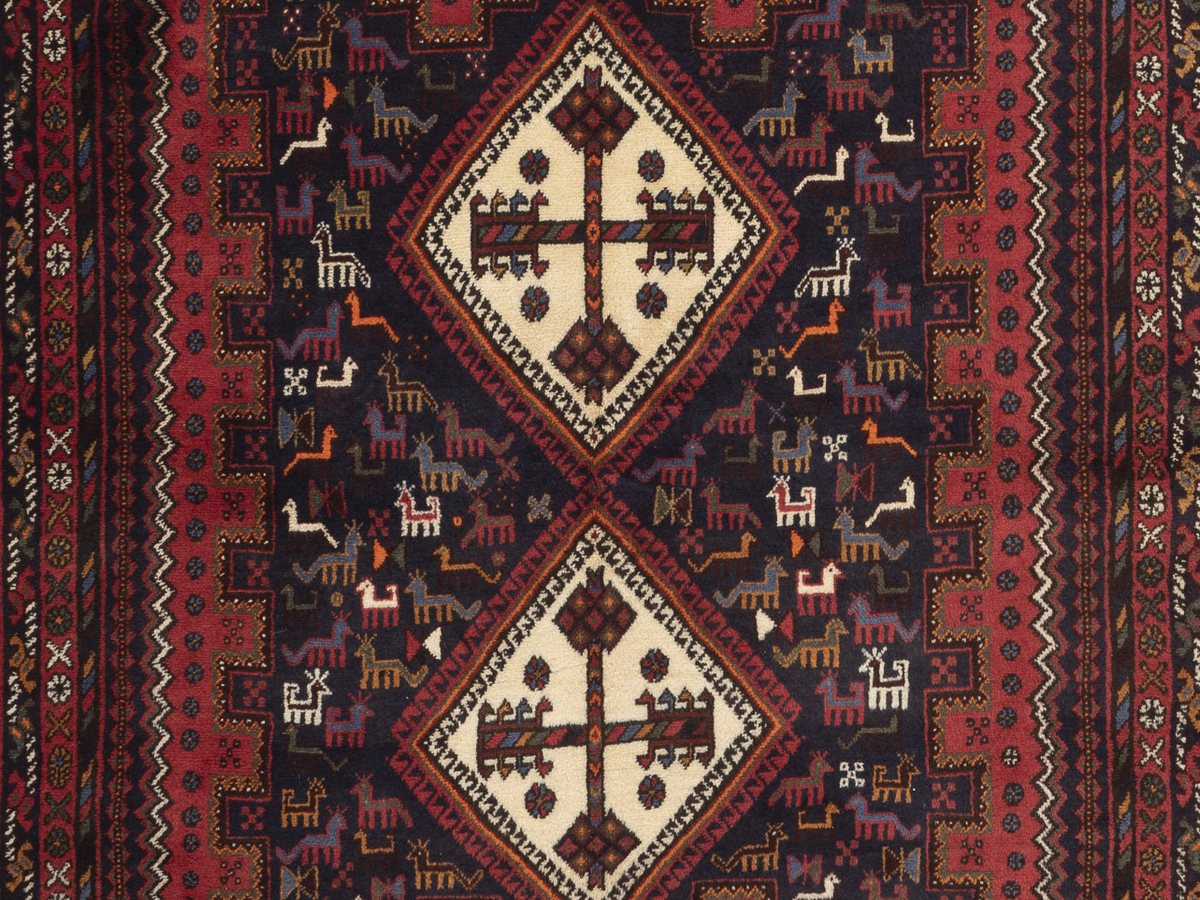
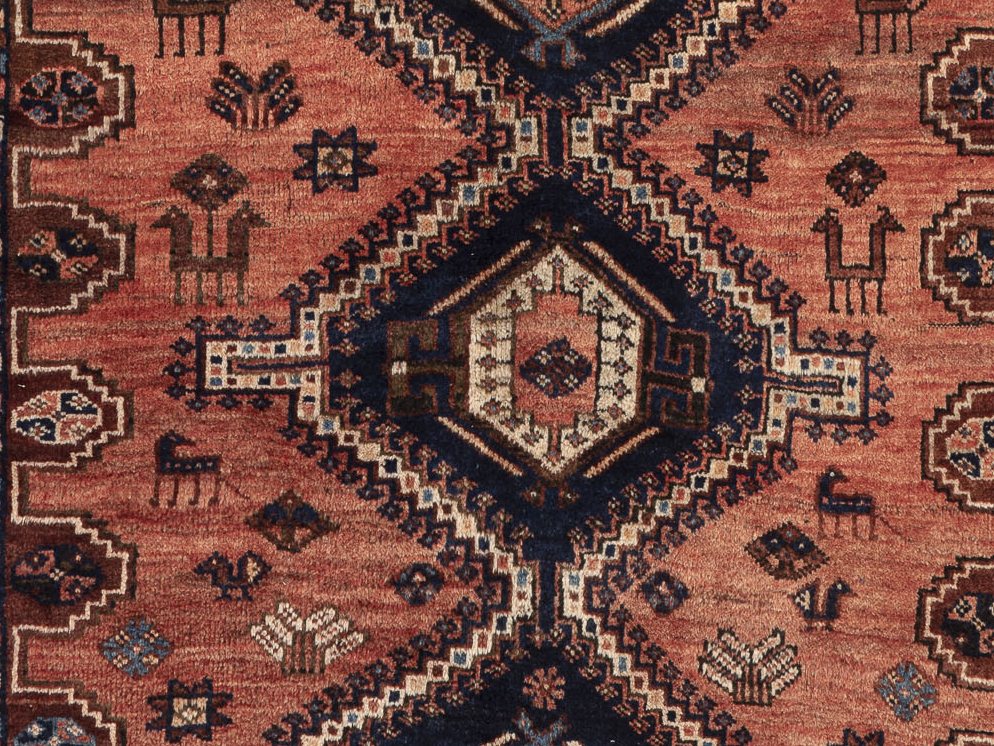
Village and tribal rugs often set small animals, birds and human figures among their main motifs, drawn freely rather than from a cartoon. In gabbehs a stick figure or a few stylised animals may be the only pattern on an open field of colour.
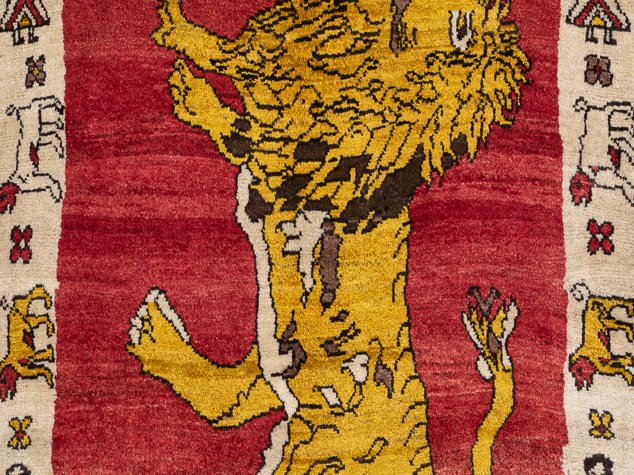
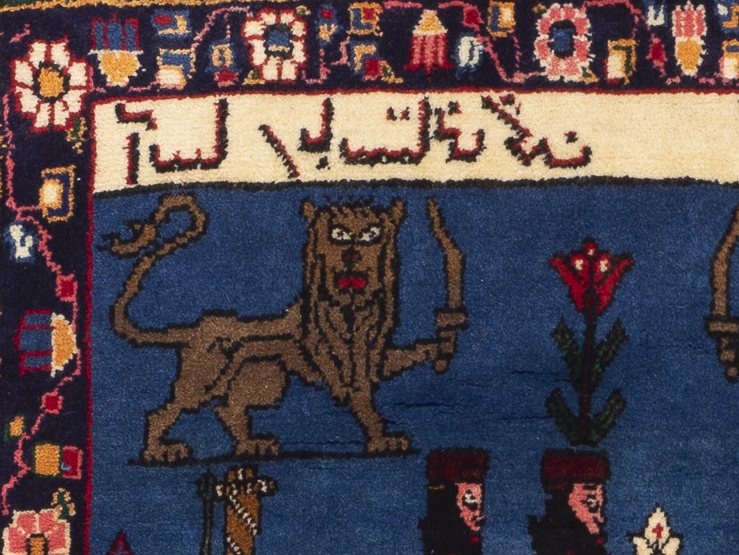
A lion rug (gabbeh-ye shiri) has a lion as its main motif. Most surviving examples were woven by Qashqai and Bakhtiari weavers in the 19th and 20th centuries. Many weavers, usually women, worked from imagination, which is why lions appear in red, green or black, often with human-looking faces. The lion has long been a Persian emblem of royalty and power.
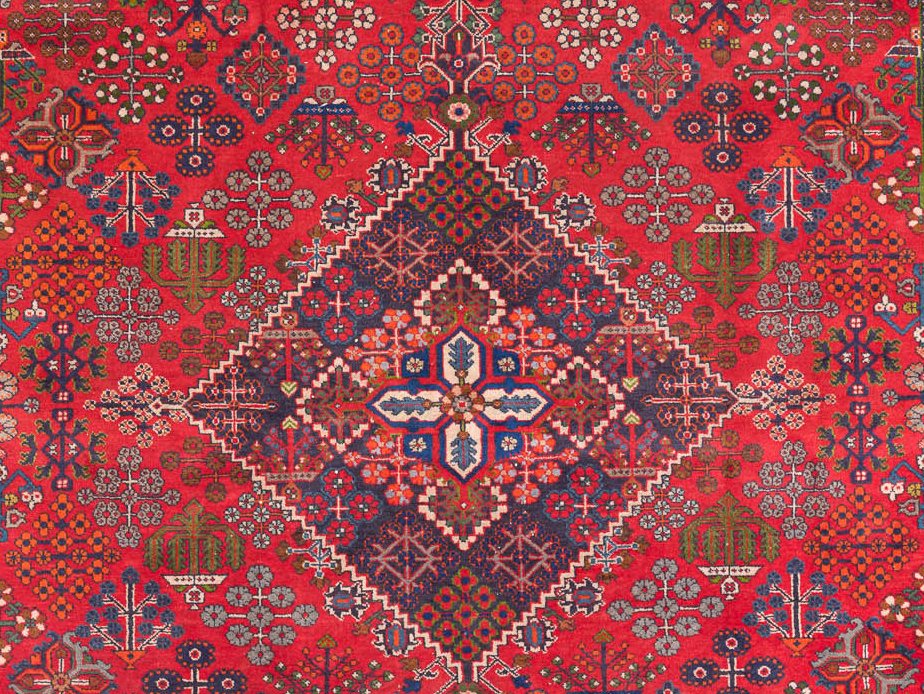
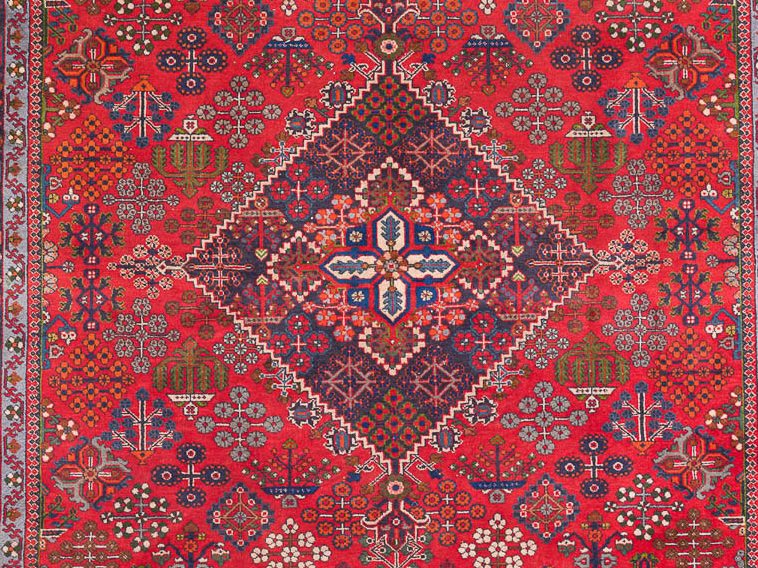
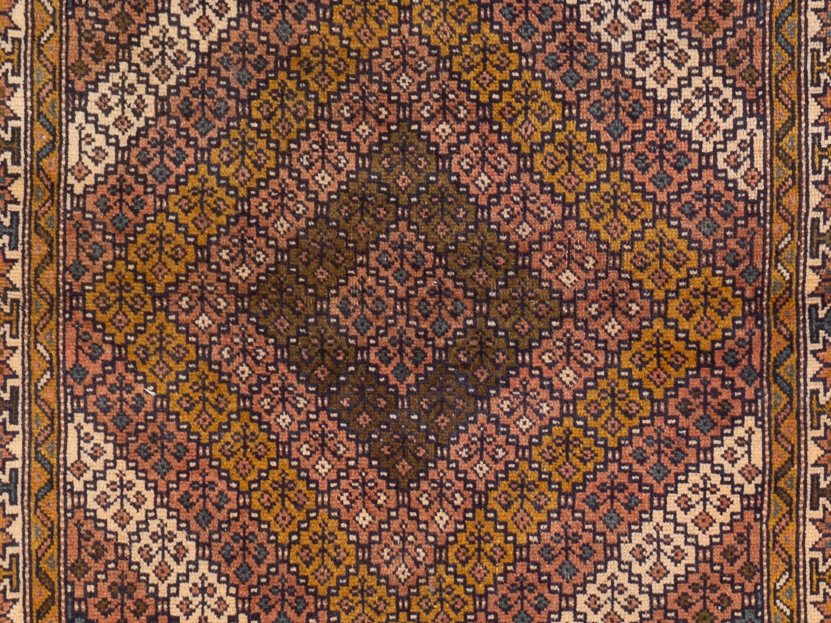
The Joshaghan design, named after the carpet district of Jowshaqan north-west of Isfahan, is a geometric lattice of diamond-shaped compartments, each holding a stylised flowering shrub or spray, with or without a medallion. Iranica describes the district's designs since the late 19th century as geometric, sometimes without a medallion, and conservative.
Ziegler names carpets in the style made for Ziegler & Co., the Manchester-based firm that organised village weaving around Sultanabad (now Arak) from around 1880, supplying dyed wool and cartoons and adapting palettes, sizes and designs to Western taste. The firm's carpets carry no marks, so the name usually describes a style rather than a proven maker.
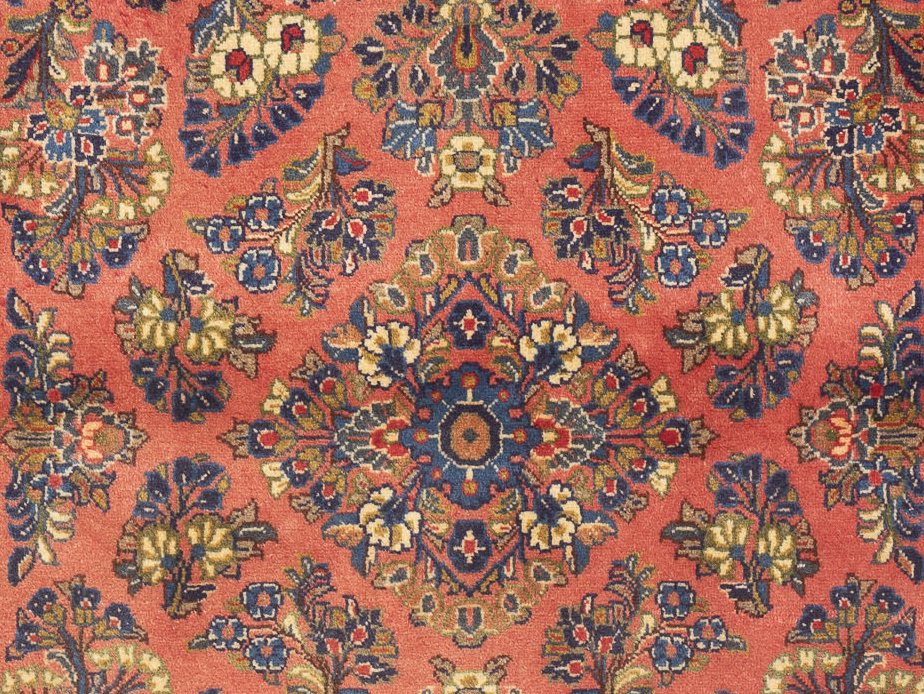
American Sarouk is a trade name for Sarouk rugs woven for the American market. Dealers date them from about the 1910s to the 1950s and describe a deep red or rose field scattered with detached floral sprays, usually without a true medallion, inside a dark blue border.
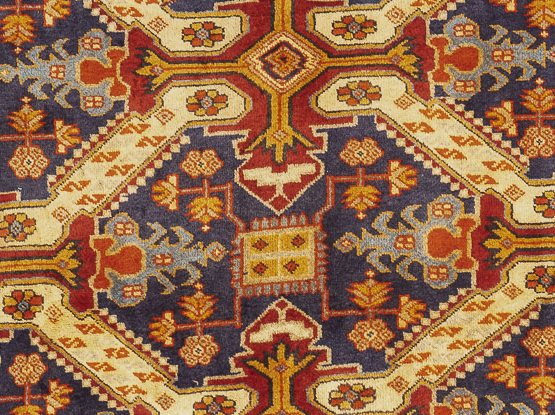
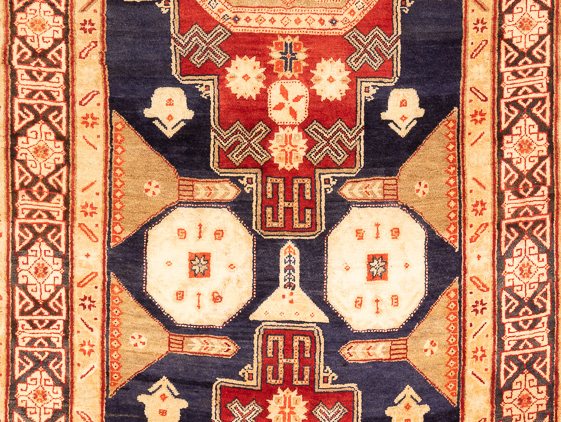
Dealers use Seychour (also Seichur or Zeikhur) for a group of north-east Caucasian pile rugs from the Kuba district of present-day Azerbaijan; they are Caucasian, not Persian. Their classic field is a column of large diagonal crosses, called St Andrew's crosses in the trade, set among stylised flowers. On a rug from Ardabil or elsewhere in north-west Iran, the name describes this Caucasian design.
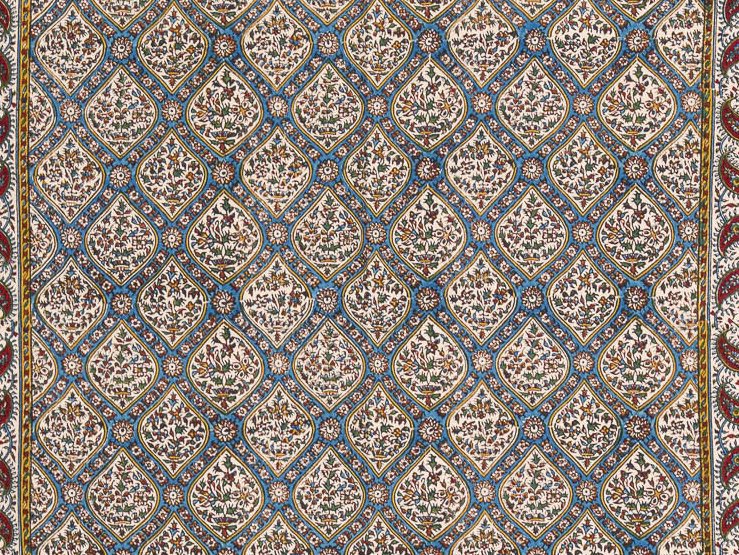
The Sheikh Lotfollah design takes its name from the Sheikh Lotfollah Mosque on Naqsh-e Jahan Square in Isfahan, built under Shah Abbas I and famous for the tilework of its dome. Our qalamkar block prints copy the radiating medallion inside the dome.
SeKale (سه کله, 'three heads') and Yek Kale ('one head') are bazaar design names, used in our titles for rugs from the Neyriz, Baft and Shahr-e Babak country. The heads are part of the motif: arrow-like points that run up and down the design, always set symmetrically.
Bandi (بندی, from band, 'tie' or 'bond') is the design name in our titles for a field drawn as a linked lattice, its compartments joined one to the next, on Afshar rugs from the Sirjan country.
Qalat (غلط, 'mistake') is a bazaar term, short for naqsh-e ghalat ('wrong design'), for village and tribal rugs whose drawing departs freely from the standard pattern. A Mahi Qalat is a freely drawn herati.
Ghezel Gheichi (قزل قیچی) is the name in our titles for a scissor-like motif in the field of some Qashqai gabbehs. In Turkic, qizil means red or golden and qaychi means scissors.
Olad (owlad, 'descendants') in our titles marks a Bakhtiari kilim woven for the family of the khans: the owlad-e ilkhani, descendants of the ilkhan, the paramount chief of the tribe.
A cartouche is an elongated compartment with pointed or lobed ends, used as a repeating unit in borders and to frame inscriptions. An inscription panel (katibeh) holds woven words: a signature, a date, a dedication or lines of poetry. The Ardabil carpet's cartouche holds a verse of Hafez, a name and a date.
A signed rug carries a woven name, often in a small panel at one end of the field or in the border. The name is most often that of the patron or the workshop owner or master (ostad), occasionally the designer, rather than the person who tied the knots. Because it is knotted in, a woven signature shows on both faces.
ALSO ARMENIAN-SIGNED · WORKSHOP SIGNATURE · MASTER'S MARK · EMZA
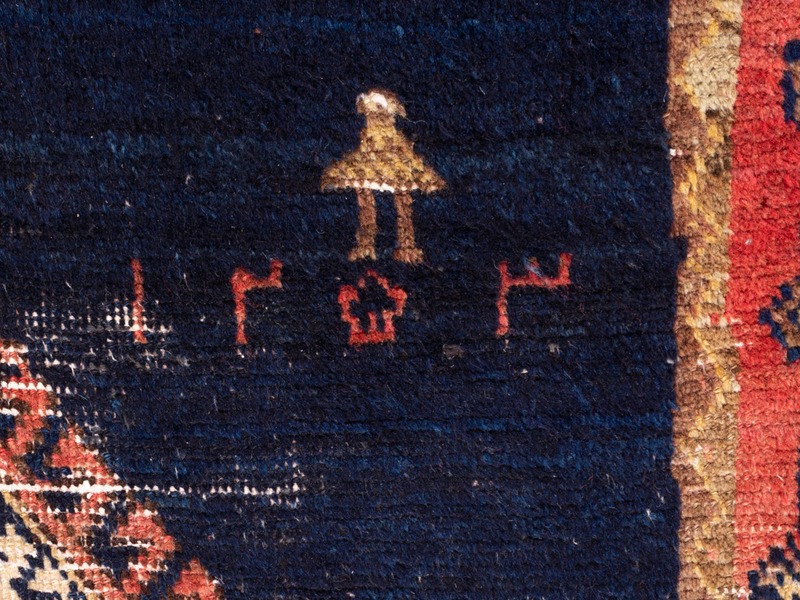
A dated rug has a year woven into it, often beside a signature. Identify the calendar before converting it: older Persian inscriptions often use lunar Hijri years. For a rough Gregorian year, multiply a lunar year by 0.97 and add 622; for solar Hijri, add about 621. Exact conversion depends on the month and day. An inscription needs interpretation alongside the rug itself.
Attribution is an assessment of who made a work or where it was made. In a rug description, it can identify a workshop, weaving community or region. It depends on evidence and can be revised as knowledge improves. A familiar motif alone does not establish an origin.
Provenance is the recorded ownership history of a piece. It can include previous owners, sales, dates and locations, supported by documents or other evidence. Many older works have gaps in that record. Naming a weaving region alone does not provide an ownership history.
A published rug has been illustrated in a book, a journal, or an exhibition or auction catalogue. The publication becomes part of its documented history: it shows that the piece existed by that date, gives a fixed image to check it against, and records how the author described and attributed it. A rug that only resembles published examples is not itself a published piece.
ALSO PUBLISHED PIECE · DATED AND PUBLISHED · LITERATURE
Azarbaijan is the region of north-west Iran around Tabriz, distinct from the Republic of Azerbaijan to the north. Its weaving ranges from the floral city carpets of Tabriz to the geometric kilims, soumaks and pile rugs of the Shahsavan nomads and of Kurdish tribes in the Qara Dagh, which Iranica describes as very similar to Shahsavan work.
Tabriz, the main city of north-west Iran, has been one of the country's most important carpet centres since the commercial revival of the mid-nineteenth century, and Tabrizi merchants were among the first to organise weaving for export. Modern Tabriz rugs are symmetrically knotted, in a wide range of qualities and designs. Weavers there tie knots with a small hooked knife, which makes them unusually fast.
Heriz rugs are woven in a group of villages around the town of Heris, east of Tabriz in East Azarbaijan, among them Goravan, Bakhshayesh and Mehraban. They are symmetrically knotted on a cotton foundation and turn city medallion designs into bold angular forms, often with a jagged vine-and-rosette border. Weavers there bought lustrous wool from the Shahsavan and later from Ardabil; a blue inner weft is a documented trait of the district.
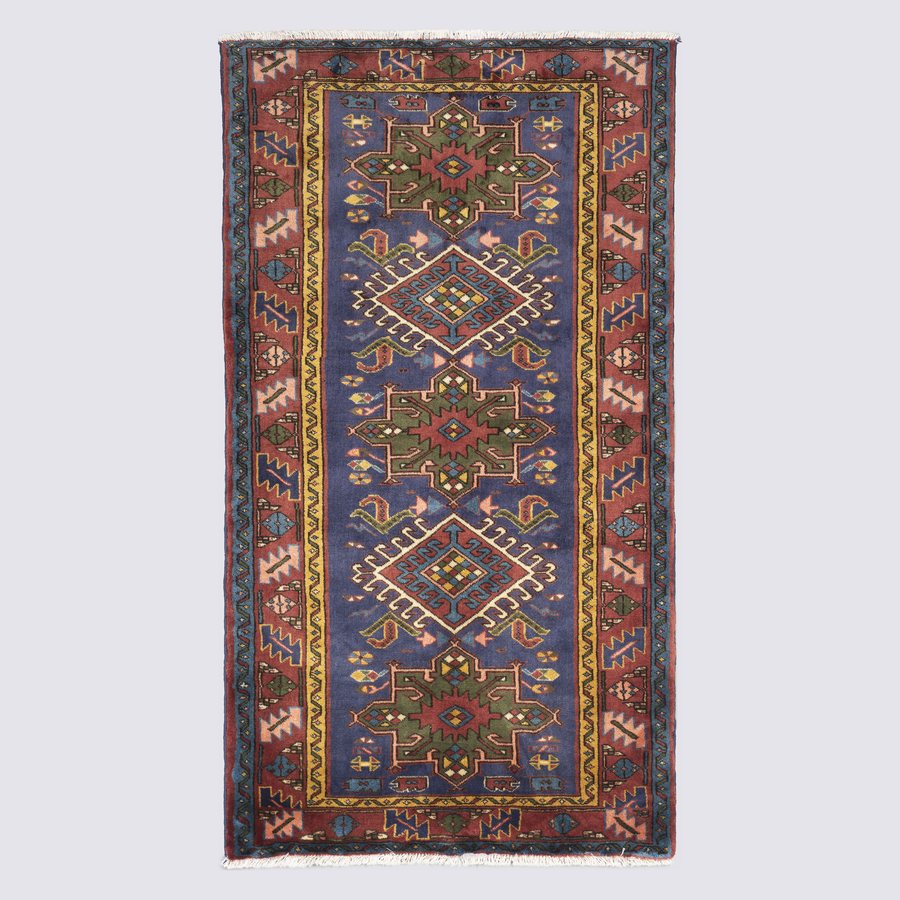
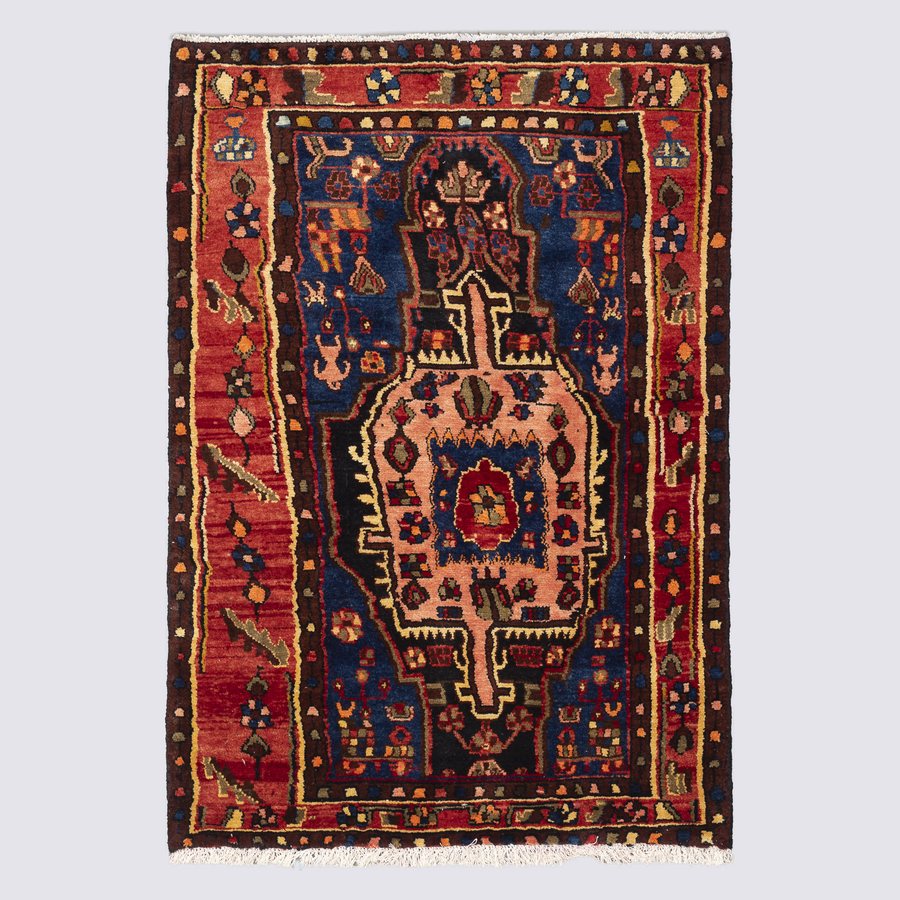
Karaja (Qarajeh) is a village in the Qara Dagh region north-east of Tabriz, just south of the border with the Republic of Azerbaijan. Its best-known design is a row of three geometric medallions: a central one with a latch-hooked outline, in a contrasting colour, between two eight-pointed stars. The rugs are symmetrically knotted, and Karaja runners resemble those of Karabagh but look more Persian.
Sarab is a town between Tabriz and Ardabil in East Azarbaijan, within the summer pastures of the Shahsavan, and Iranica attributes its rugs to Shahsavan weavers around the town. They use undyed camel hair extensively and are close in colour and design to the camel-hair rugs of Hamadan, but are usually double-wefted where Hamadan rugs have a single weft.
Ardabil is a city in north-west Iran beside Mount Sabalan and the Shahsavan pastures, and one of the region's main organising centres for carpet weaving in town and villages alike. Wool from around Ardabil is strong and lustrous and takes dye well; Heriz weavers buy it. The famous sixteenth-century Ardabil Carpet, said to come from the city's shrine, is a separate subject from modern Ardabil rugs.
Qara Dagh (Karadagh) is a district of Iranian Azarbaijan north-east of Tabriz, just south of the Republic of Azerbaijan border, where Kurdish tribes weave rugs very similar to Shahsavan work.
Khoy is a city in West Azarbaijan province, about 41 km north of Lake Urmia near the Turkish border, long a trading town between Iran and Anatolia; a tenth-century geography already noted carpets made there.
Miane (Mianeh) is a town in Iranian Azarbaijan, between Tabriz and Zanjan. Iranica records that the Kurdish Shaqaqi tribe returned to settle around Miane, Sarab and Khalkhal after 1747. Our Miane runners are the work of Azari, Turkic-speaking, village weavers.
Zanjan is a city and province of north-west Iran, about halfway along the Tehran to Tabriz railway; the district between Zanjan and Qazvin is known as Khamseh, unrelated to the Khamseh tribes of Fars. Inallu and Afshar groups, both also called Shahsavan, settled in Khamseh, Kharaqan and Tarom; most Shahsavan of Khamseh and Kharaqan were settled by 1900. Most of our Zanjan rugs come from the village of Qoltuq.
Tarom is a district of Zanjan province in north-west Iran, south-east of Ardabil. Iranica records that Afshar and Inallu groups, both also called Shahsavan, settled in Tarom, Khamseh and Kharaqan after 1747. Our Tarom rugs are village work of these Shahsavan and Afshar groups.
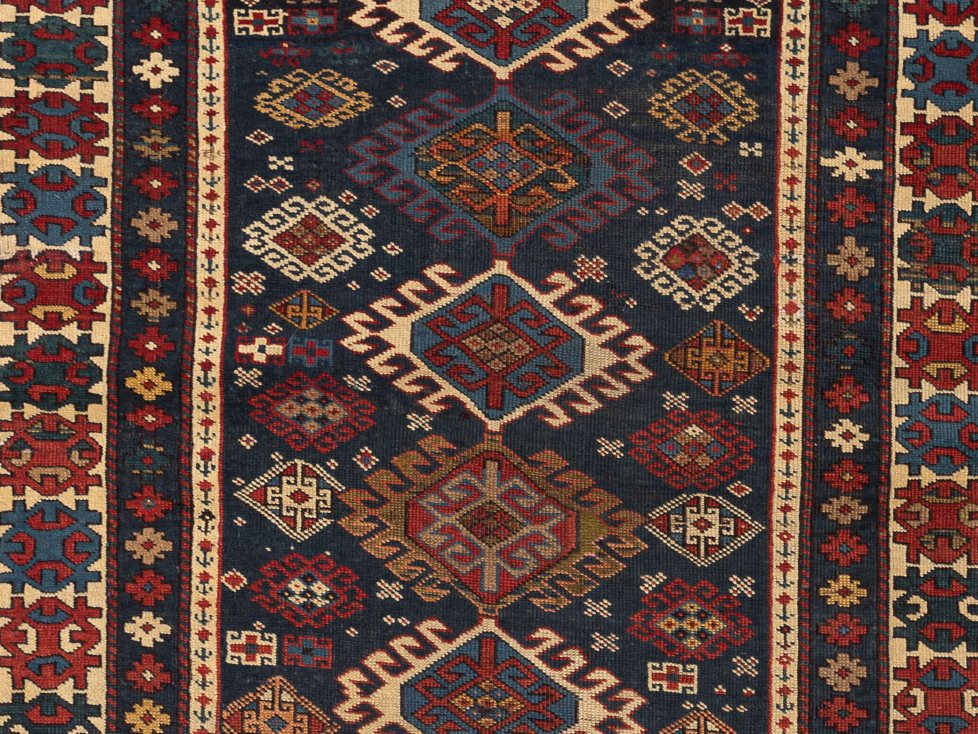
Kazak is the trade name for a group of long-piled geometric rugs from the western Transcaucasus, where Azerbaijan borders Georgia and Armenia. They are Caucasian, not Persian. Compared with the rugs of eastern Azerbaijan they are usually squarer and longer in the pile, with more red and green.
ALSO KAZAKH · GAZAKH · QAZAX · CAUCASIAN KAZAK · AZARBAIJAN CAUCASIAN KAZAK
Karabagh (Qarabagh) is a historic region of the southern Caucasus, historically home to both Armenians and Azerbaijanis, whose rugs are Caucasian rather than Persian; it lies north of the Aras and is distinct from Qara Dagh on the Iranian side.
Caucasian rugs are woven in the Caucasus, north of Iran, and are not Persian. Kuba (Quba) in north-east Azerbaijan was a major production area in the late nineteenth century, and like all Caucasian rugs its pile rugs are symmetrically knotted, usually on a wool foundation.
Kayseri is a city in central Anatolia, Turkey; Kayseri rugs are woven in and around it. Britannica says the best known are twentieth-century pieces, made largely for sale to tourists, that freely copy Ghiordes, Persian and Cairene designs in wool, silk, mercerised cotton or, later, rayon. 'Hereke prayer design' refers to the prayer rugs of the Hereke imperial workshops east of Istanbul.
Hereke is a weaving centre in Turkey, east of Istanbul, associated with imperial workshops and carpets made for Ottoman palaces. Hereke carpets include wool and silk pile examples. The name refers to a Turkish weaving tradition; it should not be used as a general name for any fine silk rug.
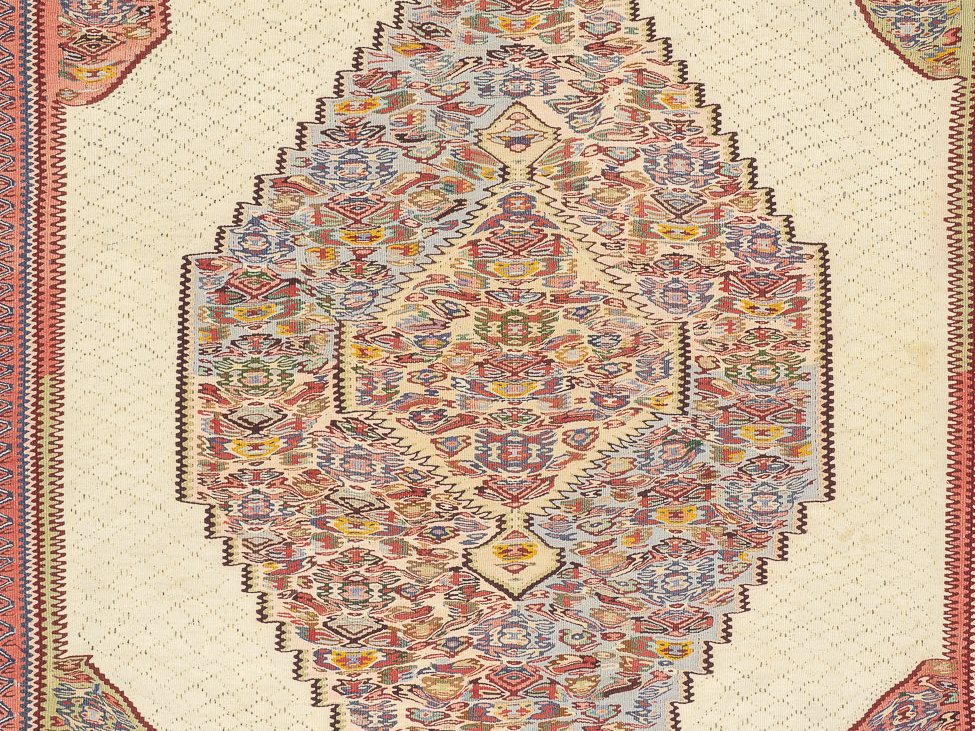
Senneh (Sanneh) is the old name of Sanandaj, capital of Kurdistan province in western Iran, whose Kurdish weavers are known for finely woven, delicately patterned rugs and kilims. Senneh kilims are fine slit tapestries whose small borders run round the ends as well as the sides. Although the asymmetric knot is often called the Senneh knot, Senneh pile rugs are tied with the symmetric knot.
Bijar is a town in Kurdistan province, western Iran, whose weaving area takes in about forty surrounding villages; the weavers are mostly Kurds. Bijar rugs are symmetrically knotted, with closely set warps on two levels and often three wefts between each row of knots, beaten so tightly that a Bijar is notably heavy and resists folding.
Halvai is a name for a type of Bijar rug, from the Bijar district of Kurdistan in western Iran, known for being pliable in the hand while extremely dense and durable. Dealers disagree on where the name comes from: a village north-east of Bijar, small workshops in the town itself, or a family of weavers.
ALSO HALVAEI · HALVAEE · HALVAI BIJAR · HALVAI BIDJAR
Howraman (Hawraman, Uramanat) is a mountain region of the Zagros on Iran's western border, in Kurdistan and Kermanshah provinces, home of the semi-nomadic Hawrami Kurds; its terraced villages are a UNESCO World Heritage cultural landscape. Dehkhoda lists shal (woollen cloth), jajim and kilim weaving among the trades of Owraman village. Our Howrami throw is handwoven there.
Kermanshah is a city and province of western Iran where kilim and carpet weaving remain cottage industries. Iranica names the Sanjabi and the Kolyai (Koliai) as the best-known Kurdish nomadic weavers, and the Lak town of Harsin is known for its kilims. In the early twentieth century 'Kermanshah' was also a Western trade name for carpets from Kerman, so old labels can mislead.
Hamadan is a city in west-central Iran whose bazaar markets rugs from a large district of villages, each with its own stock patterns. Older Hamadan rugs have a cotton foundation with a single weft after each row of symmetric knots, and natural camel hair often forms a broad band in the pile. Iranica attributes most such camel-hair rugs to the Qaragozlu tribe; single wefting separates them from the double-wefted camel-hair rugs of Sarab.
Borchalu (Borchelu) is a trade name for rugs woven near Hamadan, in western Iran, by formerly nomadic groups now settled in the district. It is one of the many local names under which the Hamadan district's village rugs, each with its own stock patterns, are sold.
Malayer is a town in southern Hamadan province, founded by the Qajars in 1808, the same year as Sultanabad (Arak), to bring the country between Hamadan, Borujerd and Qom under control. Iranica lists Malayer among Iran's main carpet-producing areas of the 1970s.
Nahavand is a town in the northern Zagros about 90 km south of Hamadan, separated from it by the Alvand massif. Its rugs are traded through the Hamadan bazaar with the other Hamadan-district village rugs, and Iranica names Nahavand among the places the gabbeh spread to from Lorestan.
Arak, founded in 1808 as Sultanabad on the plain of Farahan in western Iran, became the country's main centre of commercial carpet production for export from the 1880s, after the Manchester firm Ziegler & Co. began organising village weaving there; by 1894 the district had thousands of looms. It remained the leading export centre until at least 1940.
Farahan is a district of Markazi province on the plain north-east of Arak, famous for nineteenth-century rugs with an all-over herati repeat, usually on a dark blue ground and framed by the paired split-arabesque 'turtle' border. They are usually asymmetrically knotted on cotton. Sarouk and Mahal rugs later succeeded them in the district.
Sarouk is a village in the Farahan district north of Arak, whose name passed to a large commercial production made in Arak and nearby villages, much of it for the United States. Sarouks are asymmetrically knotted on a cotton foundation. The later commercial type has a longer pile and a rose-red field of detached floral sprays, and many were chemically bleached and repainted after import.
ALSO SARUK · SARUQ · SAROUGH · SAROOQ · AMERICAN SAROUK
Mahal is a trade name for village carpets of varying quality from the neighbourhood of Arak (formerly Sultanabad) in western Iran. Britannica records that Sarouk and Mahal carpets succeeded the older Farahan production in the district, and groups Mahal with Mushkabad as Arak-area trade names.
Lilihan (Lillian) is a village of the Arak district of western Iran whose Armenian weavers gave their name to Lilihan rugs; like other Armenian-woven rugs of the Hamadan and Arak districts, these are Persian rugs, classed by where they were woven.
Saveh is a city of Markazi province in central Iran. A large group of the Turkic Khalaj settled in the mountains south-west of the city, where a district is still called Khalajestan, and many have kept their tribal identity. Our Saveh runners and the kilims titled Khalaj are their work.
Mazlaghan is a trade name for village rugs woven towards Saveh, on the eastern side of the Hamadan weaving country. Dealers link the name with a large medallion whose zigzag outline is sometimes called a 'lightning' design.
Zarand (Zarandieh) is the district around Mamuniyeh in Markazi province, between Tehran and Saveh; Dehkhoda lists it as part of Saveh county, and it is now a county of its own. It is the source of our Shahsavan Zarand kilim. Other places share the name, among them a town north-west of Kerman and villages in Zanjan province.
Qom is a shrine city south of Tehran whose carpet industry grew from about eleven weaving villages in 1948 and spread steadily through the 1960s, with materials and designs organised from the city. With Kashan and Nain, it is one of the central Iranian towns where carpets are woven entirely in silk.
Kashan is a desert city in central Iran with a long record of fine weaving: silk carpets and silk kilims are credited to it in the Safavid period, and a large commercial production of wool and silk pile carpets began there in the early twentieth century. Kashan carpets are asymmetrically knotted on cotton or silk foundations, depending on the pile fibre.
Kamu (Kamo) is a village near Kashan in central Iran, listed by Iranica with its neighbour Chowkan (Chugan) among the settlements of the Joshaghan district. It is known for flatwoven wool bread sofrehs, the subject of Parviz Tanavoli's book The Sofreh of Kamo (1998). In the gallery's titles, 'Kamu Bijar' means a Bijar kilim inspired by Kamu sofrehs.
Joshaghan (Jowshaqan) is a district north-west of Isfahan, best known for its carpets; the one pattern known to have been used there habitually divides the field into diamond panels, each holding a shrub or a group of blossoms.
ALSO JOSHAQAN · JOWSHAQAN · JOWSHEQAN · JOSHEGHAN · DJOSHAGHAN
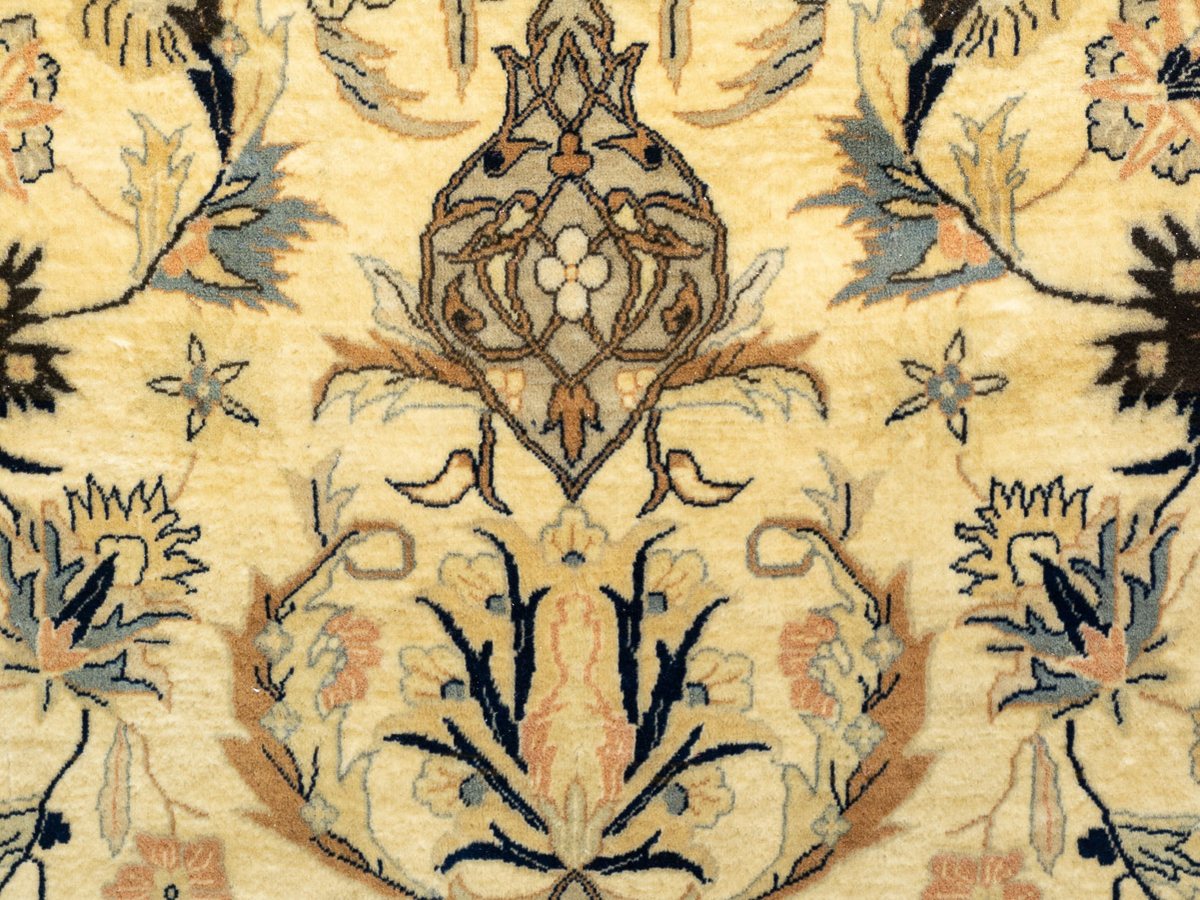
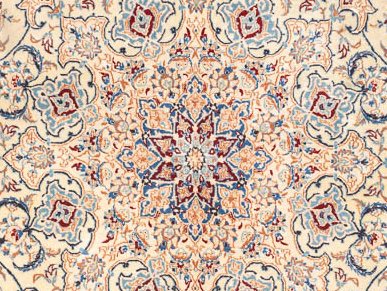
Isfahan, the Safavid capital in central Iran, revived carpet weaving from the 1920s, producing fine export carpets drawn by professional designers, often with swirling vines or arabesques on cream grounds. They are closely clipped and asymmetrically knotted on cotton or silk foundations. Many villages around the city had their own weaving traditions.
Najafabad is a town west of Isfahan in central Iran, the centre of a county in the irrigated Zayandeh River oasis. Iranica records carpet weaving in the Najafabad valley, formerly dominated by master contractors (ostad-kar) who supplied the weavers; by the Pahlavi period few remained, and weavers sold to itinerant traders and other middlemen.
Faridan is a county at the foot of the Zagros in western Isfahan province. Iranica lists carpet, jajim and mat weaving as its main crafts. Bakhtiari of the Chahar Lang branch graze its pastures, and some villages have been home to Azeris, Lurs, Armenians and Georgians since Safavid times.
Shahreza, formerly Qomsheh, is a town in Isfahan province and one of the few places outside Isfahan city where urban carpet weaving was recorded in the province in the 1970s.
Nain is a small town east of Isfahan that took up carpet weaving in the twentieth century after its traditional weaving of aba cloaks ended. Nain carpets are very finely knotted, in designs related to those of Isfahan, and the town is one of the central Iranian centres where carpets were woven entirely in silk.
Yazd is a desert city in central Iran whose surrounding towns, notably Meybod and Ardakan, have long been known for zilu (ziloo), a sturdy cotton flatweave made on a special loom, with an extra set of inner warps that sets it apart from other Persian flatweaves. Yazd is also listed among Iran's twentieth-century centres of pile carpet weaving.
Ardakan is a town near Yazd, one of the towns long known for zilu cotton flatweaves, and the home of our Ardakan rugs. A second Ardakan, Ardakan-e Fars, is an upland town north-west of Shiraz in Qashqai summer country.
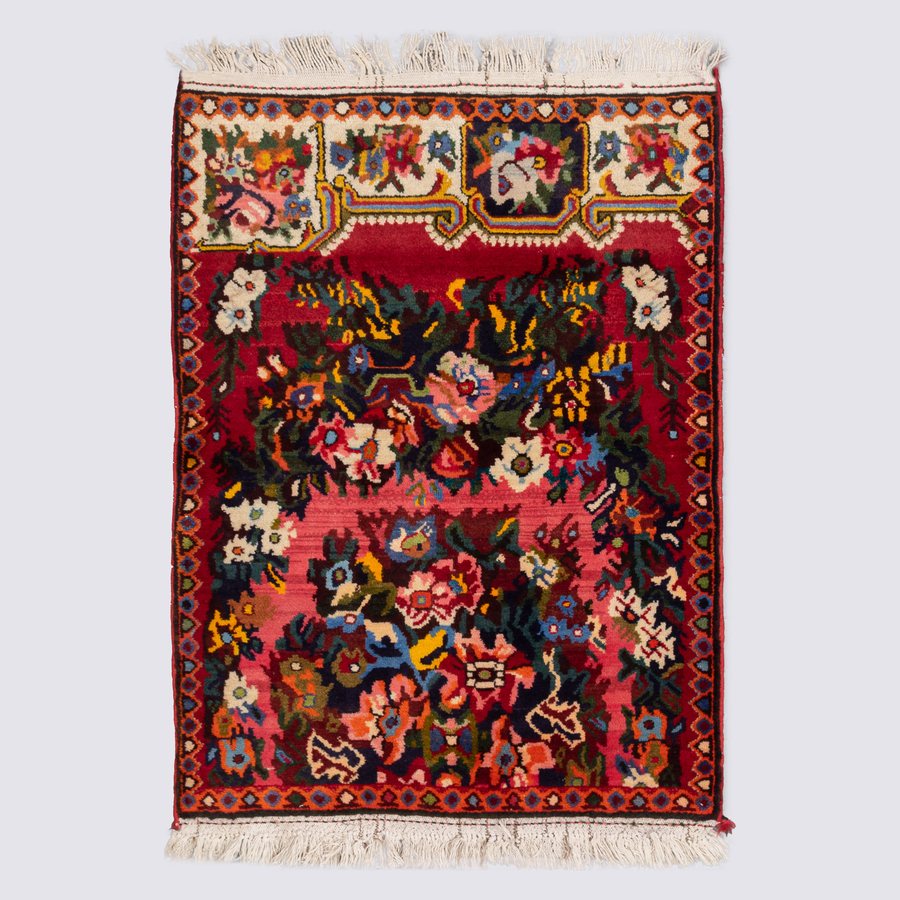
Chahar Mahal is the district near Isfahan, now the province of Chahar Mahal and Bakhtiari, whose villages are thought to produce most of the rugs sold as village Bakhtiari. These are typically single-wefted on cotton foundations, and inscribed examples name their villages, such as Shalamzar. Medallion-and-corner, prayer and figural designs, including a group with heraldic lions, are associated with the district.
ALSO CHAHAR MAHAL VA BAKHTIARI · CHAHAR MAHAL-E BAKHTIARI · CHAHAR MAHAAL
Faradonbeh is a town just west of Borujen in Chahar Mahal and Bakhtiari province, where Dehkhoda records carpet weaving as the women's craft. It lies in the Chahar Mahal district, where, Iranica says, most village Bakhtiari rugs are thought to originate.
ALSO FARADONBE BAKHTIARI · FARADONBEH BAKHTIARI · FARADOMBEH
Lorestan, 'land of the Lurs', is a mountainous province of western Iran between Kermanshah and Khuzestan. Iranica records that the gabbeh is said to have originated there, around Khorramabad, Borujerd and Aligudarz, and spread to Kurdish and Qashqai weavers; Borujerd was already a named carpet centre in the nineteenth century.
Fars is the province of south-west Iran around Shiraz and home to its largest tribal weaving groups: the Qashqai and Khamseh confederacies and Luri groups such as the Boir Ahmad and Mamasani. Rugs from the province commonly have wool foundations and are often sold under the Shiraz name; both symmetric and asymmetric knots occur.
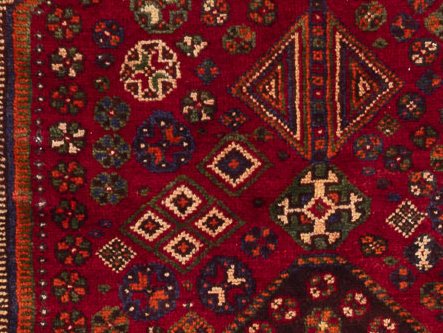
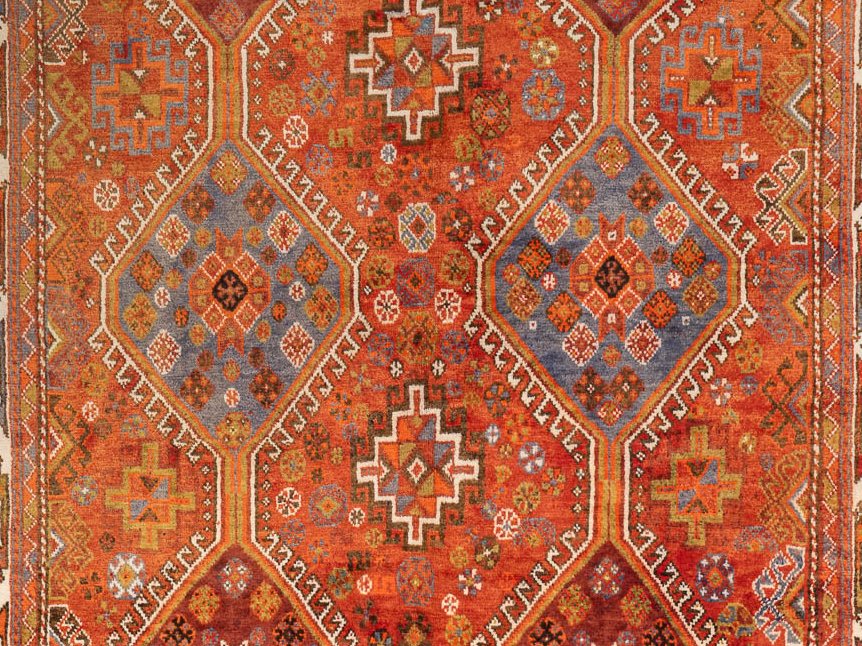
Shiraz, capital of Fars province, is the market town that gives its name to rugs from the surrounding district, chiefly Qashqai and Khamseh tribal work and the rugs of local villages. Shiraz rugs typically have wool foundations, soft pile wool and rectilinear medallions, often three diamonds joined by a pole, or many narrow stripes. 'Mecca Shiraz' is a dealers' term for Qashqai rugs.
Firuzabad is a town and district in Fars, south of Shiraz, on a plain watered by springs and a perennial river. Qashqai chiefs kept their residence there until 1963, and Iranica calls it the Qashqai capital. Dealers use the name on labels for Qashqai work from the surrounding district.
Eqlid (Iqlid) is a town in the Zagros Mountains of northern Fars, in the cold upland zone that medieval geographers called the sardsir. It belonged to the Abadeh district, for which Iranica lists carpet and rug weaving among the notable crafts, and is now the centre of its own county. Our Qashqai Eqlid rug was woven in its district.
Abadeh is a small town in northern Fars, on the main Isfahan to Shiraz highway. Its people are mostly Persian-speaking, with some Luri and Turkish speakers toward the Bakhtiari country, and carpet and rug weaving is one of its main handicrafts, with woodcarving.
Neyriz (Niriz) is a town in eastern Fars, about 220 km south-east of Shiraz, on the eastern side of Lake Bakhtegan, which Iranica also calls Lake Neyriz. Dealers sell Neyriz rugs as Afshar work, but Iranica records that it is not known whether the Afshar of Fars wove carpets. Our Neyriz rug is village work from the district.
Yalameh is a trade name for village rugs woven around Abadeh, on the border of Fars and Isfahan provinces. Dealers describe their designs as drawn from Qashqai work, often with nested or stepped diamond medallions.
Shooli means 'from Shul', a village on the edge of Bushehr province that Encyclopaedia Iranica describes as reputed to make the best gabbehs. In our titles it marks a gabbeh from Shul.
Kerman is the provincial capital of south-east Iran and, since the late nineteenth century, a major centre of city carpet weaving; the nearby village of Ravar gave the trade grade 'Lavar Kerman'. City workshops use the asymmetric knot, now on cotton, with local kork wool, while the province's tribal weavers, chiefly Afshar, typically use the symmetric knot. Kerman dyers are known for an unusually wide range of shades.
Sirjan is a town and district in western Kerman province, south-east Iran, and the base of several nomadic Afshar groups, including the Jahanshahi, Amu'i and Buchaqchi, all recorded there as nomads in 1957. Remnants of a fourth Afshar group, the Mir Habibi, may survive around nearby Bardsir.
Baft is a mountain town in south-east Kerman province, about 2,270 m above sea level, that gives its name to a county west of Jiroft. Most nomads around Baft belong to the Siahjel branch of the Raen tribe, who keep cashmere goats and Kermani carpet-wool sheep and weave carpets for their own use. Our Baft region rug is their work, sold, like much Kerman weaving, under the Afshar name.
Shahr-e Babak is a town and county in north-west Kerman province. Like much of the tribal and village weaving of the Kerman region, its rugs are generally sold as Afshar.
Dehaj is a small town in Shahr-e Babak county in north-west Kerman province. Its settled weavers' rugs are often sold in the West under the Afshar name, as ours are, like much of the village and nomadic weaving of Kerman.
Esfandagheh is a cool upland district of southern Kerman province, west of Jiroft and south of Rabor, watered by qanats and branches of the Halil Rud; the name also belongs to a mountain west of Jiroft. Dehkhoda, quoting Kayhan's geography of Iran, names carpets as the district's manufacture. Our Esfandagheh bags are its work, sold, like much Kerman weaving, under the Afshar name.
ALSO ESFANDEGHE · ESFANDAQEH · ESFANDAQA · ISFANDAQA
Jebal Barez is a mountain range in south-east Kerman province, east of Jiroft, forming the natural boundary between Jiroft and Bam. The Jabal Barezi villagers of the range are a tribal group of their own, whose work is often sold in the West as Afshar Kuhi.
Jaz Murian is a closed basin in south-east Iran where the Halil Rud, flowing south-east from the mountains above Jiroft in southern Kerman, ends in swamps; Iranica counts the depression among the physical regions of Baluchistan. Our Jaz Murian bags are Baluch work.
Khorasan is a historical region now divided between north-east Iran, southern Turkmenistan and northern Afghanistan; the Iranian province of that name was split into three in 2004. Iranica calls it the province with the most varied tribal weavers in Iran: Baluch and groups weaving in the Baluch tradition, Kurds, Turkmen and Afshar. Room-sized carpets come from Mashhad, Birjand and nearby villages, and Khorasan wool is noted as particularly fine.
ALSO KHURASAN · KHORASSAN · KHORĀSĀN · KHORASANI · KHURASANI
Mashhad, the shrine city of Khorasan in north-east Iran, is the centre of Khorasan city carpets, often room-sized with unusually round medallions and cochineal reds that, with much blue, give a purplish cast.
Quchan is a town in northern Khorasan whose people are largely descended from Za'faranlu Kurds resettled there as frontier guards. Iranica describes Quchan rugs as a purely Kurdish type: knotted, with polychrome geometric designs, brighter than the Baluch-tradition rugs that other Khorasan Kurds also weave.
ALSO GHUCHAN · KUCHAN · QŪCHĀN · KURMANJ · KURMANJI
Mood (Mud) is a weaving centre near Birjand in South Khorasan, eastern Iran. Iranica (1989) names Mud and Dorokhsh as the main centres of the Birjand district, where carpet weaving is a traditional industry, looms stand in almost every village and natural dyes come from local shrubs. Curzon counted Birjand among Persia's districts making carpets of good quality.
Mazandaran is a province of northern Iran on the Caspian Sea, a humid coastal lowland backed by the northern slopes of the Alborz mountains. Iranica records the Kurdish weaving of Kelardasht, known only since the 1960s, and notes that the work of some of the province's tribes is unknown. The gallery's New Weave Mazandaran kilims are woven in Chahar Dangeh, a mountain district of Sari county.
ALSO MĀZANDARĀN · MAZANDERAN · CHAHAR DANGEH · CHAHAR DANGE
Kelardasht is a district in western Mazandaran, on the Caspian side of the Alborz, with Kurdish and Lak communities. Its Kurdish weaving has been known outside the region only since the 1960s, and Iranica notes that the work of the province's other tribes is largely unrecorded.
Kuhi (Koohi) is Persian for 'of the mountains'. In our titles, as in Qashqai Koohi, Afshar Kuhi or Jiroft Kuhi, it marks where a piece was woven, in the mountain country of its tribe or district, and does not name a tribe.
The Shahsavan are a confederacy of Turkic-speaking tribes in north-west Iran who winter on the Moghan steppe and summer on the slopes of Mount Sabalan, in the districts of Ardabil, Meshkin and Sarab; other groups live between Zanjan and Qazvin. Their women wove mainly kilims, soumaks and bags, including mafrash packs, in geometric designs. Much of this work was sold as 'Kurdish' or 'Caucasian' until the 1970s.
ALSO SHAHSEVAN · SHAHSEVEN · SHAHSEVAN NOMADS · ELSEVAN
The Kurds are a people who speak Kurdish, one of the Iranian languages. Kurdish tribes are found throughout Iran, among them in West Azarbaijan, Kurdistan, Kermanshah and Hamadan; most of those in Khorasan descend from tribesmen moved there around 1600. Bijar and Senneh are Kurdish weaving towns, the Sanjabi and Kolyai are the best-known Kurdish nomadic weavers, and Iranica calls Quchan rugs a purely Kurdish type.
ALSO KURDISH · KURDI · KORD · KURDISH WEAVING · KURDISTAN · KORDESTAN
Luri (Lori) weaving is the work of the Lurs, who live in the Zagros from Lorestan through the Bakhtiari country to Fars. They weave gabbehs, kilims and bags. Many motifs in Luri flatweaves and pile rugs, such as offset rows of cypress trees, also appear in Bakhtiari work, so attribution by motif alone is unreliable.
Bakhtiari is a trade label for pile rugs and kilims from the Bakhtiari region of south-west Iran, covering both nomadic and village work, so Iranica calls it territorial rather than ethnic. Double-wefted, symmetrically knotted rugs on wool are usually classed as nomadic, and single-wefted rugs on cotton as village work from Chahar Mahal. The best-known design is the garden or brick (khesht) pattern of square compartments.
The Qashqai are a confederacy of mainly Turkic-speaking tribes in Fars province, south-west Iran, and the province's largest weaving group. Iranica lists six main tribes: the Amaleh, Darrehshuri, Kashkuli Bozorg, Kashkuli Kuchek, Farsimadan and Shesh Boluki. Qashqai pile rugs are commonly asymmetrically knotted on an all-wool foundation; in pieces of exceptional quality weavers sometimes added pairs of red silk wefts. Clan names in our titles, such as Doghozloo and Shababloo, are as the seller gives them.
The Khamseh ('five') is a confederacy of five tribes in Fars, formed in 1861 to 1862 as a rival to the Qashqai: the Turkic Baharlu, Aynallu and Nafar, the mixed Basseri, and the Arab tribe. Their rugs are close to Qashqai work and are sold with it under the Shiraz name. Iranica records pairs of red silk wefts in exceptional Khamseh pieces, as among the Qashqai.
The Afshar are a Turkic tribe whose main body lives in Kerman province, south-east Iran, with nomadic groups around Sirjan; smaller Afshar groups live elsewhere, including north of Bijar. Kerman's tribal rugs became so well known that many are sold as 'Afshar' whoever wove them. Tribal weavers there typically use the symmetric knot, and Iranica records cotton wefts, with red wool wefts in earlier pieces.
Baluch rugs are woven by Baluch tribes in Khorasan and Sistan, in eastern Iran, and by neighbouring groups who weave in the same tradition, not in Makran where most Baluch live. They are knotted with the asymmetric knot, traditionally on wool warps, in dark blues, reds and browns with near-black outlines; undyed camel hair sometimes fills prayer-rug niches. Wide selvedges of dark goat hair are characteristic.
ALSO BALUCHI · BALOCH · BALOUCH · BELUCH · BELOUCH · BALUCH PERSIAN
Turkmen weavers in Iran live on the Gorgan and Atrak plains, now Golestan province, and in northern Khorasan; Iranica names the Yomut, the largest group, the Göklan and small Tekke groups. Yomut work is geometric and close to monochrome, and covers an unusually wide range of bags, trappings and covers. Larger Yomut carpets are usually symmetrically knotted; small pieces more often use the asymmetric knot.
The Amaleh are the chief tribe of the Qashqai confederacy of Fars. The name means workers or retainers: they began as the warriors and workmen of the ilkhani, the paramount chief, recruited from all the Qashqai tribes, so they are not a kinship group. All the Qashqai paramount chiefs came from the Amaleh's Shahilu clan. Iranica records as many as 6,000 families in 1956.
The Darrehshuri are one of the five major tribes of the Qashqai confederacy. They summer around Vardasht in Isfahan province, the northernmost of all Qashqai summer pastures, and winter around Kazerun and Lake Famur in Fars. A former chief put them at about 35,000 people in 1957. Iranica's GABBA article names their old lion gabbeh (gabbeh-ye shiri) as an exception to the loose, coarse weave of traditional tribal gabbehs.
ALSO DARRESHURI · DARESHURI · DARRASHURI · DARRASHULI
The Kashkuli are a tribe of the Qashqai confederacy. Iranica counts the Kashkuli Bozorg (Big Kashkuli) among its five major tribes; after the First World War the paramount chief made the Kashkuli Kuchek (Little Kashkuli) and the Qarachahi separate tribes. The Kashkuli Bozorg winter around Kazerun and summer around Ardakan in north-west Fars, and were noted in 1946 for jajims and for fine rugs and trappings.
The Farsimadan are one of the most important tribes of the Qashqai confederacy. They claim Khalaj origin and were already in Fars by 1590. They summer north and north-east of the Kuh-e Dena range and winter between Lake Famur and the Kuh-e Gisakan range, south of Kazerun. Iranica gives 1,750 families in 1956 and 2,715 families in 1982.
The Shesh Boluki are one of the main tribes of the Qashqai confederacy of Fars. Encyclopaedia Iranica's article on Iran's tribes names them among the six main tayefehs, or tribal divisions, into which the Qashqai's many earlier tribes were merged: the Amaleh, Darrehshuri, Farsimadan, Kashkuli Bozorg, Kashkuli Kuchek and Shesh Boluki.
Shekarlu is a clan name used in the rug trade for some south Persian tribal rugs. Dealers mostly describe the Shekarlu as a small group, probably Luri in origin, that came under the Qashqai confederacy and no longer exists as a separate group; one notes Khamseh traits in a rug sold as Shekarlu. Encyclopaedia Iranica does not list it among the Qashqai or Khamseh tribes.
On this site, Antique means woven in 1940 or earlier. Dealers use the word loosely, often for anything 80 to 100 years old, so we use a fixed year to make the label mean the same thing on every listing.
On this site, a piece woven between 1941 and 1999. Most of our vintage pieces date from the middle and second half of the 20th century, and the listing gives the closer range where we can tell it.
Semi-antique is a dealers' age term, most often for a rug about 50 to 100 years old, though some dealers stop at 99 and others say vintage instead. The bracket is counted back from today, so it moves with the calendar. We do not use the term: our listings give a period, such as a quarter of the twentieth century, and keep Antique for pieces woven in 1940 or earlier.
Most rugs carry no date, so we give age as a range. The first quarter of the 20th century is 1900 to 1925, the second 1925 to 1950, the third 1950 to 1975 and the fourth 1975 to 2000. Where the evidence allows a closer range, such as c. 1960s to 70s, the listing says so. These are approximate dating ranges, so their boundary years overlap.
The youngest age band on this site, for pieces woven in 2000 or later. New Weave in a title means recent production, including pieces we commission from weavers today.
The trade uses Contemporary in two ways: for recent weaving, and for a modern look. On this site it is a style, for open, minimal or freely drawn designs, whatever their age. A piece's age is given separately, in its period.
A full wash in water that removes grit, old soiling and excess dye from the pile and foundation. Every piece we sell is professionally washed before it reaches the gallery, so a bright fringe or fresh colour says nothing about a rug's age.
Trimming a rug's pile level after washing, so the surface reads evenly. Shearing is part of finishing every pile rug, and it is done again before export. It also softens the low patches that corroded dark wool leaves, which makes them harder to see.
Pile that is still at or close to its original height across the rug, with no worn patches. It is a statement about condition, not age: an old rug that was little used can have full pile.
Pile worn down by use, in places or overall. Light, even wear often suits an old rug; wear down to the knots or the foundation affects how long a piece will last on the floor.
A painted rug has had its pile or worn areas coloured with dye markers, inks or tints to hide wear or deepen a colour; auction condition reports call this tinting. Suspected retouching should be assessed by a rug conservator or experienced specialist. Avoid rubbing colours with a damp cloth as a home test.
ALSO TINTED · TINTING · OVERTINTING · TOUCHED UP · MARKERED · INKED
Dry rot is the rug trade's name for decay of a foundation, usually cotton, that has stayed damp for a long time, from floods and leaks, pet urine or a pot plant standing on it. Cleaners describe the fibres turning stiff and brittle, crackling or snapping when the rug is bent, and the decay as irreversible. The name misleads, because the harm was done while the rug was wet.
ALSO DRY ROTTED · FOUNDATION ROT · ROTTEN FOUNDATION · BRITTLE FOUNDATION
Repairs that bring a worn or damaged rug back into use: reknotting lost pile, rebuilding ends and sides, rewrapping selvedges and stabilising fringes. Older pieces in the collection are restored where needed before export.
An underlay is a thin pad laid under a rug. It cushions the rug against an uneven floor and the weight of furniture, helps it lie flat and stops it slipping. The British Antique Dealers' Association advises never laying an antique rug straight onto a hard floor.
ALSO RUG UNDERLAY · RUG PAD · CARPET UNDERLAY · UNDERPAD · UNDERPADDING
Clothes moths lay their eggs on wool, and it is the larvae that eat a rug, grazing the pile and leaving irregular holes, silk webbing and gritty droppings. They prefer dark, undisturbed places, and particularly like the ground under furniture and the edges of carpets. Regular vacuuming, including under furniture, discourages them, and conservators advise checking stored rugs every year.
Rug washing is a full wet clean by a professional, which removes dirt that has become embedded in the pile. The British Antique Dealers' Association suggests professional cleaning every three to five years for antique rugs. Steam cleaning and carpet shampoos, made for machine-made carpet, do not suit hand-knotted rugs, and wet cleaning cannot be undone, so whether a rug can be washed depends on its condition and dyes.
ALSO RUG CLEANING · PROFESSIONAL WASH · CARPET WASHING · WET CLEANING
Rotating a rug means turning it round from time to time so that it wears evenly; Icon, the UK conservation body, suggests every year or two. Light fades dyes and weakens fibres, so conservators also advise keeping rugs out of direct sun.
A colour run is dye bleeding from the yarn into neighbouring areas, usually when a rug gets wet. It happens when a dye is not fast to water: Iranica notes that some early synthetic dyes ran when washed. Conservators test dyes before any wet cleaning and do not wash a textile whose colours move. After a spill, soak up the liquid at once and dab rather than rub.
ALSO COLOR RUN · DYE RUN · DYE BLEED · BLEEDING · RUNNING COLOURS · COLOUR BLEED
Reweaving rebuilds a damaged rug in its own structure. Worn or lost pile is knotted in again, which condition reports call repiling, and where the foundation itself is missing, new warps and wefts are woven in first and then knotted over. Auction condition reports list rewoven and repiled areas separately from tinting, where worn pile is coloured in rather than replaced, and restorers treat patching as a different repair.
The traditional Persian unit of length used for carpets, divided into 16 gereh. Its value varied by region from about 100 to 112 cm: Dehkhoda gives 104 cm for the ordinary zar and 112 cm for the shah's zar used in Tabriz. The Persian size names count in zars.
From posht, back: a firm cushion set against the wall to lean on, and, after the small rugs woven to cover it, a rug size of under one square metre, most often about 60 by 90 cm. A poshti rug may be a cushion face or simply a small rug of that size.
ALSO PUSHTI · PERSIAN POSHTI · BOLSTER · BACK CUSHION
A zar and a half: a rug about 1.5 to 1.6 m long and 1 to 1.1 m wide, roughly 100 by 150 cm. Sources give slightly different figures, since the zar itself varied.
Two zars: a rug about 2 to 2.2 m long and 1.3 to 1.4 m wide, often given as 140 by 220 cm or 4 ft 6 in by 6 ft 6 in. In Iran the same size is also called sajjadeh-i, prayer-rug size.
Literally a small qali: a rug, as against a room-size carpet. Persian sources draw the line by area, some at under 4 square metres and some at 6, and give common qalicheh sizes of about 140 by 220 cm and 150 by 250 cm.
Persian for curtain. As a rug size, pardeh-i names a rug of about 150 by 250 cm; one Persian source keeps the name for finely woven rugs of that size, and another stretches it to about 170 by 280 cm.
Persian for a knotted-pile carpet, and in the size vocabulary a carpet big enough for a room, conventionally 6 square metres or more. Persian trade lists give common sizes of 2 by 3 m, 2.5 by 3.5 m, 3 by 4 m and up to 4 by 6 m and larger.
ALSO GHALI · HALI · QALEE · GALI · ROOM-SIZE CARPET
The long carpet laid at the head of a room in the traditional Persian arrangement, across the end of the central mian farsh and its two kenareh runners. It is narrower than a room carpet and long for its width: Britannica gives an average of about 3.7 by 1.8 m, and Persian sources give 1.5 by 3 m up to 2 by 3.7 m or longer.
ALSO KELLEH · KELLEY · KELEI · KALLEH · KALEGHI · LONG CARPET
Persian for a runner, from kenar, side: in the traditional arrangement two kenarehs lie along either side of the central carpet. Britannica gives about 5.5 by 1 m; Persian trade sources give widths of roughly 0.7 to 1.1 m and lengths of 3 to 10 m, sometimes 15 m or more.
A long, narrow rug for halls and stairs, usually under about 1.2 m wide and more than twice as long as it is wide. Kenareh is the Persian word; in Persian practice long, narrow pieces were also woven to flank a central carpet.
A round rug has a circular outline instead of the usual rectangle; our titles call them Circular. Dealers describe them as far less common than rectangular rugs, some knotted round on an ordinary rectangular loom with the circle formed in the knotting. Others, like our antique Bakhtiari, are cut round from a rectangular rug and the edge bound by hand.
Nishapur ceramics are an early Islamic pottery tradition from Nishapur in Khorasan, particularly associated with the 9th and 10th centuries. The pieces in our collection are contemporary Nishapur-style ceramics made by the Nazhoo studio in Mehrshahr, Karaj. The historical name describes their inspiration, not their age.
Mehr Shahr (Mehrshahr) is a district of Karaj, west of Tehran, where the Nazhoo studio makes the Nishapur-style ceramics in our collection. It names where the pieces are made; the historical style belongs to Nishapur in Khorasan.
Over cooked, in our ceramics titles, means over-fired: the piece is fired on purpose beyond the usual point, for a crackled or deeper finish. It appears on Nishapur-style bowls from the Nazhoo studio and plates from Lalejin.
Earthenware from Meybod, near Yazd, home to a long-established community of potters with its own quarter. Local potters traditionally make their own pigments and glazes.
Aghai (Aghaei) is the name of a potter, or a family of potters, of Meybod or elsewhere in the Yazd region, behind the glazed earthenware vases and bowls in our collection, painted in green and dark brown on a cream ground, some with boteh.
Hand-built, unglazed earthenware from Kalporgan, a village near Saravan in Sistan and Baluchestan. Women shape the pots by hand without a wheel, using local clay and simple tools, and paint them with geometric motifs in a dark mineral pigment. The skill is passed down from generation to generation.
ALSO KALPOURGAN · KALPURGAN · KALPOREGAN · KALPOUREGAN · KALPORAGAN
Engraving: cutting designs into the surface of metal, usually copper, brass or silver, with hand tools. The name comes from qalam, pen, here the engraver's chisel, and Dehkhoda's dictionary notes that the qalamzani of Isfahan is famous.
ALSO QALAMZANI · ENGRAVED COPPER · ENGRAVED BRASS · ENGRAVED
Persian marquetry: thin rods of coloured wood, bone and metal are bundled and glued so that their ends form a star pattern, then sliced into thin slabs that are laid side by side to cover boxes, frames and furniture. The basic unit is a small star set in a hexagon. In rug listings, khatam names a field drawn after this mosaic.
ALSO KHATAM-KARI · KHATAM-BANDI · PERSIAN MARQUETRY · KHATAM DESIGN
Printed cotton cloth, made today mainly in Isfahan. Qalamkar means pen work: Dehkhoda describes it as cloth with designs drawn on it with a pen. The Isfahan craft combines stamping with carved wooden blocks and painting by hand, traditionally in four colours: black, red, yellow and blue.
ALSO GHALAMKAR · KALAMKAR · QALAMKARI · KALAMKARI · PERSIAN BLOCK PRINT · BLOCK PRINTING
Calico is plain-woven cotton cloth, often left in the natural colour of the raw cotton; it originated in Calicut (Kozhikode), India. In Australian and British English the word means this plain cloth, and in American English a cotton printed with a pattern. Our qalamkar block prints are printed on calico, listed as "Calico Cotton". The Persian name is chelvar.
Herami is a thick, striped woollen cloth woven in Lorestan, the name our source gives to the antique throws from Borujerd. It belongs to the Lori tradition of heavy woollen cloth known as mashteh, woven at home around Khorramabad and in workshops concentrated in Borujerd, and used to wrap bedding and as spreads and covers.