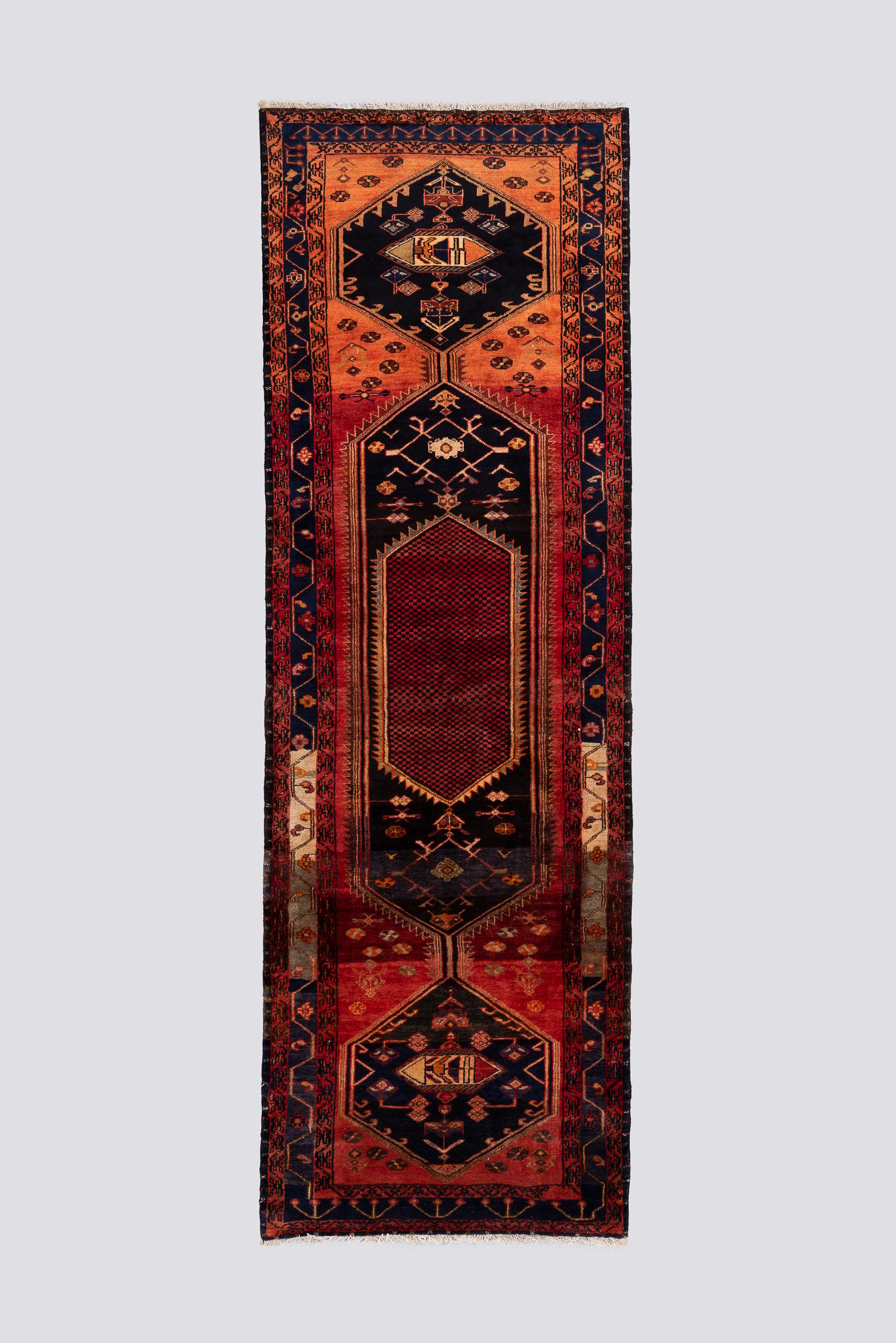
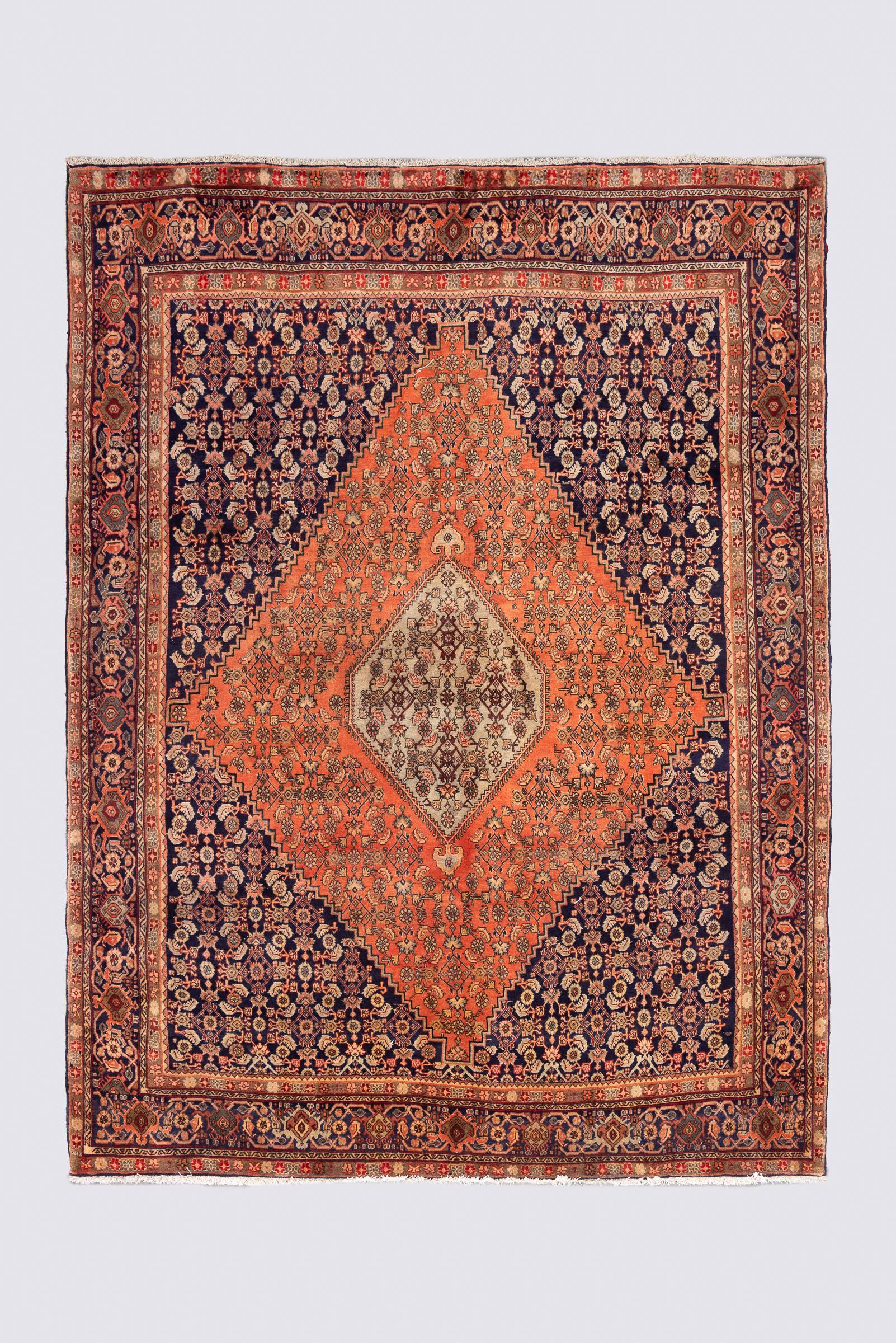
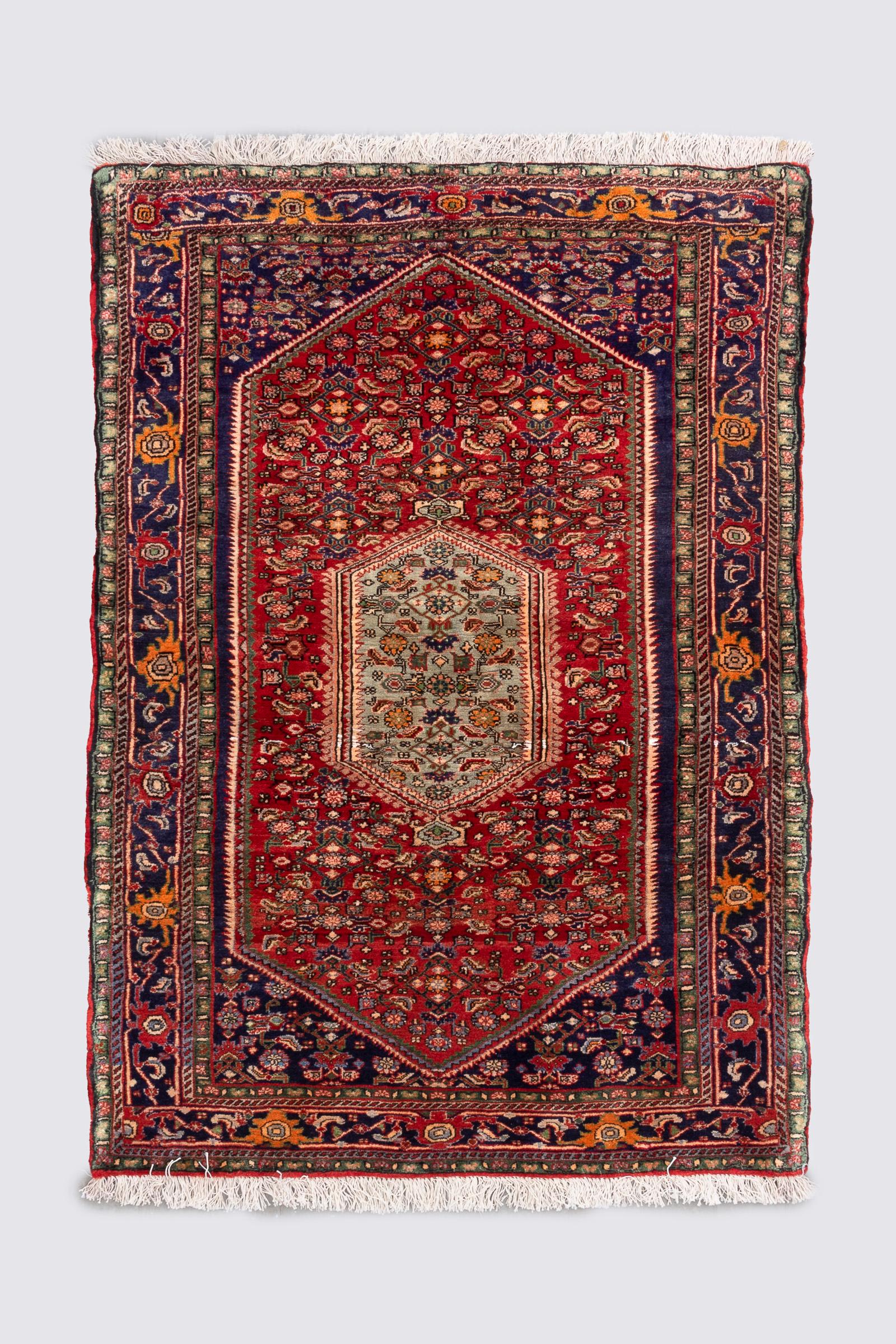
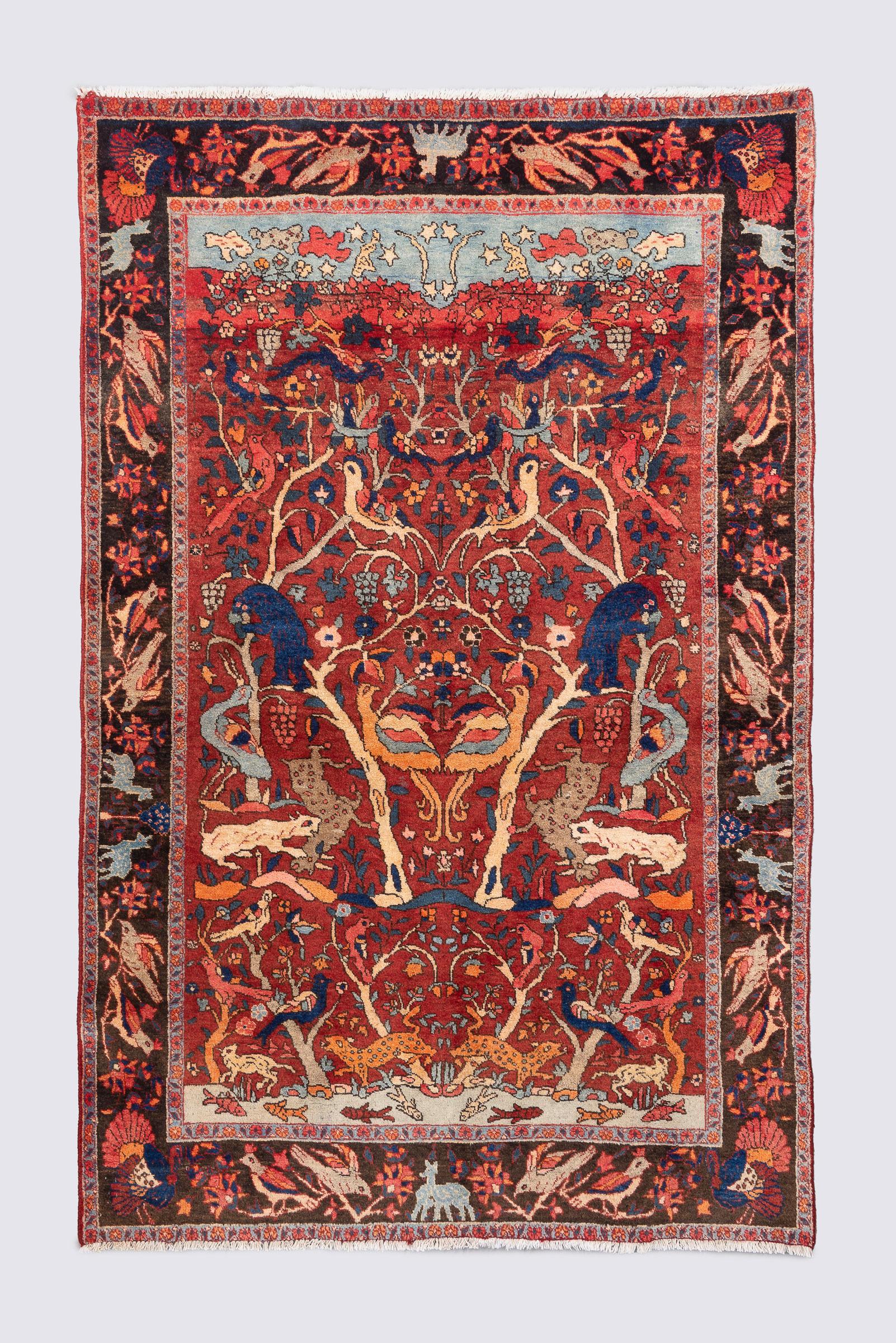
Antique Bijar Triple Medallion Persian Rug, Indigo Field, 1890–1910
A viewing is a request, not a booking: we write back within 24 hours to confirm a time, in open hours or out of them. No account needed.
ABOUT THIS PIECE
An antique Kurdish rug from Bijar in western Persia, hand-knotted in wool on a cotton foundation.
Three hexagonal medallions run the length of a deep indigo field. The centre one is filled with a fine chequered lattice and outlined in saffron, the two flanking it in soft terracotta with hooked edges. Combs, rosettes and small flowering plants sit scattered around them in the free village manner, and the main border carries angular palmettes on terracotta between bands of clear orange.
Look along the two long borders and you can see two hands at work. One side holds an even, confident rhythm from end to end. The other begins crowded and uncertain, the vine wandering and the palmettes squeezed together, then steadies as it climbs until by the far end it matches its neighbour. A learner was weaving beside an experienced hand and improving as the rug grew. A workshop would have corrected it, which is exactly why it is worth seeing.
The weave is multi-wefted with the warps depressed in the Bijar manner. Abrash runs through the terracotta and the orange, the tonal drift within one colour that comes of small hand-dyed lots. The weaver worked a date into the field, reading 1224 in the Islamic calendar. Woven dates on village rugs are not always the year of weaving, and the cotton foundation places this piece between about 1890 and 1910.
Bijar has been among the most respected weaving towns in Persia since the nineteenth century, its Kurdish weavers known for packing the wefts hard and building rugs that outlast their owners. This one comes from the Garrus district nearby, and it was woven in the same house and by the same hands as its companion runner, which repeats its medallions, its palette and its border down to the smallest motif.
The rug itself carries no reweaving or restoration. The fringes have been professionally replaced, re-worked into the original warp.
At 296 by 144cm it suits a wide hallway or a seating group. Explore more antique and vintage Persian rugs.
SPECIFICATIONS
How it sits in your room.
296 × 144 CM (9'9" × 4'9"), DRAWN TO SCALE WITH TYPICAL AUSTRALIAN FURNITURE SIZES.
Long enough for a 3-seater sofa but not deep enough to reach under its front legs as well as hold the coffee table, so it sits just in front with the table on it. Floated like this it reads as a deliberate island.
Only 32 cm of rug would show beyond even a four-seat table, so the chairs would sit off it. This one belongs in a living room or bedroom.
Under the lower part of a king bed with 57 cm of rug showing on each side, so your feet land on it either side of the bed.
Measure the room, or just the area the rug should cover, and we will draw this rug in it to scale.